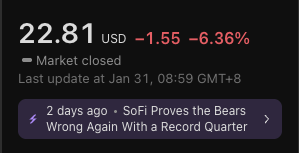
Hate it when these youtubers or influencers just say to "nibble" on $META or $MSFT for weeks. They will always be right whether the stock goes up or down. Such a coward answer. Just say you don't know
@aleabitoreddit@ryn_xue Yes but the thing is last year we couldn’t fathom that AI can produce these pretty good looking websites.
Our designer is transitioning to be a front end developer, now he just uses figma to create the brand design guidelines then feeds it to claude
Previous giveaway has more than 10 comments with 0 likes.
Therefore a new giveaway is being replaced.
Just ❤️ & ♻️ within 12 hours. New accounts are pre disqualified👍
A few common mistakes in these conditions:
1. Excessive leverage. Specifically, introducing liquidation risk in assets that are regularly moving 10%-20%+ in a day. Let the volatility do the heavy lifting, not the leverage (or specifically, massively inflated position sizes facilitated by leverage that force you to use very tight stops or liquidate you on small moves against you).
2. Excessively tight stops. Same consideration. If you're targeting larger rotations in a higher volatility asset, being overly tight with stop placement can work against you. You don't want to create a loop where your idea is broadly correct, you get wicked out because you were LARPing as some 50R tick sniper, and then the market moves straight to your target without you.
3. Excessive rotation. If you're trying to make the most of a multi-week and multi-month trending period, you shouldn't be overly concerned with any specific 24H window of returns. It is a form of overtrading. It is also a form of FOMO. This also introduces the risk of creating a loop whereby you sell your bags to chase the strong stuff --> strong stuff consolidates --> the bags you sold moon --> repeat ad infinitum. Find some setups or ideas that you like and give them some room to breathe.
4. Mistaking consolidation for weakness. This is another version of time-based FOMO. Participants will infer that just because their bags haven't turbo mooned in a short period of time, the market is weak or they've allocated poorly. Instead, your rebuttable presumption should be that consolidations are a form of pullback and present an opportunity to buy stuff that eluded you when it was breaking out. Boredom and impatience do not necessarily signal weakness.
5. Excessive trade management. The degree to which you intervene in your trade ideas should somewhat mirror the time frames of those ideas. For example, if your trade is predicated on a breakout from a multi-week range, your targets and trade management time frames should be derived from (or resemble) the weekly time frame. That makes more sense than, for example, buying a large weekly breakout and setting a target at 15M resistance that's 5% higher and panicking over every red 5M candle.
6. Overtrading your core holdings. There are countless stories of traders getting very good swing and/or HTF positional entries but gradually fumbling them through trying to time every single dip and rotation that takes place on the way to their target. An unfortunately common version of this is selling 100% of exposure at some level in order to 'buy back lower'. This is particularly a strange choice when a trader's target is materially higher than the pullback they're hoping to rebuy. For example, if your ultimate target is 50% higher, is it worth selling all of your exposure in an attempt to time a 5%-10% dip? This can result in the market not offering the pullback that was hoped for, and now the trader is sidelined - this usually comes with a mental block, as buying back higher than you sold can be psychologically tricky/feels like you're chasing. In short, this is a form of overoptimisation. If you're bored and feel like gambling in between, use a sub account or @breakoutprop (disclaimer: I have a financial interest in its success) so you can scratch the trading itch without sabotaging yourself. Or go to the casino, get a hobby, whatever.
7. Excessive number of open positions. With every added position, your capacity to effectively manage any single position decreases. The altcoin market is still pretty tightly positively correlated, so you're more likely just spreading yourself thin rather than 'diversifying'. Focusing on a smaller number of higher conviction trade ideas and managing them patiently and judiciously is probably better than trying to catch everything at once and drowning in noise. If you want to spread yourself thin, go buy some Solana shitter lottery tickets i.e. X amount of $ across [large number] of memecoins/new coins that will either go to 0 or appear on your feed when you're up multiples. At least that doesn't take up your trade management RAM.
8. Allowing social media to materially impact your perception. It's PnL + leaderboard season. It may feel like absolutely everyone is winning massively all the time. Granted, the market has been very good unless you've been stubbornly short, but social media is still a highlight reel boosted by selection bias and survivorship bias. You don't see the fumbled entries, the break evens, the times traders got stopped at the bottom, undersizing great ideas and oversizing bad ideas, not pulling the trigger, and so on. As long as you're trading well and improving, don't try to speed run some arbitrary returns or net worth goal.
TL;DR
I ain't reading all that. I'm happy for u tho. Or sorry that happened.
stop writing essays nerd give me a ticker