Si acabas de llegar a mi perfil:
Principalmente hablo de Kaspa y Qubic.
Pero intento hacerlo de una forma distinta.
No solo “ha subido KAS” o “Qubic anuncia X”.
Me interesa explicar qué hay detrás:
⚡ BlockDAG y DAGKnight
🧠 Useful Proof of Work y AI
🔐 ZK, Covenants y vProgs
🧩 KCC20, KRC20 y smart contracts
⚙️ Computors, quorum y arquitectura de Qubic
Si algo es bueno, lo digo.
Si algo no me convence, también.
Y siempre intentando explicarlo para que se entienda.
If you are building applications on Kaspa that use zero-knowledge proofs, this might be relevant to you.
TL;DR: RISC Zero recently disclosed a critical soundness vulnerability in their zkVM that allows malicious provers to produce valid-looking proofs for false statements.
Since Kaspa hard-codes RISC Zero's STARK verification circuit into its node, its native STARK verification pipeline is also affected and should currently be considered unsound.
We checked Kaspa's on-chain transaction history and found no uses of native STARK verification on mainnet. This means the vulnerability has no impact on existing mainnet applications or ordinary users.
However, if you are building something that would require this larger and more expensive proof format (e.g. for post-quantum security), you should be aware of this temporary limitation.
For applications that currently don't require post-quantum proof verification, an alternative is to compress STARK proofs into Groth16 proofs and settle them through Kaspa's generic Groth16 verification pipeline. This requires using a patched RISC Zero version (3.1.0 or later) and the corresponding verification keys, but I suspect most applications already take this approach anyway, since it's cheaper and more efficient for on-chain settlement.
Fixing the native STARK verification pipeline will require a hard fork. However, given that direct STARK verification is currently unused on mainnet, we've decided not to rush a consensus change.
Instead, we're aiming for a more flexible, modular approach to STARK verification, similar to how Kaspa already handles Groth16 proofs. This would allow developers to choose their own verification circuits and update them independently of the base layer, without requiring a hard fork whenever an upstream implementation needs to be patched.
I think the broader lesson here is that we should be very careful about embedding third-party cryptographic implementations directly into the base layer, regardless of how established or thoroughly reviewed they may seem.
Keeping these components modular and independently upgradeable makes the ecosystem more resilient to exactly this kind of issue (especially in the age of AI) and improves the expressiveness of the execution engine.
Every time I see Bitcoin, I remember Internet Explorer.
It brought millions online. It paved the way for Chrome. Then Chrome wiped it out. Lmao.
Bitcoin brought millions into crypto.
Now Kaspa is here to rewrite the story.
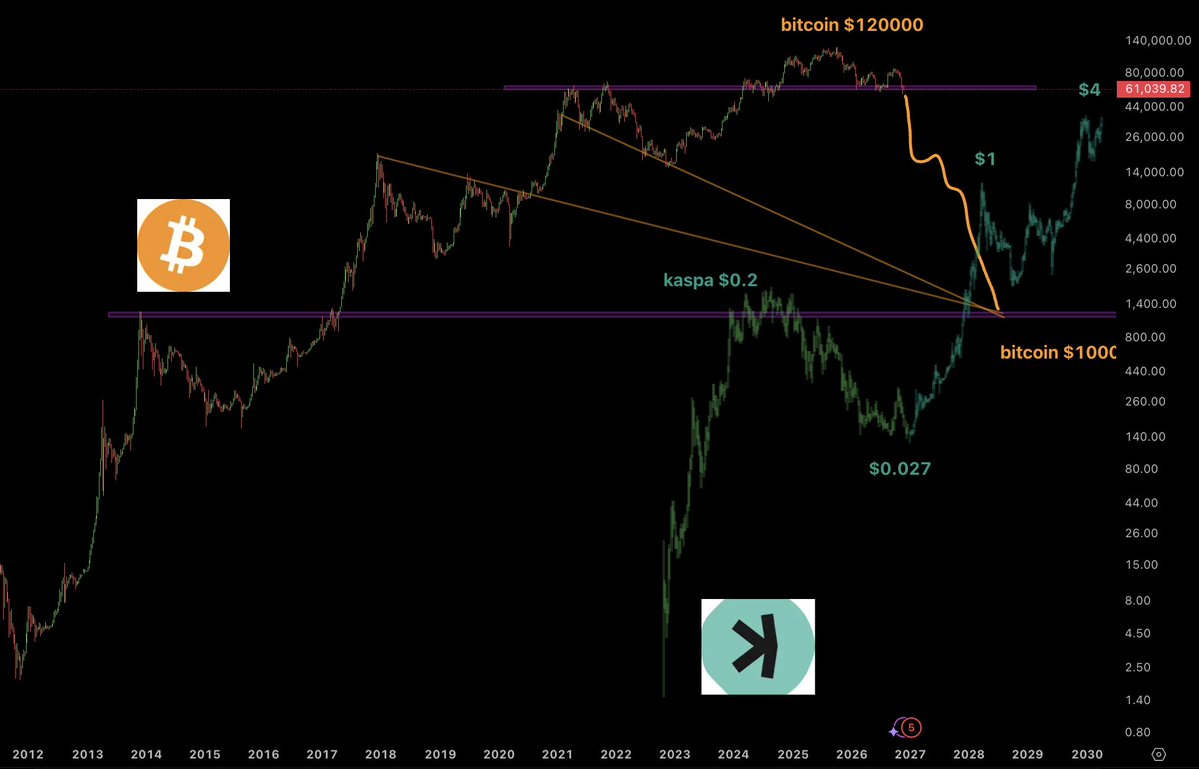
$BTC: $1,500 → $1,000
$KAS: $1 → $4
DAGKnight is moving again, first merge into its Kaspa branch since September
PR #1168 by @coderofstuff_ landed this week, @michaelsuttonil still expects a testnet before year end
10 BPS now, latency-adaptive consensus next for $KAS
Quiet weeks on the chart, busy ones on GitHub
🚨BREAKING: $25,000 buys you 1,000,000 $KAS today. Soon to be $1.000.000 American dollars 🔥
Now imagine what that million Kaspa could be worth if the project reaches its long term potential.
$25K to $1M. That’s the kind of upside that gets people thinking.
Sounds crazy? Maybe.
But the biggest opportunities rarely look obvious while they’re still unfolding.
Kaspa isn’t another ticker chasing the latest narrative. It’s building around a serious technological vision, with unique architecture and long term ambitions.
The potential is what gets your attention. The technology is what makes you look deeper.
Of course, those returns are hypothetical, not guaranteed.
But if you genuinely believe in what Kaspa is building, the risk/reward from these levels is worth studying.
Imagine holding 1 million KAS before the wider market understands what it could become.
Would you take that bet?
One platform for the whole energy market.
Kii-EnergyOS brings generation, storage, flexibility, heat, hydrogen, transport, buildings and finance onto one console, with every trade, certificate and settlement on a single shared record.
Now open for pilots. Speak to our team.
Build on Kaspa.
#kaspa $kas #EnergyTransition #carbonmarkets
🔥 WATCH: @KaspaKii has unveiled Kii-EnergyOS, an energy coordination and settlement system built on Kaspa.
The platform features 12 programme families, payments triggered by verified delivery, privacy-focused verification and regulatory reporting.
Pilot programmes are expected to kick off soon.
🔥 LATEST: @KaspaKii has introduced Kii-EnergyOS, an energy coordination and settlement platform powered by @kaspaunchained.
The system includes 12 programme families, payments triggered by verified delivery, privacy-preserving verification and regulatory reporting. Pilot programmes are expected to launch soon.
Kron has proven time and time again that we are leaders in the ecosystem and always keep our system up to date with the latest standards.
Legitimate question, however claiming we are fragmenting an ecosystem is a bit of a reach since we are the ones who created it and its the only one that exists.
Usually these comments come directly from our competitors who are mad that we did it first.
The whitepaper is part of the work, so consider it already started! I personally, have been working on the stablecoin initiative on $KAS for the past few months which started off as discussions with centralized issuers. Now after the clear signal that a decentralized stablecoin is the only pathway forward we are proceeding as such. The funding is necessary in order to bring the implementation, relevant tooling, support and security needed for a production-grade system. If this is to be successful, it cannot be slopped together by AI and called job done.
Write a Kaspa covenant with nothing installed: kascov's Build tab compiles SilverScript 1.0.0 or Argent and shows the KCC-1 template hash.
Or fill a Mecenas, Escrow or LastWill form for testnet-10, and preflight a tx without broadcasting it.
https://t.co/xnIa9WfbzX #Kaspa
TODAY: Nearly 97% of @kaspaunchained $KAS supply has already been mined, with 27.82B KAS in circulation out of a maximum supply of 28.7B. Only around 882M KAS (3.1%) remain to be mined, with block rewards currently at approximately 1.94 KAS and decreasing monthly. Kaspa launched fairly with no premine, ICO or VC allocation.
$KAS
KaChat is now just known as K.
Your decentralized Kaspa app to do it all.
No more separate apps.
Just simplicity and being able to use your Kaspa daily all in one place.
Download the beta now! Let’s create the ultimate app for Kaspa that values the network and your needs.
https://t.co/FN49h2aBJF
KaChat is going through a full rebrand to become K.
No longer will require separate apps.
K will be an all in one app with all features to ensure that K can be your app to do everything Kaspa.
Download the beta NOW to test!
https://t.co/P9ldNBGmDU
Beta includes kUSDT support via @trestly_io
kaspa:native
I'm tired of armchair experts crying about "locked stablecoins" on Kaspa when they don't even know how the chains they use every day work. So here are the real numbers. $KAS
BNB has been running for over 6 years with $9.18B locked and there's still no native Tether USDT. Tether never issued it there. Binance owns the contract, holds the reserves and mints its own pegged token on a 21 validator PoS chain.
Arbitrum has been running for over 5 years and peaked at $3.46B in bridged USDT, with $1.31B in bridged USDC.e for 2 years. There's still no native USDT, it's all locked on ETH and it runs on a centralised sequencer.
Polygon has been running for over 6 years and peaked at $1.48B in bridged USDT, with $2.31B in bridged USDC.e for more than 3 years. There's still no native USDT there either and it's all locked on ETH.
Avalanche peaked at $1.98B in bridged USDC.e and $940M in bridged USDT.e, and native USDT only came after more than a year.
Every big chain ran billions on the exact same lock and mint model. Now look at Trestly on Kaspa L1.
It's the first pure PoW L1 with a native covenant stablecoin and a built in L1 DEX. It settles at 10 blocks per second and there's no centralised sequencer.
It's not controlled by one company like Binance's pegged USDT. 5 independent, known Kaspa signers secure it, so 3 of them have to sign every transfer and 4 have to agree to change the rules.
It's open source so everyone can audit its code, and you can check the 1 to 1 reserves on chain any time.
The critics can keep waiting for Tether to save them. We actually shipped it on Kaspa L1.
Do what you want with this information.
KIP-22 hidden-key addresses
Ori Newman published a draft that keeps your public key hidden until you spend. No network upgrade is required. Some wallets already let you receive this way.
Something else to note personally I have constantly used USDC on the polygon network never cared how it actually worked under the hood. Just always used it cause it worked.
Stables are not meant to store your life savings in. They are meant to easily live on a crypto network and still have some stable value to trade for something else.
Kaspa has this now with @trestly_io and this development is the most exciting thing I’ve seen on Kaspa in a while.
This is why @KaChat_ is going to be integrating full support so that you can finally live on the kaspa network and still have access to a stable value. (kUSDT) This is game changing for Kaspa. No L2, no gas from another network, no wrapped Kaspa needed. Just Kaspa is all you need to easily acquire kUSDT or sell it back into Kaspa.
@KaChat_ will also undergo an entire rebrand to be known as just K. This is because KaChat has grown into so many things. K will be your decentralized X platform.
More details coming soon. kaspa:native