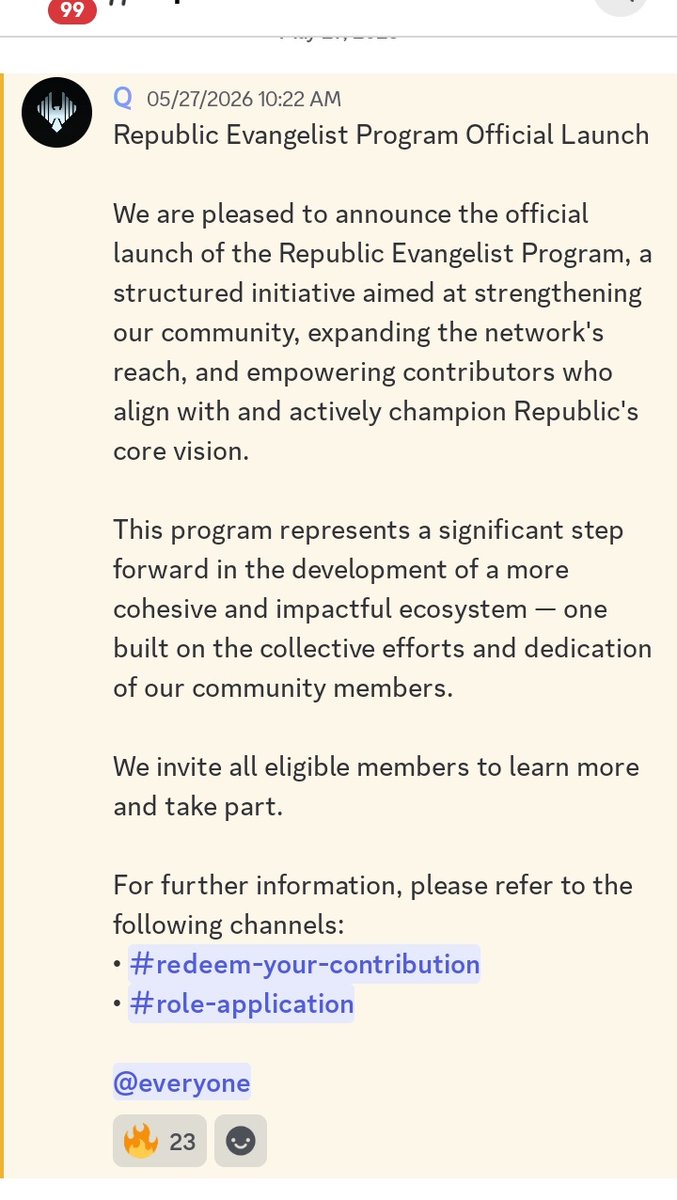
Day 98 of posting @republicfdn
Republicai Social campaign is live 🔥
Are you contributing by now ?
Sign up with my link and connect your discord and wallet : https://t.co/J6ks8wxyIR
join the discord and check social campaign details and choose your way you can contribute 🥰
Disclaimer : Not paid promotion!
Day 17 of posting @DlicomApp
Why The Future Of Social Media Is Bigger Than Content
Social media was built to help people connect.
Web3 is helping people own what they create.
For years, users have been forced to split their digital lives across multiple platforms.
One app for communication.
Another for payments.
Another for creator earnings.
Another for crypto and digital assets.
The result?
A fragmented experience that slows participation and limits opportunity.
Dlicom takes a different approach.
It combines social networking, encrypted messaging, creator monetization, self-custody wallets, staking, and Web3 access into a single mobile ecosystem.
The significance goes beyond convenience.
Online communities are evolving into digital economies where users want more than likes and followers.
They want:
• Ownership of their digital presence
• Direct monetization opportunities
• Greater community influence
• Financial participation
• Control over their assets and identity
As Web3 adoption grows, platforms that merge social interaction with economic participation may define the next era of the internet.
Dlicom is building with that future in mind.
Disclaimer: Not paid promotion !
The first Overlayer Community Proposal has officially passed.
3,179 votes in favor.
81 votes against.
The ORIGIN reward eligibility threshold will increase to 15,000 Points.
Community spoke.
Overlayer evolves.
Day 14 of posting about @overlayerfi
Looking for an early stage testnet with real utility?
OverLayer is building a protocol that upgrades stablecoins like USDT and USDC into productive on-chain assets called T+ and C+, allowing users to keep their assets liquid while exploring additional utility through staking and other protocol features.
🔥 The testnet is currently live, and participants can complete tasks such as minting, staking, redeeming, bridging, and interacting with the ecosystem using Faucet on sepolia network.
If you're interested in positioning yourself early for potential future rewards, ecosystem opportunities, and gaining hands-on experience with the protocol, now is a great time to get involved.
Join the OverLayer testnet and start exploring:
https://t.co/N0OV5eBDyi
Early users often have the advantage 🚀
Disclaimer: Not a paid promotion!!
Day 13 of posting about @overlayerfi
Why OverLayer Is Different: The Missing Piece in Stablecoin Utility
Most protocols ask users to choose between liquidity and yield.
Lock your assets to earn rewards, and you lose flexibility.
Keep your assets liquid, and your capital sits idle.
For years, DeFi users have accepted this tradeoff as normal.
OverLayer challenges that assumption.
Instead of forcing users to replace their stablecoins or lock them away in complex strategies, OverLayer introduces a simpler approach: make stablecoins productive while keeping them usable.
When users deposit supported stablecoins into OverLayer, they receive a matching overlaid asset. This asset remains liquid, transferable, and fully compatible with other on-chain applications. It can be moved, traded, or integrated into DeFi just like any other asset.
What makes OverLayer different is its separation of utility and yield.
In many protocols, yield is embedded directly into the asset itself. This often creates complications around accounting, integrations, and composability.
OverLayer takes a different route.
The base overlaid asset is designed for movement and settlement. Users who want yield can voluntarily stake that asset and receive a separate representation that tracks rewards over time.
This creates a clear distinction:
- One asset for transactions and liquidity.
- Another asset for earning yield.
The result is a cleaner architecture that avoids mixing two different functions into a single token.
OverLayer also follows a receipt-based design. Every minted asset corresponds directly to deposited collateral, creating a transparent and deterministic process for minting and redemption.
Rather than reinventing stablecoins, OverLayer upgrades them.
The protocol doesn't replace existing assets. It enhances them by adding new functionality while preserving the characteristics users already trust.
As DeFi continues to evolve, the next wave of innovation may not come from creating entirely new assets. It may come from making existing assets more efficient, more flexible, and more productive.
That's where OverLayer stands apart.
Not by replacing stablecoins.
But by unlocking what stablecoins can become
#DeFi #Overlayer
Disclaimer: Not paid promotion!
Day 13 of posting about @overlayerfi
Why OverLayer Is Different: The Missing Piece in Stablecoin Utility
Most protocols ask users to choose between liquidity and yield.
Lock your assets to earn rewards, and you lose flexibility.
Keep your assets liquid, and your capital sits idle.
For years, DeFi users have accepted this tradeoff as normal.
OverLayer challenges that assumption.
Instead of forcing users to replace their stablecoins or lock them away in complex strategies, OverLayer introduces a simpler approach: make stablecoins productive while keeping them usable.
When users deposit supported stablecoins into OverLayer, they receive a matching overlaid asset. This asset remains liquid, transferable, and fully compatible with other on-chain applications. It can be moved, traded, or integrated into DeFi just like any other asset.
What makes OverLayer different is its separation of utility and yield.
In many protocols, yield is embedded directly into the asset itself. This often creates complications around accounting, integrations, and composability.
OverLayer takes a different route.
The base overlaid asset is designed for movement and settlement. Users who want yield can voluntarily stake that asset and receive a separate representation that tracks rewards over time.
This creates a clear distinction:
- One asset for transactions and liquidity.
- Another asset for earning yield.
The result is a cleaner architecture that avoids mixing two different functions into a single token.
OverLayer also follows a receipt-based design. Every minted asset corresponds directly to deposited collateral, creating a transparent and deterministic process for minting and redemption.
Rather than reinventing stablecoins, OverLayer upgrades them.
The protocol doesn't replace existing assets. It enhances them by adding new functionality while preserving the characteristics users already trust.
As DeFi continues to evolve, the next wave of innovation may not come from creating entirely new assets. It may come from making existing assets more efficient, more flexible, and more productive.
That's where OverLayer stands apart.
Not by replacing stablecoins.
But by unlocking what stablecoins can become
#DeFi #Overlayer
Disclaimer: Not paid promotion!
Day 12 of posting about @overlayerfi
Simple Explanation of Overlayer
Overlayer helps users make their stablecoins useful without losing control of them.
Here’s how it works in simple terms:
You deposit your stablecoin into the protocol.
Overlayer gives you a matching digital asset in return.
That asset can still be used, sent, or traded normally.
If you want to earn rewards or yield:
You can stake the asset.
Overlayer then gives you another token that tracks your earnings over time.
The main idea is simple:
One asset is used for transactions.
Another asset is used for earning rewards.
This keeps the system organized, flexible, and easy to manage while your assets remain usable.
Check my previous thread 🧵 and join the testnet and perform daily tasks to claim Origin Points for future rewards.
Disclaimer: Not paid promotion!
Day 98 of posting @republicfdn
Republicai Social campaign is live 🔥
Are you contributing by now ?
Sign up with my link and connect your discord and wallet : https://t.co/J6ks8wxyIR
join the discord and check social campaign details and choose your way you can contribute 🥰
Disclaimer : Not paid promotion!
Day 15 of posting @DlicomApp
Why Digital Communities Need Better Infrastructure
Communities are the foundation of the internet.
Every movement, creator economy, project, and platform begins with people gathering around shared interests.
Yet most online communities still operate using fragmented systems.
Communication happens in one place.
Payments happen somewhere else.
Ownership often doesn't exist at all.
This separation creates unnecessary friction.
As communities become increasingly global, they need tools that allow them to communicate, collaborate, and create value without jumping between multiple platforms.
Dlicom is exploring a more connected approach.
Instead of separating social interaction from digital ownership, it combines messaging, content creation, Web3 tools, community engagement, and self-custody into one environment.
The result is a platform designed not only to connect people but also to help communities grow stronger together.
The future of digital communities may depend less on audience size and more on the infrastructure supporting them.
Better infrastructure creates stronger ecosystems.
And stronger ecosystems create greater opportunities for everyone involved.
Disclaimer: Not a paid promotion