The long awaited Singapore Major has begun
The first match day already brought some upsets.
FlyQuest 2-0
Imperial 2-0
Many people sent them home 0-3 in their Pick'Ems,
9z are 0-2, which is also surprising
The magic of the Major in action
$1.76M ALREADY TRADED AND THE MAJOR HASN'T EVEN STARTED
Less than 12 hours to the Singapore Major
Stage 1 is all BO1, so my round 1 pick'em is either genius or a disaster
My pick'em is in the video
> PGL Major matches:
https://t.co/NGEUwPSn3V
> PGL Major Singapore 2026: Winner: https://t.co/Whrxs5YLzo
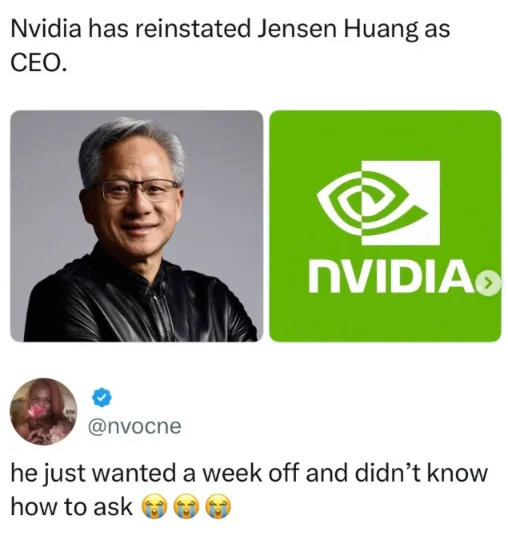
November 23. Nvidia reinstated Jensen Huang as CEO just 11 days after his resignation, even though the investigation into the spy scandal is ongoing.
Decision was unanimous, and the board took into account input from senior US government officials. Trump said the federal government has no reason to believe that Huang return poses a threat to national security
In 6 days Nvidia board of directors went from "we dont intend to reinstate him" to a unanimous reinstatement
On November 20 Polymarket gave Huang a 3% chance of returning by the end of the year, and 19% in the next CEO market a few hours before the news
The story isn't over
The board's independent investigation into the foreign intelligence effort targeting Huang remains open, and Huang is scheduled to be questioned by House committees on Dec 1, and Nvidia general counsel on Dec 2
Where will AI regulation take us?
On one hand, the AI era gives humanity something that multiplies the pace of technological progress in every area of life, research, health, solving global problems
On the other hand, uncontrolled development brings a lot of risks, from AI spreading unchecked into areas where it can cause harm, to people with bad intentions.
In recent months we've seen many cyberattacks that caused serious damage to systems people depend on every day. If this continues, this weapon will end up in the hands of people who already hold a lot of power and money and that could end very badly
But regulation also has downsides, including for regular users.
I already hear from friends that it's become much harder to use AI, especially the smartest models. Because of regulation, the AI starts suspecting you of all sorts of things, even where it doesnt really make sense. That's not a pleasant experience for ordinary users
If you step back, the same thing happens with every new industry. Take crypto as an example:
At first its a tiny niche. At some point it grows very fast and becomes popular. Then, once everyone is using it, it creates a range of uncontrolled processes and problems that wont solve themselves without regulation
Either way, AI regulation is needed, and sooner or later it will come. The only question is how well it will be done, and whether it will restrict the right people without hurting the experience of regular users
What do you think?
Top of the Democratic agenda on day 1 needs to be a pause on advanced AI development, regulation of this out of control industry, and a ban on artificial superintelligence.
Models are starting to look a lot like people
You can change the name, the system prompt and the interface but the way it reasons through edge cases stays the same
It's basically handwriting - hard to fake and almost impossible to fully hide
Today any app can claim it runs on a top model while quietly routing requests to something cheaper
who benefits more from this, builders protecting their models or users who want to know what they're really talking to?
a model can tell you the wrong name and still give away exactly what it is through its behavior
clever part is that LLMmap does not need the model to identify itself
researchers do not need access to the weights, logits or internal configuration
they send a small set of carefully chosen prompts, look at how the model responds, and use those traces to identify which model is sitting behind the interface
with eight interactions, LLMmap reached 95.3% accuracy across 42 different LLM versions, even when system prompts, sampling settings and layers like RAG or Chain-of-Thought were changed
what makes this more interesting for @SentientAGI fingerprinting work is that the "fingerprint" here is not something deliberately planted into the model, it comes from the model's own behavioral quirks
different models handle malformed prompts, alignment questions, mixed languages and other edge cases in slightly different ways, and those differences can be enough to trace them back to their likely origin
that makes model identity feel much less like metadata and much more like behavior that is hard to completely hide
CT has never been louder, but it feels like people are saying less than ever
Every day the same threads, the same next 100x and the same confident predictions that nobody checks later
Maybe the problem isnt opinions, it's that opinions cost nothing?
Everyone on CT is right in hindsight
Nobody remembers who called the top, but everybody remembers they "saw it coming"
The market doesn't care about takes, it only cares about positions
Lately I'd rather trust a probability with real money behind it than a thread with thousands of likes
The main goal of making the V2 collection was for people to bring money to the developer
Low.
With the launch of the second collection, a number of problems arise:
People had the association ''Index Brokers nft = INDEX token''.
With a second collection, that connection is gone. The two collections won’t grow together, one will only get in the way of the other.
You were gone for long enough that most people have forgotten about the first collection. Only a small core of people still remembers it. You won’t attract enough attention for people to mint V2, especially not if it isn't free.
People won't mint an NFT even for $1 if they feel like there's something suspicious going on.
You didnt even airdrop V2 to holders of the first collection. Do you really think even half of them will claim their V2 NFTs?
The silence was more successful than what you've done.