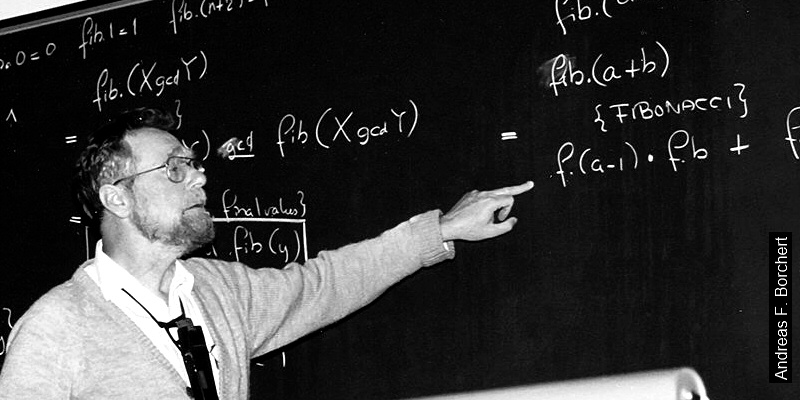
A mathematician invented the algorithm inside every GPS on earth while sitting in a café in Amsterdam with no pen and no paper, worked it out in his head in 20 minutes, and did not bother publishing it for three years.
His name was Edsger Dijkstra.
He was born in Rotterdam in 1930, the son of a chemist father and a mathematician mother.
He studied mathematics and physics at the University of Leiden, earned his PhD in computing from the University of Amsterdam in 1959, and became the first professional programmer in the Netherlands at age 21.
The café story is real, and the detail that makes it strange is this: he was not trying to solve a famous problem.
He was trying to find a demo impressive enough for a public audience.
In 1956, his lab at the Mathematical Centre in Amsterdam had just finished building a new computer called the ARMAC.
They needed to show it off at an inauguration ceremony to an audience of non-technical people.
Dijkstra needed a problem that regular people could understand, with an answer they could verify. He landed on one: given a map of Dutch cities connected by roads, what is the shortest route between two of them?
He was shopping with his fiancée Ria in Amsterdam when the solution came to him. They stopped at a café. He sat down, no paper, no pencil, and spent 20 minutes working through it entirely in his head. When he stood up, he had the algorithm.
He used it for the inauguration. It worked. He then filed it away and did not publish it for three years because, as he later explained, he was not sure it was worth a paper. He thought it was too simple.
That algorithm now has a name. Dijkstra's algorithm.
It finds the shortest path between any two points in a network. Every GPS navigation system on earth runs it when you ask for directions.
Every internet router runs it to decide where to send your data packets. Every airline uses it for flight path optimization. Every logistics company uses it to route deliveries. Google Maps, Apple Maps, Waze, every mapping tool you have ever opened, all of them are running a version of what one Dutch mathematician worked out in his head over a cup of coffee in 1956.
He did not stop there.
In 1965 he invented the concept of the semaphore, the mechanism that lets multiple programs share a computer's resources without crashing into each other.
Every operating system on earth uses semaphores. Every time your phone runs ten apps at once without any of them corrupting each other's memory, that is Dijkstra's idea holding things together underneath.
In 1968 he published a two-page letter to a computing journal with the title "Go To Statement Considered Harmful." The letter argued that a common programming instruction called goto, which let a program jump to any arbitrary point in its own code, was making programs impossible to understand and debug.
He called for removing it from all serious programming languages entirely.
The letter caused an immediate uproar. Programmers who had built careers on goto were furious. Dijkstra received angry letters for years.
The programming community eventually concluded he was completely right. The structured programming approach he was advocating, where code flows through clear, predictable logic rather than jumping unpredictably around, became the foundation of how every modern programming language is designed. Python, JavaScript, Java, C#, every language you can name was built around the principle Dijkstra defended in two pages in 1968.
He won the Turing Award in 1972.
Now the part almost nobody knows.
Dijkstra refused to own a television. He refused to own a video player. He never owned a mobile phone. He never sent an email. His house in Nuenen in the Netherlands was small and plain. He played the piano and listened to Mozart.
From the early 1970s until his death in 2002, he wrote every research paper, every technical note, every letter, and every lecture by hand with a fountain pen.
He numbered them sequentially using his initials as a prefix: EWD. EWD1, EWD2, all the way to EWD1318, his last note, written four months before he died.
When he finished each one, he made photocopies and mailed them to colleagues around the world. That was his publishing system. Fountain pen, paper, photocopier, post office.
More than 1,300 of those handwritten documents have been scanned and are now archived at the University of Texas. Researchers still read them. New papers still cite them.
His reasoning for refusing computers in his own work was precise, not eccentric. He believed that the friction of writing by hand forced him to think more carefully before committing anything to paper.
The ease of editing on a computer, he thought, made it too tempting to produce volume instead of clarity. He wanted every sentence to be worth the effort of writing it.
He died on August 6, 2002, in Nuenen. He was 72.
The man who invented the algorithm your phone uses to give you directions never used a phone.
The man who shaped how every programmer writes code wrote his own work exclusively by hand. The man whose ideas run silently inside every connected device on earth chose to live without almost all of them.
He just wanted to think clearly.
Everything else followed.
#Bitcoin Historical floor is now near $44.5K.
Every BTC cycle bottom has formed above the lower boundary of the Power Law V2.0.
That boundary is currently near $44.5K and continues to rise overtime.
While no model guarantees future outcomes, a sustained move below this level remains unlikely.
🇮🇶🇺🇸 Every dollar of Iraq's oil money flows into ONE bank account, and it sits in the United States.
Beirut-based writer Sharmine Narwani, of The Cradle, lays out an arrangement most people, including most Iraqis, have never heard of.
All of Iraq's oil revenues must be deposited into a single account in the US, and every month, Baghdad sends what amounts to an invoice to the Treasury Department explaining what it needs money for.
Washington then decides what Iraq gets.
The delivery method makes it stranger.
With key Iraqi banks under heavy US sanctions, the money arrives as pallets of cash flown in by airplane, a system Narwani says has fueled enormous corruption:
"I can't tell you, Mario, how many Iraqis don't even know about this."
This, she argues, is what strategic control actually looks like, a country's entire oil wealth flowing through a foreign government's approval process, one month at a time.
@snarwani
When scientists put slime mold over a map of Tokyo, they used food to represent urban areas.
After a day the mold created a network nearly identical to Tokyo's rail network: all this without any brain.
🌈Beam’s biggest announcement ever is finally here.
▶️Watch the video below.
Four projects shaping our future:
1. Global Expansion: Beam chosen by Abu Dhabi
2. BeamAI: Beam's new AI division
3. Beam L1: The evolution of Beam Network
4. Beam Nodes: Huge opportunities
Thread🧵
🐂 Bulls’n’Bears game is LIVE!
Tap away, get BTC to 1B, farm points, and invite frens to score a massive airdrop
❓ LOOKING FOR THE LINK?
Hunt it EVERYWHERE! Check KOL posts, comments... or maybe it's on the moon
💡 If you’ve got the link — spread it to the world