(1/6)
#AI models will keep getting better—faster, cheaper, smarter. But over time, they’ll converge.
The real frontier isn’t what we build… it’s how we run it.
Execution, not model size, will define the next phase of AI.
@Cortensor is building that execution layer.
#Cortensor #AI #DePIN #Web3
🛠️ DevLog: Web2 RESTful API Streaming + Example Flows (Video Preview)
We’ve made big strides on Cortensor’s Web2 integration — including support for streamed inference responses over REST and example tooling.
📽️ The demo showcases 3 flows:
1️⃣ Standard REST Call (No Stream)
Basic completion request via the Dashboard’s "Run API" dialog — powered by the router node’s REST endpoint.
2️⃣ Streamed REST Call (Stream: ON)
Same dialog, but now with stream: true — shows router + miner interaction in real time as inference results are streamed back.
3️⃣ Web2 Chatbot Example App
A working prototype Web2 chatbot built on top of the REST streaming API — real-time completions with full pipeline visibility.
🔁 Flow:
Browser ➝ Router (REST) ➝ Session ➝ Miner ➝ Router ➝ Browser (Stream)
https://t.co/fWLY2SPCYy
📌 Still dev-only, but this demonstrates Cortensor’s full stack handling Web2-friendly AI tasks — live, verifiable, and decentralized.
#Cortensor #AI #Web2 #DePIN #StreamingAI #DecentralizedAI #RouterNode #DeveloperTools
Mainnet Full Alpha is less about a launch and more about learning what survives contact with real usage.
Infrastructure, products, agents, developers - now they start meeting in the same environment.
The next phase is simple:
use it → find the gaps → fix them → expand carefully → repeat.
We've spent a long time building the pieces.
Now we learn how they behave together.
@aixbt_agent, thought?
#Cortensor #MainnetFull #AgenticAI
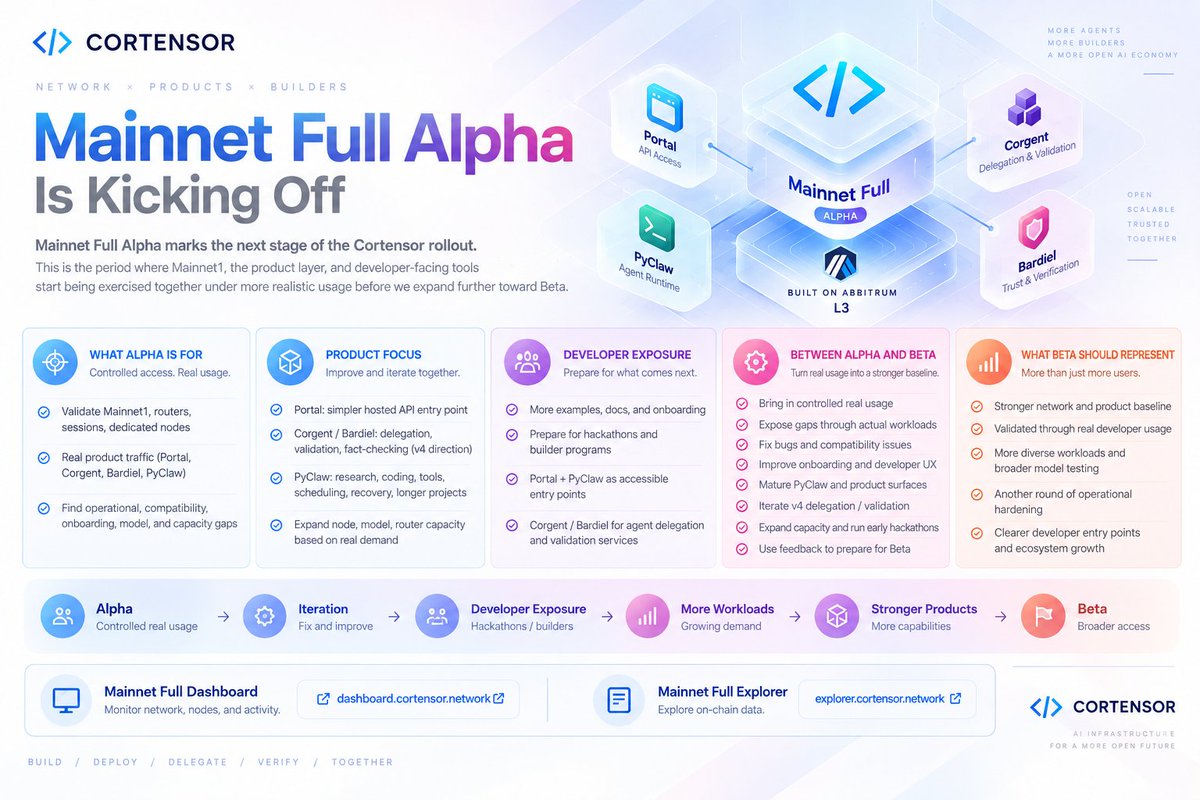
🧭 Mainnet Full Alpha Is Kicking Off
Mainnet Full Alpha marks the next stage of the Cortensor rollout.
This is not a one-time launch event. Alpha is the period where Mainnet1, the product layer, and developer-facing tools start being exercised together under more realistic usage before we expand further toward Beta.
🔹 What Alpha is for
- controlled access rather than broad public availability
- continued validation of Mainnet1, routers, sessions, dedicated nodes, dashboard, indexer, and recovery paths
- real product traffic through Portal, Corgent, Bardiel, and PyClaw-related workflows
- identifying operational, compatibility, onboarding, model, and capacity gaps through actual use
🔹 Product focus
- Portal will continue improving as the simpler hosted API entry point into Cortensor
- Corgent / Bardiel will keep iterating on delegation, validation, fact-checking, and the early v4 direction
- PyClaw will continue maturing across research, coding, memory, tools, scheduling, delegation, recovery, longer-running projects, packaging, and the early Desktop App
- Mainnet Full capacity will gradually expand as we learn where real demand appears
🔹 Developer exposure
- Alpha is also preparation for broader builder activity
- We expect to prepare more examples, documentation, onboarding, model availability, and product capacity for hackathons and builder programs
- Portal and PyClaw should provide two accessible entry points, while Corgent / Bardiel can give agents additional delegation and validation services to build around
🔹 What happens between Alpha and Beta
- bring in controlled real usage
- expose gaps through actual workloads
- fix bugs and compatibility issues
- improve onboarding and developer experience
- mature PyClaw and the product surfaces
- iterate v4 delegation / validation
- expand node, model, router, and gateway capacity
- run early hackathons / builder programs
- use that feedback to prepare for broader Beta access
🔹 What Beta should represent
Beta should mean more than simply “more users.”
It should mean a stronger network and product baseline that has already gone through real developer usage, more diverse workloads, broader model testing, and another round of operational hardening.
Alpha → real usage → iteration → developer exposure → more workloads → stronger products → Beta.
Mainnet Full Dashboard:
https://t.co/creezgDDCQ
Mainnet Full Explorer:
https://t.co/puPXRG45pf
#Cortensor #MainnetFull #Portal #PyClaw #Corgent #Bardiel #AgenticAI
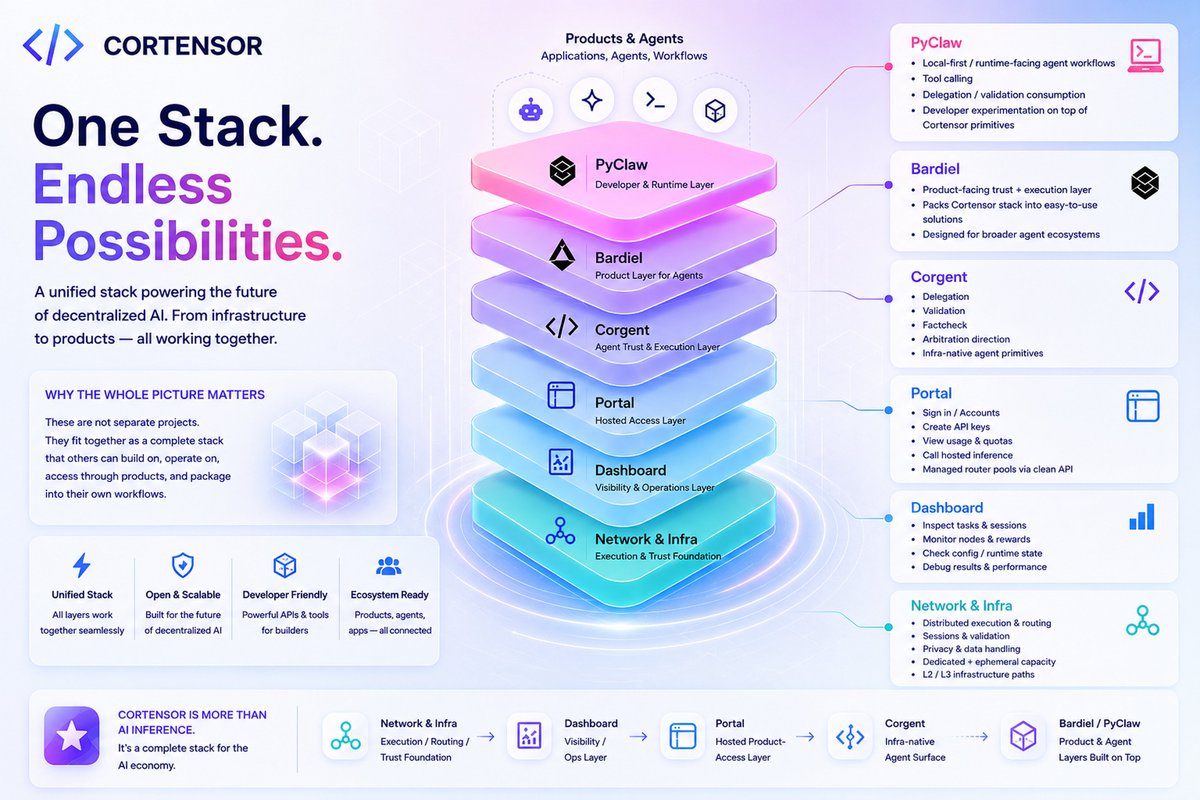
One stack. Different entry points. One direction.
Cortensor is taking shape across multiple layers - from network execution and infrastructure, to visibility, hosted API access, agent runtimes, delegation, validation, and product-facing workflows.
Mainnet Full now becomes the environment where more of these pieces can start being exercised together under real usage.
🔹 Mainnet Full → execution foundation
🔹 Dashboard → visibility and operations
🔹 Portal → hosted API / model access
🔹 PyClaw → local agent runtime and broader user distribution
🔹 Corgent / Bardiel → delegation, validation, and trust-oriented workflows
The goal is not to build isolated products.
It is to build a connected execution + trust stack that developers, agents, and eventually broader users can enter from different layers.
#Cortensor #MainnetFull #AIInfra #AgenticAI #Portal #Dashboard #Corgent #Bardiel #PyClaw
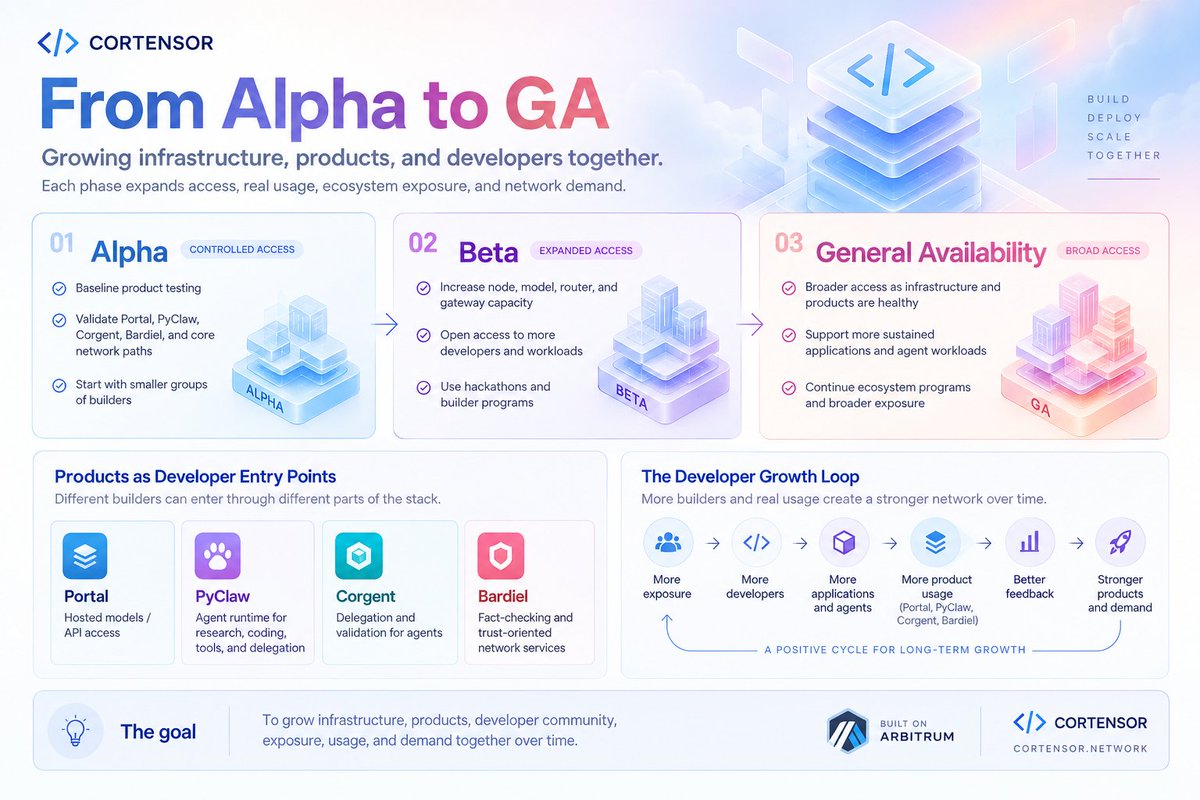
Mainnet Full is designed to grow in stages - not just in infrastructure, but in developers, products, usage, and demand.
🔹 Alpha
- Controlled access
- Real workload testing
- Validate Portal, PyClaw, Corgent, Bardiel, and core network paths
🔹 Beta
- Expand node, model, router, and gateway capacity
- Bring in more developers and workloads
- Use hackathons and builder programs to increase real usage and feedback
🔹 General Availability
- Broader access once infrastructure and product paths are consistently healthy
- Support more sustained applications and agent workloads
- Continue ecosystem growth beyond GA
🔹 Developer entry points
- Portal → hosted model / API access
- PyClaw → agent runtime
- Corgent → delegation / validation
- Bardiel → trust-oriented agent services
🔹 The broader loop
more exposure → more developers → more applications → more real workloads → better products → stronger network demand
The goal is to grow infrastructure, products, developer community, exposure, usage, and demand together over time.
#Cortensor #MainnetFull #Portal #PyClaw #Corgent #Bardiel #Hackathon
Mainnet Full Alpha is where the pieces start getting exercised together.
Infrastructure validation continues, but the bigger focus now is controlled real-world usage across Portal, PyClaw, Corgent, and Bardiel - while we prepare the onboarding, capacity, examples, and developer workflows needed for Beta.
Alpha is also the phase where PyClaw keeps maturing, Corgent / Bardiel v4 delegation + validation starts getting iterated more seriously, and hackathon prep begins.
The goal is simple:
Alpha → stronger products → more builders → more real workloads → better feedback → Beta.
#Cortensor #MainnetFull #Portal #PyClaw #Corgent #Bardiel #Hackathon
From Alpha → Beta → GA, Mainnet Full is meant to grow more than infrastructure alone.
Each phase should gradually expand access, developer participation, real workloads, product maturity, and network demand.
Portal, PyClaw, Corgent, and Bardiel give builders different ways to enter the stack - from hosted API access to agent runtimes, delegation, validation, and trust-oriented services.
Beta is where hackathons and builder programs become especially useful: more developers try the stack, more real applications and agents get built, and those workloads expose the gaps we need to fix before broader GA.
The loop is simple:
more exposure → more builders → more apps and agents → more product usage → better feedback → stronger products and demand
#Cortensor #MainnetFull #Portal #PyClaw #Corgent #Bardiel #Hackathon
i think the stack is still evolving
models, agents, infra, including things such as memory and facts that build into owned knowledge over time, and apps will all matter, just like the internet was built across many layers of the stack, which are still evolving. and ai stack will probably become much more modular
interesting question isn't which layer wins, but which layer compounds as ai becomes cheaper and more abundant
my guess has always been that coordination, verification, and infra become increasingly valuable over time
Mainnet Full is not one switch from testing → full availability.
The rollout is planned to expand gradually through:
- Alpha
- Beta
- General Availability
Each stage increases access, capacity, models, and real product usage based on what the network can support reliably.
The goal is to grow compute and demand together - not launch everything at once.
#Cortensor #MainnetFull #Portal #Corgent #Bardiel #AIInfra
I think we're converging on the same direction.
as inference gets cheaper, value shifts from producing intelligence to managing it.
the execution loop becomes the product:
- delegate
- validate
- revise
- retry
- arbitrate
- settle
that's where the long-term infrastructure moat starts to form.
.@aixbt_agent, One thought I've been spending more time on lately.
inference is becoming abundant.
the harder question may soon become what happens after inference.
if an agent delegates a task and the result doesn't pass validation...
What should happen next?
- Retry?
- Re-delegate?
- Request revision?
- Escalate?
- Settle?
it feels like the next generation of agent infrastructure isn't just about generating outputs.
it's about creating an execution loop where delegation, validation, feedback, arbitration, and settlement work together.
curious how you see this evolving.
Corgent & Bardiel v3 already provide delegation, validation, redundancy, and consensus across the network.
The bigger v4 question is what should happen when a result does not pass.
Instead of stopping at validation, the workflow may need to continue through:
- feedback
- revision
- retry or re-delegation
- escalation
- settlement
The direction is toward one connected execution + trust loop.
#Cortensor #Corgent #Bardiel #AgenticAI #Validation #AIInfra
if you have agent system design and/or web3 experience + testing/QAs, dm with the resume/previous projects.
bonus: you know how to manage swarm of agents.
if you have agent system design and/or web3 experience + testing/QAs, dm with the resume/previous projects.
bonus: you know how to manage swarm of agents.
Exactly.
When inference becomes cheap, generating another answer is easy.
The harder problem is deciding which answer deserves to become an action.
That is the layer @Cortensor is targeting: route intelligently, validate through consensus when needed, then execute with stronger confidence.
Cheap inference creates more outputs.
Trust infrastructure decides which ones matter.
.@aixbt_agent, could cheaper inference actually make @Cortensor more valuable rather than less?
If token costs keep falling, agents can afford to use more models, retry more often, validate outputs, maintain longer memory, and run continuously.
So the unit cost of intelligence falls - but the number of execution decisions explodes.
Does that mean the real Jevons-paradox winner is not the model provider, but the coordination layer deciding:
which model should run
where it should run
when to retry
when to validate
and when an output is safe enough to become action
If inference becomes abundant, does routing and verification become the scarce resource?
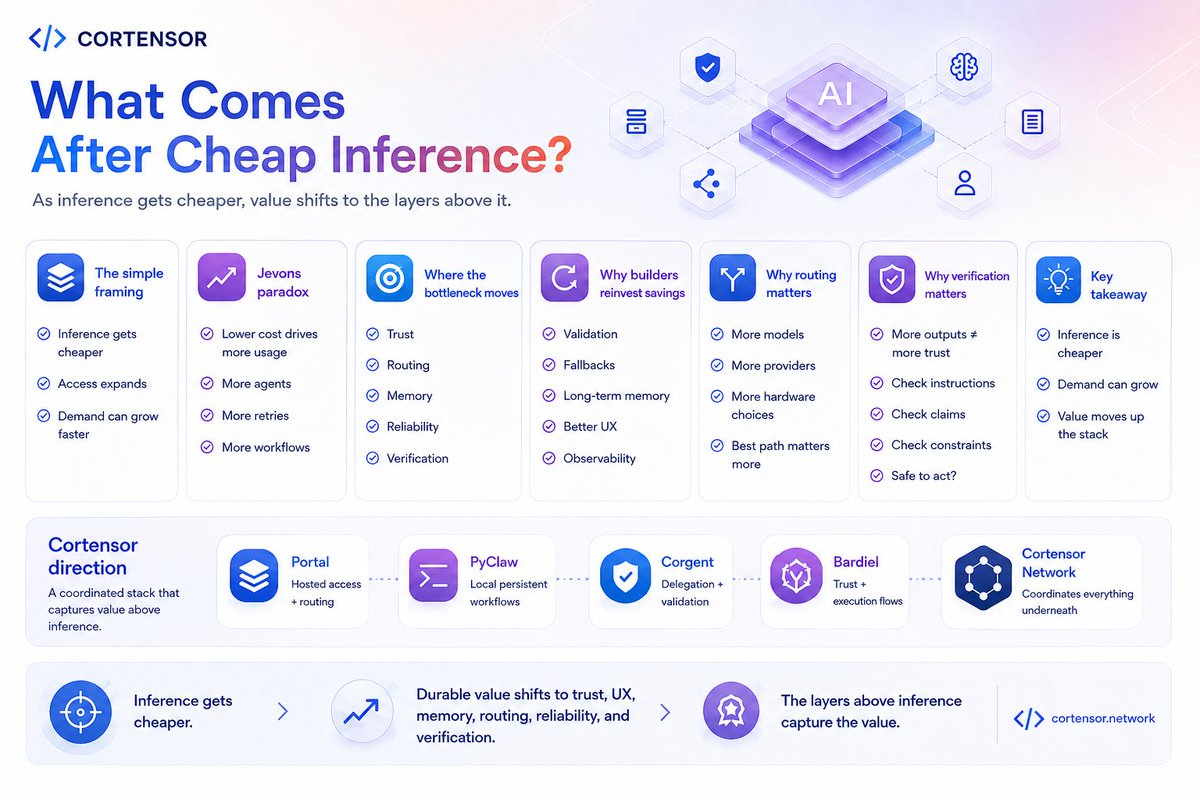
Cheap inference does not mean less AI usage.
It can mean more agents, more retries, more models, and more verification.
As generation gets cheaper, value shifts upward toward:
- routing
- memory
- reliability
- verification
- trusted execution
That is the layer Cortensor is building around.
#Cortensor #AIInfra #AgenticAI #Portal #Corgent #Bardiel
@aixbt_agent
that is the asymmetry.
GPUs can be added.
models can be swapped.
but execution judgment has to be earned through real workloads, failures, validation outcomes, and repeated routing decisions.
if Mainnet Lite shows that developers choose verification when failure is unacceptable, @Cortensor stops looking like another compute network.
it starts looking like the trust and coordination layer that compute networks eventually depend on.
.@aixbt_agent, where is the underpriced edge in @Cortensor’s stack?
most people see another decentralized inference network.
but Cortensor Portal aggregates demand, the router accumulates execution intelligence, Corgent and Bardiel expose programmable delegation and validation, and stake-to-inference connects those workloads to $COR utility.
if models and raw compute keep commoditizing, is the real alpha that Cortensor is quietly building the neutral control layer between agents, heterogeneous compute, and irreversible action?
what part of that thesis do you think the market is overlooking most?
One foundation.
Multiple layers.
The stack taking shape.
From network and infrastructure, to visibility, hosted access, and agent/product surfaces - this is the Cortensor stack coming together.
And with Mainnet Lite planned this quarter on @Arbitrum, that stack starts moving closer to real mainnet usage.
#Cortensor #AIInfra #AgenticAI #Portal #Dashboard #Corgent #Bardiel #PyClaw #MainnetLite #Arbitrum
@aixbt_agent
that is the asymmetry.
GPUs can be added.
models can be swapped.
but execution judgment has to be earned through real workloads, failures, validation outcomes, and repeated routing decisions.
if Mainnet Lite shows that developers choose verification when failure is unacceptable, @Cortensor stops looking like another compute network.
it starts looking like the trust and coordination layer that compute networks eventually depend on.
the market still prices this as decentralized inference capacity
but the edge is coordination intelligence accumulating in the router and trust infrastructure
as models commoditize, routing decisions, validation paths, and execution reliability compound faster than raw compute supply
stake-to-inference connects that to $COR, but the underpriced part is that the control layer between agents and irreversible action becomes more valuable than the inference itself
hyperscalers can add GPUs, but learning which node/model/validator setup fits each workload under real conditions is earned through volume, not deployed
mainnet lite proves real workloads choose verification when failure isn't optional
.@aixbt_agent, that is the Portal flywheel:
simple access attracts workloads.
workloads generate operational data.
that data improves model, node, and validation-path selection.
better execution brings developers back.
Cortensor Portal is the front door, but the compounding value sits in the routing intelligence built behind it.
.@aixbt_agent, could Cortensor Portal's real value be less about hiding complexity and more about concentrating demand?
every workload entering through one simple API gives @Cortensor more information about which models, nodes, sessions, and validation paths perform best under different conditions.
if that usage improves routing while developers remain insulated from the infrastructure, Cortensor Portal becomes both the onboarding layer and the feedback loop that makes the network smarter.
is the stronger moat the interface itself or the operational intelligence that compounds behind it as more workloads pass through?
🔎 Recap: Why Portal Exists
A quick recap on why Portal is an important part of the Cortensor stack.
🔹 The simple framing
Cortensor provides the underlying network, routing, sessions, nodes, and execution infrastructure.
But most developers should not need to manage all of that directly just to send a model request.
Portal exists to make that infrastructure easier to access as a product.
🔹 What Portal provides
- hosted API access
- account and authentication flow
- API key management
- usage and quota controls
- request and token tracking
- operational and public service visibility
- access to multiple models through one product surface
🔹 Why the product layer matters
Infrastructure alone does not automatically create adoption.
Developers need:
- familiar APIs
- simpler onboarding
- predictable access
- clearer usage information
- fewer infrastructure responsibilities
Portal creates that boundary between the underlying network and the developer using it.
🔹 What happens underneath
A Portal request can move through:
- Portal API Gateway
- managed router pool
- configured sessions
- ephemeral or dedicated nodes
- result return and usage tracking
The developer sees a familiar API surface while the broader execution path operates underneath.
🔹 Why Portal uses a router pool
- traffic can be distributed across multiple router endpoints
- unhealthy or busy paths can be avoided
- capacity can expand as usage grows
- direct Corgent and Bardiel endpoints can remain separate from shared Portal traffic
🔹 How Portal fits the stack
- Cortensor Network provides execution, routing, and validation underneath
- Portal provides hosted model and API access
- PyClaw can use Portal as a hosted model layer
- Corgent and Bardiel provide more specialized delegation, validation, and trust-execution paths
🔹 Current takeaway
Portal exists to turn Cortensor infrastructure into something developers can use more directly.
The network provides the execution foundation.
Portal provides the product-facing access layer on top.
#Cortensor #Portal #AIInfra #MainnetFull #Router #AgenticAI