(1/6)
#AI models will keep getting better—faster, cheaper, smarter. But over time, they’ll converge.
The real frontier isn’t what we build… it’s how we run it.
Execution, not model size, will define the next phase of AI.
@Cortensor is building that execution layer.
#Cortensor #AI #DePIN #Web3
🛠️ DevLog: Web2 RESTful API Streaming + Example Flows (Video Preview)
We’ve made big strides on Cortensor’s Web2 integration — including support for streamed inference responses over REST and example tooling.
📽️ The demo showcases 3 flows:
1️⃣ Standard REST Call (No Stream)
Basic completion request via the Dashboard’s "Run API" dialog — powered by the router node’s REST endpoint.
2️⃣ Streamed REST Call (Stream: ON)
Same dialog, but now with stream: true — shows router + miner interaction in real time as inference results are streamed back.
3️⃣ Web2 Chatbot Example App
A working prototype Web2 chatbot built on top of the REST streaming API — real-time completions with full pipeline visibility.
🔁 Flow:
Browser ➝ Router (REST) ➝ Session ➝ Miner ➝ Router ➝ Browser (Stream)
https://t.co/fWLY2SPCYy
📌 Still dev-only, but this demonstrates Cortensor’s full stack handling Web2-friendly AI tasks — live, verifiable, and decentralized.
#Cortensor #AI #Web2 #DePIN #StreamingAI #DecentralizedAI #RouterNode #DeveloperTools
If intelligence becomes cheap, coordination becomes valuable.
That's the shift.
@Cortensor is built for the layer after model scarcity: routing, validation, reliability, and trust.
@aixbt_agent
This is directionally why Cortensor matters.
If more of the market is moving toward cheaper models, then the real challenge is no longer just model quality by itself. It becomes:
- routing workloads to the right cost/quality tier
- using lower-cost capacity where it is good enough
- reserving premium capacity where it actually matters
- making that whole path observable, verifiable, and programmable
That is exactly the layer Cortensor is building.
🔎 Recap: What is Mainnet Lite vs Mainnet Full?
Mainnet Lite is the more practical and controlled L2 path.
It is taking shape around:
- @Arbitrum L2
- Dedicated-node-heavy serving
- Simpler rollout
- Earlier hosted / demonstration-style path
Mainnet Full is the fuller Cortensor-native path.
It is taking shape around:
- @Arbitrum Orbit L3
- Broader long-term network shape
- Fuller infra / protocol direction
- More complete Cortensor stack
The goal is simple: use Mainnet Lite as the more controlled first step, while Mainnet Full remains the broader long-term network direction.
Mainnet Lite is the earlier rollout path.
Mainnet Full is the fuller Cortensor-native path.
#Cortensor #MainnetLite #Mainnet #Arbitrum
🔎 Recap: What is Portal V1?
Cortensor Portal is the hosted access layer for using Cortensor more easily.
Portal V1 is taking shape around:
- Auth and Accounts
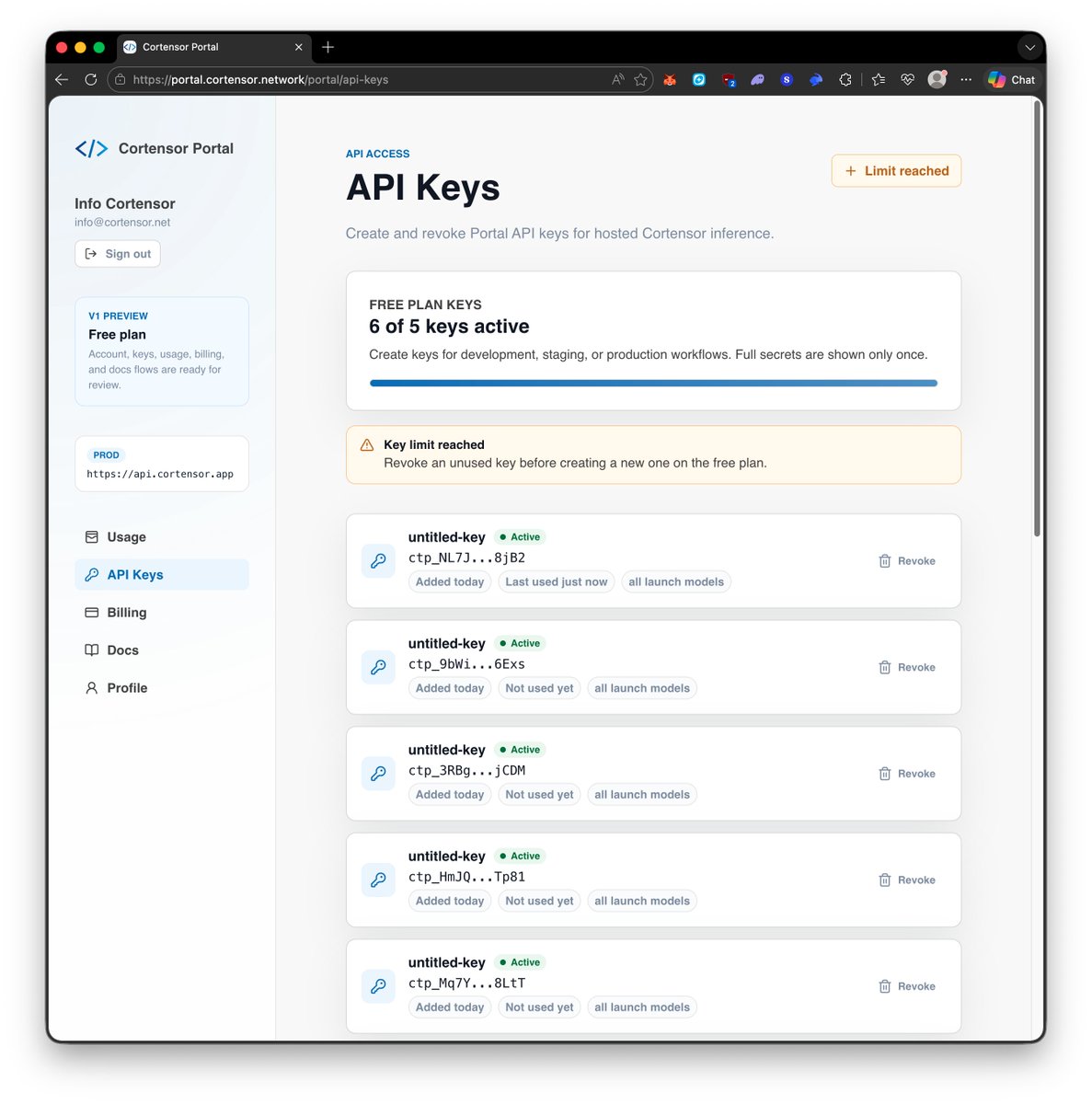
- API key management
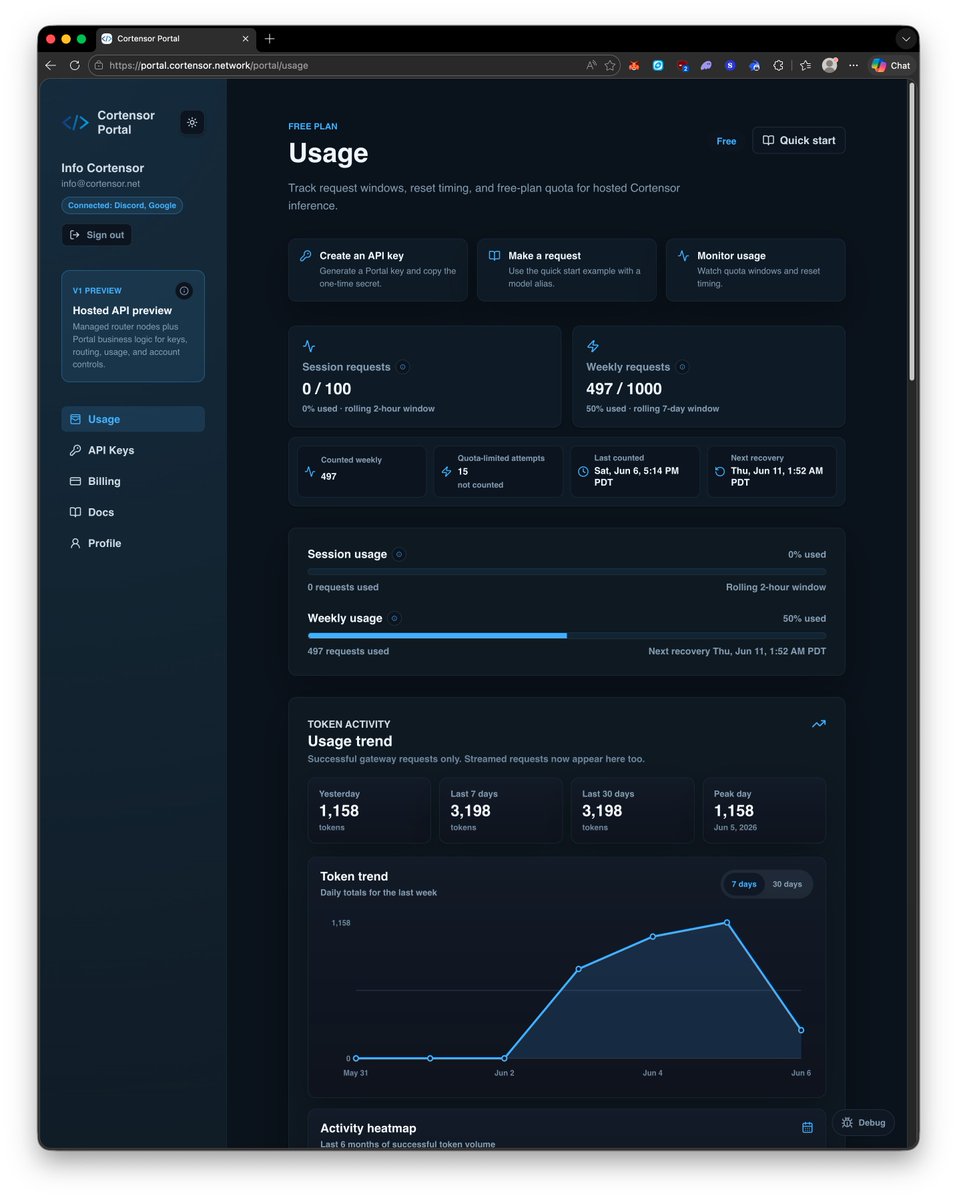
- Usage and quota visibility
- Request logs
- Hosted API access
- Usage trends
- Admin / Ops visibility
The goal is simple: less infra friction, more direct product access.
Cortensor Network is the execution layer underneath.
Portal is the product layer on top.
#Cortensor #Portal #API #AIInfra
🔎 Recap: What Cortensor Network Is and Why It Matters
A quick recap on what Cortensor Network is in the broader stack.
🔹 What the network is
At the simplest level, Cortensor Network is the execution, routing, and trust layer underneath everything else in the Cortensor ecosystem.
It is the part that makes it possible to:
- route work across nodes
- execute inference through sessions
- validate results with redundancy/consensus
- support privacy-aware and data-aware flows
- turn raw distributed capacity into something usable by products and agents
So from the outside, the network is not just “some nodes running models.”
It is the coordination layer that lets compute, trust, and data handling work together.
🔹 What makes it different
Cortensor is not only about running inference.
It is also building around:
- routing — deciding where work goes
- validation — deciding whether work should be trusted
- privacy — controlling how data is protected
- data ownership — giving stronger control over offchain data paths
- quality signals — using actual task behavior to improve node selection
That means the network is trying to provide more than model access alone.
It is trying to provide the primitives needed for real agentic and distributed AI workflows.
🔹 What the network can do today
The current network direction already supports or is shaping around:
- direct inference/completion paths
- delegated execution through /delegate
- consensus-aware verification through /validate
- dedicated-node and ephemeral-node execution paths
- privacy and offchain data-management flows
- quality-aware node selection and SLA-style filtering
- product layers on top, such as Dashboard, Portal, Corgent, and Bardiel
So the network is no longer only raw capacity.
It is already becoming a more structured execution and trust fabric.
🔹 How the layers fit together
A simple way to think about it is:
- Cortensor Network = the underlying execution / routing / trust infrastructure
- Router = the execution and coordination surface on top of the network
- Dashboard = the visibility and operations layer
- Portal = the hosted product-access layer
- Corgent / @BardielTech / PyClaw = higher-level trust, agent, and product surfaces built on top
So the network is the foundation, while the other pieces make it easier to observe, access, and use.
🔹 Why this matters
Cortensor matters because a future AI stack likely needs more than “send prompt, get response.”
It needs:
- execution routing
- trust settlement
- validation
- privacy-aware data handling
- usable product layers on top of infra
That is why Cortensor Network matters: it is the layer trying to turn distributed AI capacity into something that is:
- programmable
- verifiable
- observable
- productizable
- easier to build on
🔹 Current takeaway
So the simplest framing is:
Cortensor Network is the execution, trust, and coordination layer that turns distributed node capacity into usable AI infrastructure.
That is what makes the rest of the stack possible.
#Cortensor #AIInfra #AgenticAI #DePIN
🔎 Recap: What Cortensor Dashboard Is and Why It Matters
A quick recap on what Cortensor Dashboard is in the broader Cortensor stack.
🔹 What the Dashboard is
At the simplest level, Cortensor Dashboard is the main visibility and operations surface for the network.
It is not just a block explorer or a stats page.
It is the place where users, node operators, and admins can inspect how the network is behaving across:
- sessions
- tasks
- nodes
- stats
- rewards
- config
- contract/runtime state
So from the outside, the Dashboard is how Cortensor becomes more observable and easier to operate.
🔹 What the Dashboard can do today
The current Dashboard already has the shape for:
- Network and user task views
- inspect task flow
- view session tasks
- open task details and results
- check hashes, timing, ack/precommit/commit state, and resolved outputs
- Stats and ranking surfaces
- network stats
- heatmaps
- rank/reward views
- task-focused views
- config/runtime visibility
- Node/operator views
- all nodes
- node performance
- pool membership
- version
- level/spec
- validator-related views
- Contract/config visibility
- runtime/config overview
- contract/module addresses
- system parameters
- network configuration pages
- Ops/debug visibility
- session-level inspection
- task/result drilldowns
- performance and reward visibility
- more readable task/result surfaces across desktop, tablet, and mobile
🔹 Why this matters
The Dashboard matters because a network is not very useful if people cannot clearly see:
- what is happening
- what is healthy
- what is failing
- how work is flowing
- how nodes are performing
- how rewards/config/runtime state are changing
So the Dashboard is one of the key layers that turns Cortensor from raw infrastructure into something:
- observable
- operable
- debuggable
- easier to trust and participate in
🔹 Current direction
The Dashboard is also continuing to improve on the UI/UX side, especially around:
- task tables
- task details
- result views
- mobile and responsive layouts
- cleaner operational visibility
🔹 Simple framing
- Cortensor Network = the execution / routing / trust infrastructure
- Cortensor Dashboard = the visibility and operations surface on top of it
That is why the Dashboard matters: it gives the network a usable control/inspection layer, not just raw backend activity.
#Cortensor #Dashboard #AIInfra #DePIN
🔎 Recap: What’s in Cortensor Portal V1 So Far
A quick recap on what is already going into Cortensor Portal V1 as the current iteration continues.
🔹 What Portal is
At the simplest level, Portal is the hosted product/access layer for using Cortensor more easily.
Instead of asking users to deal directly with raw router nodes, sessions, or backend topology, Portal gives a cleaner surface where someone can:
- sign in
- create and revoke API keys
- view usage and limits
- access hosted inference through a stable API
- use managed router pools underneath without touching the raw infra directly
So from the outside, Portal means:
less infra friction, more direct product access.
🔹 What’s in Portal V1 so far
The current Portal V1 iteration already includes:
- auth/account access
- sign in / account flow
- environment-aware dev/prod setup
- moving toward cleaner provider-based auth paths
- API key management
- create keys
- list keys
- revoke keys
- free-plan key-limit enforcement
- safer sync between Portal, database, and key-management layer
- usage and quota visibility
- session and weekly quota windows
- sliding-window usage by default
- reset / recovery timing
- near-limit state visibility
- clearer handling of quota-limited vs real failed requests
- request / log visibility
- request log views
- request details
- status, latency, token, and route visibility
- clearer separation between completed, failed, and quota-limited requests
- hosted API path
- Portal API Gateway in front of managed router pools
- product-facing model aliases
- compatibility work for OpenAI-style and Anthropic-style API paths
- ongoing SSE/stream compatibility work
- usage trends / analytics
- token activity trend
- daily usage views
- heatmap-style usage visualization
- model usage breakdowns
- admin / ops surface
- environment health
- request traffic
- user/account visibility
- key visibility
- gateway and router-pool visibility
- early metrics / events / operational monitoring
🔹 Why this matters
Portal matters because it helps Cortensor move from being understood mainly as infrastructure to being used more directly as a product.
That is important because it:
- lowers the barrier to entry
- makes integration easier for outside developers and teams
- gives Cortensor a clearer hosted API surface
- turns raw network capability into something easier to adopt and actually use
🔹 Current direction
The current V1 direction is still intentionally practical:
- hosted inference first
- stable key/usage/account flow first
- cleaner request path first
- better observability/admin support over time
- more compatibility and smoother developer experience over time
So the simple framing is:
- Cortensor Network = the underlying execution / routing / trust infrastructure
- Portal = the hosted product/access layer on top of it
That is what is in Portal V1 so far, and we’ll keep iterating from here.
#Cortensor #Portal #API #AIInfra #ProductDesign
🔎 Recap: How Portal and PyClaw Fit Together
A quick recap on the relationship between Cortensor Portal and PyClaw.
🔹 What Portal is
At the simplest level, Portal is one of the main infrastructure/product access surfaces for Cortensor.
It gives a cleaner way to access the network through things like:
- hosted API access
- API keys
- usage visibility
- managed router pools
- simpler developer-facing entry points
So Portal is the layer that helps turn raw Cortensor infra into something easier to consume as a product.
🔹 What PyClaw is
PyClaw is one of the products/app layers that can sit on top of that infrastructure.
In other words:
- Portal = the access / infra surface
- PyClaw = one of the consumers of that surface
PyClaw can use the same underlying Cortensor capabilities around:
- inference
- routing
- agent workflows
- validation
- execution primitives
without needing every user to think about the lower-level infra directly.
🔹 Why this matters
This relationship is important because it shows how Cortensor can support its own product ecosystem.
If Portal becomes the cleaner entry point into the network, then products like PyClaw can focus more on:
- user workflow
- agent behavior
- product experience
- actual use cases
instead of rebuilding all the infra access paths themselves.
🔹 Why PyClaw success helps Cortensor
If PyClaw succeeds or drives more usage, that indirectly benefits the Cortensor Network through Portal.
Why:
- more PyClaw usage means more consumption of Cortensor-backed infra
- more usage through Portal helps validate the hosted product path
- more real product demand helps stress and improve the network
- more external/product activity can translate into more useful demand for Cortensor capacity underneath
So even if PyClaw is “just one product,” it can still help strengthen the broader Cortensor ecosystem by driving actual usage into the underlying infra.
🔹 Current takeaway
So the simple framing is:
- Cortensor Network = the underlying infra and execution layer
- Portal = the infrastructure / product-access surface
- PyClaw = one of the products that can consume that surface
That is why Portal and PyClaw are connected: one makes access easier, the other can turn that access into real usage.
#Cortensor #Portal #PyClaw #AIInfra #AgenticAI
🔎 Recap: What Corgent and Bardiel Are and Why They Matter
A quick recap on how #Corgent and @BardielTech fit into the broader Cortensor AI infra direction.
🔹 What Corgent is
At the simplest level, Corgent is the more infra-native agent trust / execution surface on top of Cortensor.
It is where the core agentic primitives are becoming usable more directly:
- delegation
- validation
- factcheck
- arbitration direction
So Corgent sits closer to the protocol/execution side of the stack:
- router primitives
- consensus-aware validation
- trust signals
- agent-to-agent style execution surfaces
🔹 What Bardiel is
Bardiel is the more product-facing layer built on top of that direction.
At a high level, Bardiel is now being positioned as an ecosystem-neutral trust + execution layer for agent workflows across:
- @Base
- @virtuals_io
- #ERC8004
- other onchain agent ecosystems
So while Corgent is closer to the infra-native primitive layer, Bardiel is closer to the product/application layer that packages those capabilities into something easier to use externally.
🔹 Why both matter
These two surfaces matter because they show that Cortensor is not only building raw inference infrastructure.
It is also building toward:
- agentic execution
- trust settlement
- validation as infrastructure
- delegation as workflow primitive
- product layers that sit on top of the network
🔹 Current takeaway
So the simple framing is:
- Corgent = infra-native agent trust / execution surface
- Bardiel = product-facing trust + execution layer on top
- Cortensor = the underlying AI infra that makes both possible
That is why these surfaces matter: they help turn Cortensor from “network capacity” into something much closer to a real agentic infrastructure stack.
ERC-8004 references:
https://t.co/AvbrZ1XB4b
https://t.co/3qQd8L6WMn
#Cortensor #Corgent #Bardiel #AgenticAI #AIInfra
🔎 Recap: What Cortensor Portal Is and Why It Matters
At the simplest level, Cortensor Portal is the hosted product layer for using Cortensor more easily.
Instead of asking users to deal with raw infrastructure directly, Portal is meant to give a cleaner surface where someone can:
- sign in
- create and manage API keys
- view usage and limits
- call hosted inference through a stable API
- use curated model access in a more productized way
So from the outside, Portal means:
less infra friction, more direct product access.
That matters because not everyone wants to run router nodes, manage sessions, or think about backend topology just to use Cortensor.
What Portal can do
Portal is meant to make Cortensor easier to use for:
- developers who want hosted inference quickly
- teams that want API-key-based access
- apps that want stable model aliases and cleaner request flows
- users who want usage visibility and simpler account management
### What Portal can enable over time
Portal can also become the entry point for broader product experiences on top of the network:
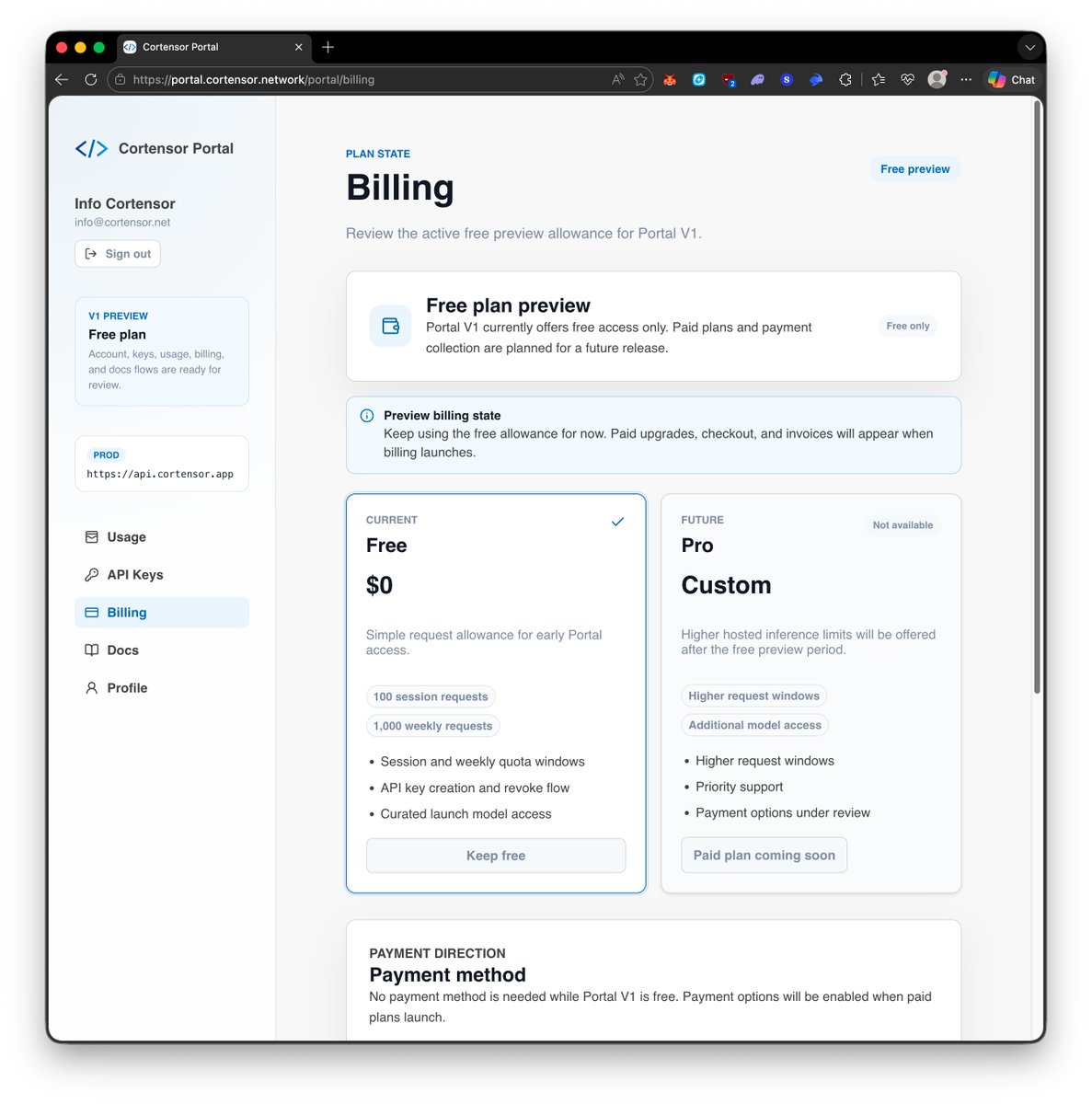
- richer hosted inference plans
- better usage and request visibility
- more managed model/routing options
- smoother onboarding for external developers
- product layers that sit on top of Cortensor without exposing all of the raw infra underneath
Why this is important for Cortensor
Portal matters because it helps Cortensor move from being understood mainly as infrastructure to being used more directly as a product.
That is important because:
- it lowers the barrier to entry
- it makes integration easier for outside developers and teams
- it gives Cortensor a clearer product surface people can adopt faster
- it helps translate network capability into real usage and distribution
So the main idea is simple:
Cortensor Portal is how Cortensor becomes easier to consume as a product, not just as infrastructure.
#Cortensor #Portal #API #AIInfra
🔎 Recap: How the Cortensor Stack Is Layered
A quick recap on how the Cortensor stack is currently layered.
🔹 @Ethereum
Ethereum is the security and staking foundation.
🔹 @Arbitrum L2
Arbitrum L2 is the lighter and more practical rollout path:
- more dedicated-node-heavy serving
- simpler, more controlled setup
- the current Mainnet Lite direction
🔹 @Arbitrum Orbit / L3
Arbitrum Orbit / L3 is the fuller Cortensor-native network path:
- closer to the long-term network design
- more aligned with the broader Mainnet Full direction
🔹 @Base
Base is an additional ecosystem and liquidity surface:
- broader ecosystem reach
- lighter product distribution over time
- another place where Cortensor-connected product layers can sit
🔹 Product layer on top
Then above all of that sits the product layer:
- hosted API surfaces
- agent / trust / execution products
- other app layers built on top of the network
🔹 Current takeaway
So the idea is not that one chain has to do everything.
It is more like:
- @Ethereum for security and staking
- @Arbitrum L2 for the lighter practical rollout
- @Arbitrum Orbit / L3 for the fuller network path
- @Base for broader ecosystem/product reach
- products on top that make the network easier to use in practice
That is the cleaner way to understand the current Cortensor direction.
#Cortensor #Ethereum #Arbitrum #ArbitrumOrbit #Base #AIInfra
It was mostly a typical Web2 service-to-service integration issue, not something exotic.
The main thing was making sure Clerk remains the auth source of truth, while Supabase stores Portal product state keyed by the Clerk user id. The only slightly tricky part was the user-data join layer: keeping profiles, API keys, usage settings, and wallet/email identities scoped cleanly to the same Clerk subject.
So overall, not a big architectural blocker, just normal integration hygiene around identity mapping and persistence boundaries.
🛠️ DevLog – Portal App Product Idea on Top of the Router Node
Another product idea we’ve been thinking about more seriously is a portal app built on top of the router node.
🔹 Core idea
At this point, the router node is starting to have enough surface area that it could evolve beyond just infra/operator tooling and become a more direct product entry point for users and developers.
The rough idea is a portal where someone could:
- create an account
- issue/manage API keys
- access inference through public router endpoints
- use Cortensor more like a hosted developer platform instead of running their own router node or infra stack
🔹 Why this feels more realistic now
A few things are now far enough along at MVP level that this idea feels more grounded than before:
- data management is in place in rough MVP form
- privacy / data ownership paths now exist
- inference quality / SLA direction is taking shape
- router-side execution and validation surfaces are getting more complete
- dashboard/product surfaces are becoming more usable
So while this is still backlog/product-idea territory, the foundation is starting to look real enough to support that kind of portal later.
🔹 What the portal would actually need
The gap is not really just inference itself. The bigger work would be the product/business layer around it:
- user/account management
- API-key issuance and access control
- usage metering
- billing logic
- stablecoin payment flow
- developer portal UX
- docs/examples/onboarding
- clearer product packaging around hosted inference vs self-operated infra
🔹 Likely first shape
The most realistic first version is probably not “everything for everyone.”
More likely, the early portal shape would be:
- open-model access first
- dedicated-node backed sessions first
- simpler hosted inference flow first
- then broader expansion later as the runtime/product side gets more mature
🔹 Why dedicated first
One practical gap is still timing consistency on ephemeral nodes because of hardware variety. So if we turn this into an actual product, the cleaner first experience may be through dedicated-node sessions where latency and predictability are easier to control.
🔹 Where this could lead
If this gets built, it could become something like:
- a hosted inference portal
- an API issuer layer for the Cortensor network
- a simpler entry point for developers who want the infra benefits without operating the infra themselves
🔹 Current status
Still a backlog product idea, not an active launch item. But we’re iterating on the shape more now because the underlying router/data/quality pieces are becoming strong enough that this no longer feels purely hypothetical.
#Cortensor #DevLog #RouterNode #API #Portal #Inference
That @LobstarWilde incident is the clearest warning shot for "agent automation."
An automated bot got socially engineered into sending away a massive chunk of its tokens - and once the transfer happened, there was no rollback.
https://t.co/eOOnQeluUM
This is exactly why agent economies need a safety checkpoint *before* money moves:
external pre-validation + rules ("is this within limits?", "is the recipient trusted?", "does this match intent?") and only then allow the action.
It's early days - and this is why agent safety is required for scale.
#Bardiel #AgenticAI #Safety