So last night during the live stream in my 🪩 I talked about my plan and explained in more detail the reason why I didn’t think it was time for a reversal in my 🎁 post- well as we know everything is about possibilities and probabilities and I did outline potential ways for the market to move.
The key lies in watching HTF levels and understanding how liquidity works. I did go into some details on the plan and reasoning for the market to drop.
It is not game over for the longs yet - and anything can happen with the current structure. Managing every position is key. The reason why longing here might work, apart from technicals- will be the ever growing fear and doom and gloom.
Funny thing tho- I stopped coming here and checking all the inflows of the news because it only add to annoyance. And I was able to track and trace the market based on money and structure on the charts.
This is where you want to be too- not sitting and waiting for the news to hit but to see everything you need to on the charts in front of you, make a plan and execute and when news come you get your extra confirmation (that 🍒 on top!). It is like music that comes from the piano once the keys get hit- still bewilders me to see how symbiotic it is- that relationship between happenings in the world and liquidity on the charts…
Anyways- go and watch the Q&A and stay in the peachiest discord ever! Can’t wait to have you there to help you grow (for FREE!).
🔥Q3 Newsletter is live! 🗞️
In this edition, I cover recent crypto tax changes across Europe and what they could mean for Portugal.
✉️ Not on the list yet? DM me your email and I’ll send you this issue plus future ones.
I will release 9-10 Crypto trade updates every week.
Will talk about What I am buying, where I might take profits but most importantly, at what price action I will take no action. This is most important.
You can follow the trades live on Youtube where I'll show my charts.
P. S. I am not an expert video maker so I want you to leave your suggestions below.
Also, leave a like it you're happy with these updates.
Outside of BTC being distributive and USDT being accumulative in demand, another chart that may indicate a big correction is due :
$OTHERS
Just hit macro trendline liquidity which is eventually going to be buyside liquidity coz people are going to look to be shorting here.. I don’t imagine we burst past it right away.
If and when we do close above the KSH at 236B, I expect a real quick swing upto 300B as we have a bunch of fake supplies/clean liquidity curve of buyside liquidity until 5D BB @ 300B which also has the macro 0.5.
How to trade a KLS
Trading a Key Liquidity Sweep (KLS) requires patience, confirmation, and disciplined risk management like every other setup I take. Once you’ve identified a valid potential KLS, you don’t immediately enter the trade once the swing was swept. Instead, you wait for the market to retest that swing and look for confirmation on the *same timeframe* in which the swing occurred. So, if the swing took place on the daily chart (1D+), you wait for a daily candle, effectively confirming that the breakout or breakdown was false. This confirmation gives more reliability to the idea that the KLS will hold and price is likely to reverse from that point.
My entry typically comes after this confirmation, and stop loss is ideally placed at the extreme end of the KLS swing, the high or low that swept liquidity. The logic here is simple: if the KLS is legitimate and respected, price should not revisit that peak. If it does, the KLS is likely to become unsuccessful and I’d want to be out of that trade.
However, there are times when the original stop loss placement for the key liquidity level, remains untouched after the swing was cemented after the reversal played out. In these cases, I might consider adjusting stop loss to a slightly, more conservative level, especially if I’m being a bit more aggressive with confirmation (EX: using a 4H confirmation for a HTF KLS). For instance, if placing your stop at the KLS swing gives a 5R (risk-to-reward) setup, but moving it slightly wider to a respected level like a valid fibonacci extension, fair value gap (FVG), or the base of a pole only reduces your R/R by less than 1R, it may be worth the conservative stop if your entry is aggressive (I don’t prefer this & don’t recommended for inexperience).
A more conservative and higher-probability approach to trading a KLS involves focusing not just on the sweep itself, but on the market structure that forms around it. Instead of immediately entering after confirmation of the KLS, you can wait for price action to stabilize and develop a clearer structure, momentum trading continuation setups through identifiable liquidity left behind inside the reversal.
One effective method is to navigate into lower timeframes after a KLS has been confirmed. As price reverses, it will often leave behind supply & demand zones, imbalances & hidden liquidity. These become potential areas for refined entries used as continuation. In this case, you base your entry, stop loss, and position sizing on the lower-timeframe setup, not the KLS, allowing for tighter risk while your target can still be based on the original higher-timeframe KLS idea, which creates a "moonshot" R/R.
Alternatively, if price enters a ranging phase after the KLS, especially on the lower timeframes, you can use the KLS as confluence for directional bias. Once the range stabilizes, you can aim for extended targets, using the higher-timeframe structure and KLS to justify a bigger move. A safer and more strategic way to trade KLS setups, giving the market time to prove its intention before you commit. It's a balanced approach that combines the power of higher-timeframe liquidity sweeps with the precision of lower-timeframe continuations.
Breaker-Block vs Hidden Liquidity
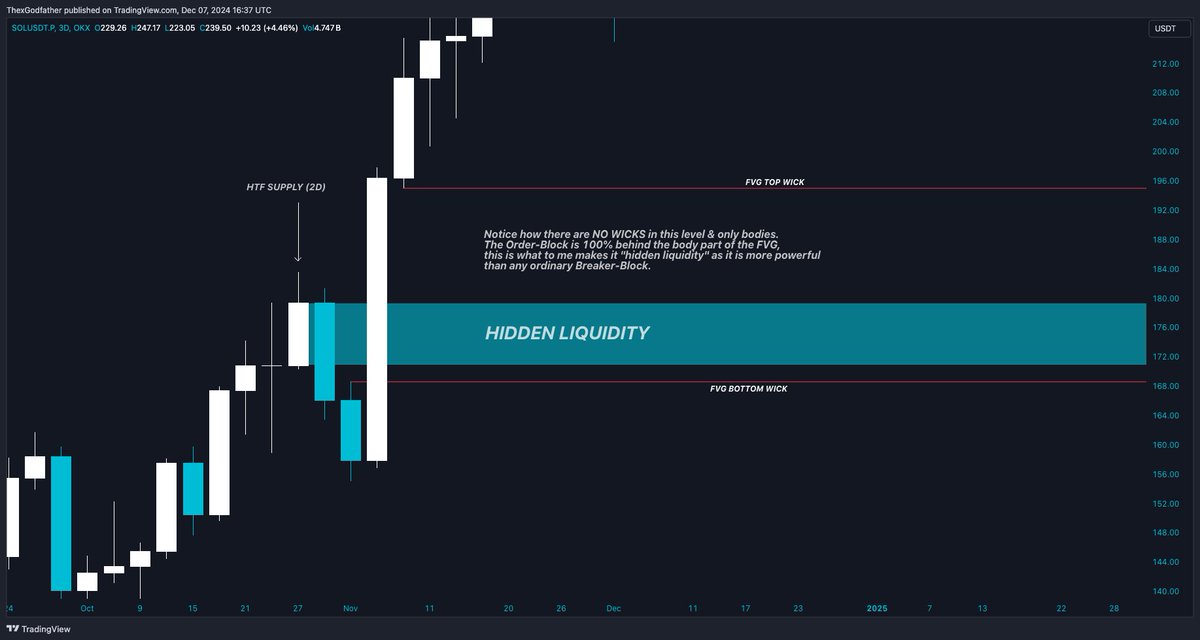
When viewing my charts, it is important to understand I view breakers differently & slightly optimized @Moneytaur_ hidden liquidity concept into my own system. The basic SMC definition of a breaker-block, is simply a broken order-block. It does need any FVG behind it. What MT did, is he took that concept & optimized it to where a breaker-block that is sitting behind a FVG is more powerful than any ordinary SMC/ICT order-block.
I do not take ordinary SMC/ICT breakers into play. I only take MT's advanced breakers & ignore any breaker-block that does not have a FVG in-front of it. But, I also categorize MT breakers & hidden liquidity differently based on how "hidden" the order-block is.
Let's first look at what I consider "Hidden Liquidity". Hidden liquidity, is an order-block that is fully behind the body of a FVG. If you notice in the example I used (2D HOB on Solana), there are NO WICKS in that level. This is the most powerful form of order-blocks & is not widely used by retail. I specifically name this "HOB" and not "BB" for that reason.
Now, for what I consider "Breaker-Blocks". A breaker is an order-block, that is behind a FVG but not 100% behind the body part of the FVG. As long as it is behind the majority of a FVG body, it is still considered powerful, but not as powerful as being fully behind a body like "hidden liquidity". In this example I used (BTC 2D BB), you notice in this level there is not only bodies. The bottom part of the FVG wick, is sitting within the level. Meaning, the Order-Block does not sit behind 100% bodies, but also minority wick.
This also goes for wicks that occur prior to the FVG. If a basic SMC/ICT supply or demand OB becomes taken partially, then later on becomes ignored causing a FVG in-front of it... that is also a breaker. As long as that level, is majority behind a FVG body, it is a worthy breaker. But, that also means it has been tapped outside of the FVG candles making it weaker than untapped breakers.
PS: You do not have to adopt my strategy. I just simply like to categorize fully hidden OBs as "hidden liquidity" and majority hidden OBs as "breakers" to separate them due to one being more powerful than the other in my personal opinion. But, if you are a MT student following my charts, it is important not to get confused by my system vs MT's system.
When you realise the liquidation event was the mid-cycle leverage flush and the drop to 60K was the mid-cycle spot capitulation flush and the deeper bleed on alts was their bear market bottom flush and it all happened whilst BTC was still up +300% from the cycle lows which aligned with the mid-cycle correction point because the whales made all the money from BTC the first half of the cycle and took their profits and nuked the market so alts die harder and the several-year alt holders finally cave in and sell to give the whales sufficient liquidity so they can buy the alts off them for dirt cheap with their BTC, Oil and stock market profits before they approve the clarity act and the mid-cycle correction turns into the usual cycle continuation where whale and institutional interest shifts to altcoins after forcing all hands out which breaks them out of a bear market so they can finally have their long overdue bull runs which will bring them up to parity with BTC for the final phase of the rally where everyone who capitulated will remain in denial and re-enter once they near the top and give the institutions the exit liquidity to dump everything and make even more money and then the really horrible narratives begin which takes us into an actual bear market dot com boom n bust style the worst we’ve ever seen and everyone who capitulated is left holding the bag at the top of the digital/AI/tech bubble as everything bleeds over a long duration of time and the real regulatory framework starts to come into play and the surviving coins fall down to just a handful as utility becomes a true measurement of valuations and then they change their mind about CBDC’s and implement them and then everything becomes tokenised and the new cycle eventually begins as the world begins to shift into a new era of digitalisation.
Before elaborating on it, i'd just say this: people will always have money available at some point, whether every month or every couple of weeks, which means they can always keep gambling. There are people with gambling addiction who have been going to casinos almost daily for years. Crypto is simply a casino disguised as investing, airdrops are the "comps" to keep people playing, which allows many to hide behind the "investor" label while continuing to feed the exact same addiction.
It's not really about how many times the herd will fall for it. It's about how long whales can keep the machine effective enough to extract from them. Not how many mistakes retail can make, but how long the system remains efficient at monetizing those mistakes. As long as enough people still believe, still hope, still think the next cycle will "make it all back" the game can continue. But once enough people learn the hard way, once enough capital is destroyed, once enough trust is gone, the efficiency of the trap declines. There'll be the people who got wrecked for life, and there will be the people who never played the game but is aware of the majority getting wrecked over several years playing the game, thus scared.
And that's when the real strategic question appears: Do whales keep milking the same game with lower efficiency, or do they gradually shift attention to the next shiny object, the next narrative, the next scam large enough to absorb mass hope?
Bitcoin gives them a unique advantage in this regard. With the "last coin mined" roughly a century from now
the dream can technically be kept alive for decades.
That long timeline is not just a feature. It's also the perfect psychological weapon. It allows people to project wealth far into the future, to build life plans around eventual riches to remain emotionally invested for years, sometimes for life. And that's where the trap becomes deeper than price, because now they’re not just holding bags. They're holding identity, belief, future expectations, and the hope that one day all the pain will be justified.
If you think like a whale, why would you rush to end that? Why would you kill a system that can keep people voluntarily attached to the dream for decades?
A dream that keeps them buying, holding, waiting, and explaining away every rug as "part of the cycle"
That's the brilliance of it, not the tech. Not that people lose once, but that they can be conditioned to lose repeatedly while believing they're still on the path to winning. So the real danger isn't that people get rugged once. It's that they spend the rest of their lives planning around a future that never arrives.
What can you use to understand whether crypto cycles will keep playing out?
1] In my opinion, everything changes dramatically once whales turn openly pro-Bitcoin. I said that many times before, and then they did. That matters because by the time whales are publicly bullish, the game is no longer early accumulation, but positioning, narrative control, and distribution into belief.
2] You need to find ways to measure whether there is still enough belief, hope, and deployable capital in the system. Not just money, but money willing to sit through volatility for the promise of insane gains. You also need to ask whether whales are even interested in playing a game where the herd is already poor. If the crowd is too drained, too traumatized, and too broke, the upside of running the same cycle becomes weaker.
Sometimes whales "give away" money first. Incentives, rewards, grants, random pumps, sudden strength across the board. People read that as opportunity, but often it is preparation. They create conditions that make people feel early again, confident again, hopeful again. Then the herd chases, leverage returns, greed comes back, and the rug becomes much more effective. In that sense, the money they "gave" was never kindness. It was bait, or more precisely, a temporary redistribution designed to be reabsorbed later at scale.
It is also important to understand how much whales may have extracted over certain periods, because that tells you how financially comfortable they are, how aggressively they can build in the real world, and how patient they can afford to be before needing another major harvest. They may be extracting constantly through normal market behavior, but that is different from the large extraction events, the real resets, the violent crashes, the moments presented as random when in reality they function as massive wealth transfers.
So the question is not just whether crypto cycles still exist. The real question is whether the ingredients for an effective cycle are still there: enough belief, enough fresh or recycled capital, enough patience from whales, and enough despair in the herd to make them chase the next breadcrumb as if it were salvation.
@Moneytaur_ Hopefully more were saved than the number of those who liked. Sooner or later they will realize this game isn’t about who gets in, it’s about who’s able to get out.
Appreciate you always 🤝