I used to write mostly about crypto.
But the same reflexive market mechanics are now showing up in public markets.
- AI infrastructure
- Memory
- Space
Or simply bitcoin miners pivoting into data centers.
I decided to track the trades where narrative, capital flows and bottlenecks collide into true reflexivity.
(crypto & public markets)
I like this Nemotron prediction because the readthrough goes beyond NVDA model share.
If Nemotron adoption grows inside enterprises, the beneficiaries are the infrastructure providers that can deliver validated NVIDIA AI capacity.
That matters especially for neoclouds with real NVIDIA alignment.
Recently NVIDIA has partnered with multiple neocloud providers.
What if they are building a distributed compute network for enterprises, governments and regulated industries that cannot simply send sensitive data to a generic public API or rely on model supply chains they cannot fully audit.
Everyone is fed up with Anthropic and OpenAI.
NVIDIA has recently be very active & they are doing a lot more than selling GPUs.
They help validate architecture, support supply access, finance deployments, standardize the software stack and route enterprise demand into trusted infrastructure partners.
Enterprise customers need:
- validated security and data governance
- dedicated private AI capacity
- local / sovereign deployment options
- auditable model provenance
Most importantly they don't trust chinese models & don't want to run their own data centers.
This raises the attractivnes of neoclouds.
The winners should be the platforms with NVIDIA supply alignment, power-secured data center capacity and credible enterprise / sovereign distribution.
Neoclouds that come to mind are $IREN, $NBIS and most recently also $SHAZ
If enterprise open-model adoption accelerates, NVIDIA-partnered neoclouds become distribution infrastructure for private AI.
Does this make sense?
Prediction: Nvidia Nemotron's market share will 5-10x from now until end of this year.
Open source AI is having a real moment. Nemotron is best set up to capture it, especially inside large enterprises. It won't show up cleanly on OpenRouter stats or similar leaderboards, because the install will live within on-prem environments.
This is not because Nemotron is the "smartest" model per se. Many other open/close models are "smarter". But it is the most open!
Weights are open. So are pre and post-training data, plus how the model is built. Only other model that is as open is the K2 models from @mbzuai, an academic institution. (See @ArtificialAnlys openness index, an increasingly important chart.)
None of the open source Chinese labs open up beyond just the weights. Many do write great papers to share methodology and innovation. None share the datasets that go into pre/post training.
This data transparency part is becoming increasingly important for large companies, who want to verify the models they deploy are not trained on data that could present security vulnerabilities, then post-train them further with its own data and IP.
Only Nemotron fits the bill. It also has all the hyperscalers plus Palantir as partners to make deploying, post-training, plus continuous improvement on-prem in perpetuity manageable. This is huge undertaking!
Something feels off with memory.
$MU has amazing fundamentals, revenue, profitability.
Every bear-case I research has strong counter arguments, yet the stock doesn't perform.
The Korean stock index corrected, driven by Samsung's fantastic earnings that again weren't enough.
This is not about me being impatient.
It's about realising that a fundamentally strong stock can correct simply due to the fact everyone already owns it.
The crowded trade is the only bear case I can't counter.
The implications are that we will go lower before we go up again and the edge becomes who can stomach enough pain.
Meaning even if the memory bottleneck is the best trade in the market, it might not be enough.
(just some thoughts of mine)
@aleabitoreddit For everyone wondering this is NOT about the speculated deal for IREN / SHAZ.
This deal is about a 401MW data center in Kentucky (US) the leaked documents are about a 1.4GW / 1,400MW deal in Australia.
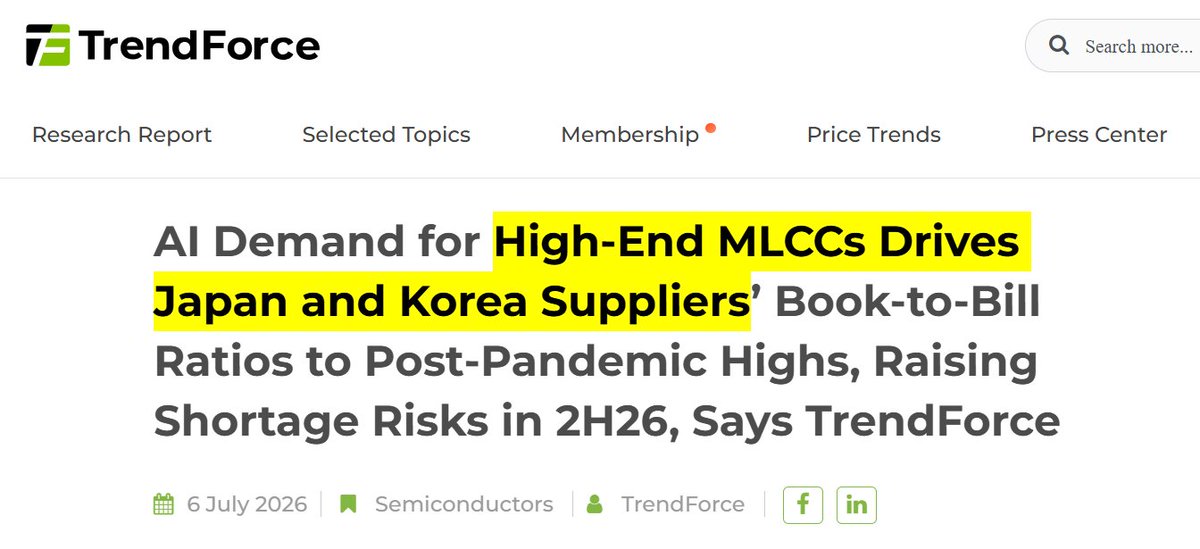
TrendForce reports thatAI demand is now pushing into high-end MLCCs.
According to their latest note, AI server platform upgrades and custom ASIC volume growth are boosting demand for high-end MLCCs.
MLCCs are multilayer ceramic capacitors, small passive components used across server boards, power delivery and signal stability.
By late June, book-to-bill ratios reached:
-> Murata: 1.30
-> Samsung Electro-Mechanics: 1.31
-> Taiyo Yuden: 1.25
A ratio above 1.0 means new orders are exceeding shipments, which usually signals tightening supply.
Overall MLCC book-to-bill reached 1.04.
TrendForce says this raises shortage risk for 2H26.
The interesting part is that AI demand is now pushing into a small component bottleneck.
AI racks pull more than accelerators and memory.
They pull passives, power devices, boards, cooling, optics and networking.
The deeper this cycle goes, the more the bottlenecks move into parts of the supply chain most investors are not watching.
This is what I mean by technological trajectory:
1. ChatGPT came out less than 4 years ago.
2. Reasoning models only became mainstream around 2 years ago.
3. Useful coding agents only became real a little over 1 year ago.
And only now we are starting to see useful agents, long-horizon tasks, long-context windows, continuously running LLMs, useful game asset creation, AI-based drug discovery, autonomously controlled drones and much more.
I think Bloomberg is wrong because they focus almost entirely on the supply side, because it is the easiest part to model.
You arrive at 2028 oversupply when you look at the expected yearly output of each newly announced facility.
But that fails to account for technological progress and exponential demand.
The demand side could massively outperform expectations:
- Useful coding agents only happened a little over a year ago, and there are still many areas where they need to improve. For example, generating sprite sheets for 2D game development.
- Currently, there are only around 10 million active agent users. What happens to HBM demand if that number grows to 100 million in two years?
- Remember when frontier labs stopped working aggressively on video models because they became too computationally expensive to run?
Nobody can imagine what AI capabilities will look like two years from now.
But if I look at the trajectory of this technology, my bet is that demand will grow much faster than anybody expects.
While I understand how Bloomberg arrived at this conclusion, my contrarian view is that there will be no oversupply in 2028.
First, regarding the 2028 figure:
The supply side is easy to calculate because it's known how many wafers each newly built facility will produce in each year.
However, I think the demand side will massively exceed expectations.
- Useful coding agents only happened a little over a year ago; we can't even imagine what the next two years will bring.
- Currently, there are only 10 million active agent users. What if this figure increases to 100 million in two years?
- Remember video models? Frontier models stopped working on them because they were too computationally intensive.
There are various other ways in which demand could vastly outpace supply, but I think you get the idea.
I thought about your comment and I think you are correct. From all the neoclouds $SHAZ has the best risk-reward.
The only push-back I would have is on the SHAZ is pretty much derisked. The main risk I see right now is that the broader AI-Infraspace could further drag down SHAZ.
So even if the price is favorable it could go lower, but you kinda captured this thought by calling it the best risk reward ratio.
Anyways, thanks for the tip!
@tengyanAI@tessara_ai So is Kyber Nvidia's HBM-saving variant? And because of the delays, there won't be any relief for the HBM situation from that new hardware?