Michael Saylor’s Corporate Alchemy: How He Turned a Software Company into a Bitcoin Machine
Most companies hold cash or bonds in their treasury. Strategy (formerly MicroStrategy) does something completely different.
They practice corporate financial alchemy — turning traditional Wall Street capital into permanent Bitcoin ownership.
Here’s how the alchemy actually works:
Main tools:
- Convertible Notes — the core instrument. Often issued with 0% interest and a high conversion premium (30–55% above the current stock price). Investors give Strategy money almost for free in exchange for the option to convert into shares later. Strategy takes that cash and immediately buys Bitcoin. If the stock (and Bitcoin) rises sharply, the notes convert into equity. If not, Strategy simply repays the debt later. They’ve done multiple $1–3 billion issuances in 2024–2025 alone — tens of billions in total.
- ATM Equity Offerings — they sell MSTR and STRC shares in real time on the open market and instantly convert the proceeds into Bitcoin.
Preferred Stock (STRK, STRC, etc.) — another layer of “digital credit” that gives investors Bitcoin exposure without directly buying BTC.
- Preferred Stock (STRK, STRC, etc.) — another layer of “digital credit” that gives investors Bitcoin exposure without directly buying BTC.
Key metrics they invented and push:
- Bitcoin per Share (BPS) — how much Bitcoin each share effectively owns (the main goal is to keep increasing it).
- BTC Yield — the percentage growth of BPS over time (they’ve shown double-digit yields in recent periods).
- BTC Gain / BTC $ Gain — how much value they’ve added to shareholders.
The self-reinforcing cycle:
1. Issue convertible notes or shares at a premium.
2. Receive cash.
3. Buy Bitcoin.
4. Bitcoin rises → Strategy stock rises → easier and cheaper to raise even more capital → buy even more Bitcoin → cycle repeats.
Saylor openly calls this financial engineering. It’s a reflexive loop: demand for their Bitcoin-linked instruments fuels both Bitcoin and their stock price.
The risks (being honest):
- Massive debt load (billions in convertible notes).
- Shareholder dilution from constant equity issuance.
- Heavy dependence on market sentiment — a prolonged Bitcoin bear market makes refinancing difficult.
- In 2026 they even started doing small Bitcoin sales (like the 32 BTC recently) and note buybacks to actively manage the balance sheet.
This is real alchemy: taking “cheap” capital from traditional markets and converting it into permanent ownership of the hardest asset in history — Bitcoin — which they believe will keep growing for decades.
What do you think — is this sustainable long-term financial engineering, or is it just leveraged speculation that will eventually blow up?
How Joseph Jagger Won the Casino Using Bias – And How to Apply It to Polymarket
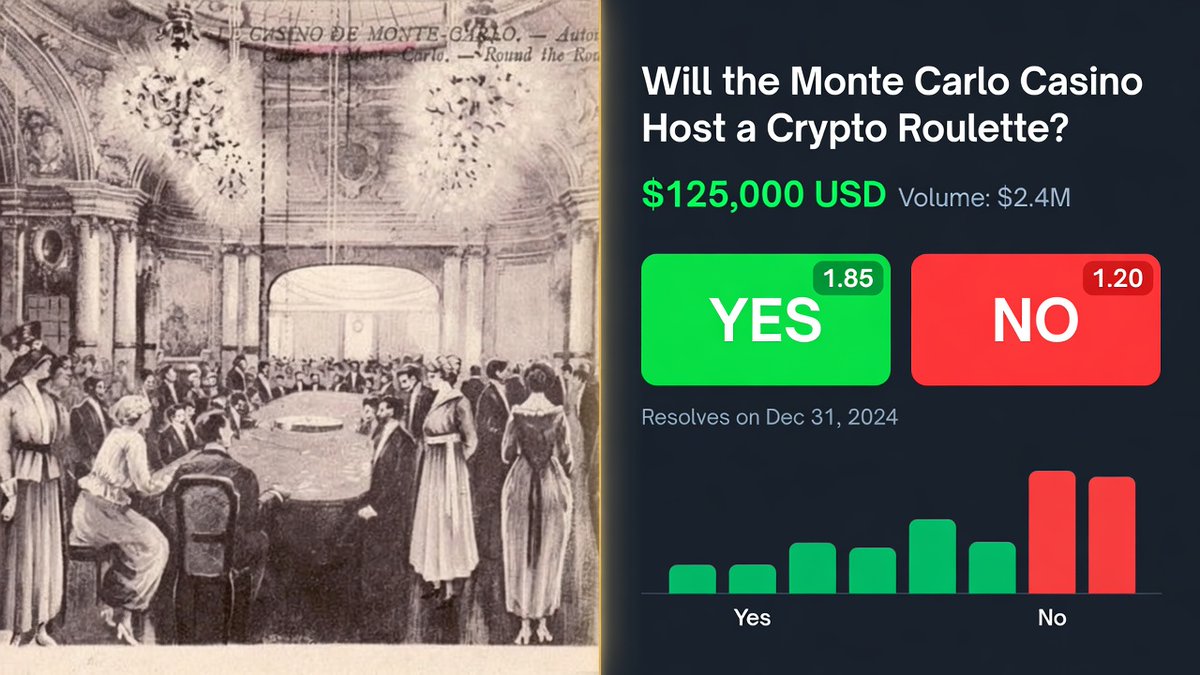
In 1881, a humble Yorkshire textile engineer walked into the Casino de Monte-Carlo and broke the bank — not once, but multiple times. He didn’t cheat. He didn’t rely on luck. He simply discovered and exploited a hidden bias in the roulette wheel.
His name was Joseph Jagger, and his story offers one of the clearest lessons in advantage gambling that still applies today — especially on modern prediction markets like Polymarket.
The Mechanical Bias That Made Millions
Jagger spent his life working with spinning machinery. He knew one simple truth: no wheel is ever perfectly balanced. There is always some tiny defect — a slightly worn bearing, a minor tilt, or manufacturing imperfection — that creates a statistical edge.
He traveled to Monte Carlo with a small team of six clerks. For days they recorded every single spin on all the roulette tables. After analyzing thousands of results, they found exactly what Jagger suspected:
One specific wheel had a clear bias. Nine numbers came up significantly more often than probability allowed:
7, 8, 9, 17, 18, 19, 22, 28, 29
These numbers appeared roughly 28% more frequently than they should have in a fair game. That small mechanical flaw gave Jagger a real mathematical edge (estimated 5–15%+).
He started betting heavily only on those nine numbers. In just a few days he won the equivalent of $7–15 million in today’s money. The casino was forced to “break the bank” (cover the table with a black cloth) multiple times.
Jagger didn’t fight the house. He found where the house was imperfect — and attacked only there.
The Core Lesson: Markets Are Never Perfect
Casinos, like all markets, pretend to be efficient and random. But they never are. There is always bias — mechanical, psychological, or structural.
This is exactly where smart players find their edge.
Applying Jagger’s Method to Polymarket (Yes/No Markets)
Polymarket is a prediction market where people bet real money on Yes/No outcomes. The prices reflect crowd probabilities, but the “wheel” is far from perfect.
Here’s how to apply Jagger’s bias-hunting strategy today:
1. Hunt for mispriced markets (your “biased wheel”)
Look for outcomes where the crowd price differs from your own researched probability by 5–10% or more.
2. Focus on Bitcoin & Crypto
Crypto markets on Polymarket are especially fertile because of high volatility, FOMO/fear, and recency bias.
3. Common Biases to Exploit:
- Recency bias (after big moves, people overprice continuation)
- Herd behavior in popular markets
- Liquidity gaps in quieter markets
- Cross-market mispricing
Bitcoin Example:
If “Will Bitcoin hit $200k in 2026?” trades at 35¢ but your analysis says ~48% — that’s your edge. Buy Yes aggressively, just like Jagger bet only on his nine biased numbers.
Final Punch
Joseph Jagger didn’t predict the future. He measured reality better than the casino.
The same opportunity exists on Polymarket right now. Find the crooked wheels.
Start collecting data. Bet only where you have a real edge.
The man who broke Monte Carlo didn’t play the game better — he found where the game was broken.
Now it’s your turn.
Edmond Dantès spent 14 years trapped in the Château d'If, isolated from the rest of the world by stone walls and https://t.co/tomvYerW9C, millions face digital isolation.
Geo-blocking, content restrictions, and local censorship act as modern stone walls, deciding what you can read, watch, or learn based purely on your location.
You don't need a 14-year escape plan.
A VPN is your tunnel through the digital walls, granting you the ultimate freedom to access the global web instantly. 🗺️
[Link in the replies ↓]
@coinbureau Ah yes, bringing TradFi compliance to the Wild West of crypto. Standardized gold tokens are just centralized stables with extra steps and counterparty risk
NORTH CAROLINA IS JOINING THE BTC ELITE. 🇺🇸🚀
A new bill to establish a STRATEGIC BITCOIN RESERVE is officially on the table. While the Fed prints paper, NC is stacking hard assets.
THE SOVEREIGN HODL HAS BEGUN. WHO’S NEXT IN THE ARMS RACE? 👁️💼
@coinbureau Surged is a funny word for retail rushing for the exits. BlackRock capping withdrawals just means someone forgot to delta hedge the coming black swan
@coinbureau Regulatory framework just means more centralized points of failure in a degen casino. Expect governance front-running and political black swans disrupting your precious stablecoin pegs soon enough
🚀 READY TO RIDE THE POLYMARKET WAVE? 💎
I’ve created a COPYTRADING SYSTEM that follows ONLY the most PROFITABLE wallets!
Get ready to MAXIMIZE your gains with $POLY! This is the future of trading! 🔥
@BullTheoryio Might be is doing heavy lifting for a $10T AUM fund. This is a textbook example of how narratives create liquidity gaps, not the other way around






![cryptosuka_'s tweet photo. Edmond Dantès spent 14 years trapped in the Château d'If, isolated from the rest of the world by stone walls and https://t.co/tomvYerW9C, millions face digital isolation.
Geo-blocking, content restrictions, and local censorship act as modern stone walls, deciding what you can read, watch, or learn based purely on your location.
You don't need a 14-year escape plan.
A VPN is your tunnel through the digital walls, granting you the ultimate freedom to access the global web instantly. 🗺️
[Link in the replies ↓]](https://pbs.twimg.com/media/HJbES0RXwAAoUly.png)


