Most AI agents are still working off training data or manually pasted context.
Now, any onchain dataset indexed on The Graph Network, DeFi protocols, NFT activity, governance data, identity, gaming, can be wired into an AI assistant as a live, queryable tool in an afternoon.
The question stops being "how do I get this data into the AI?" and starts being "what do I want the AI to do with it?"
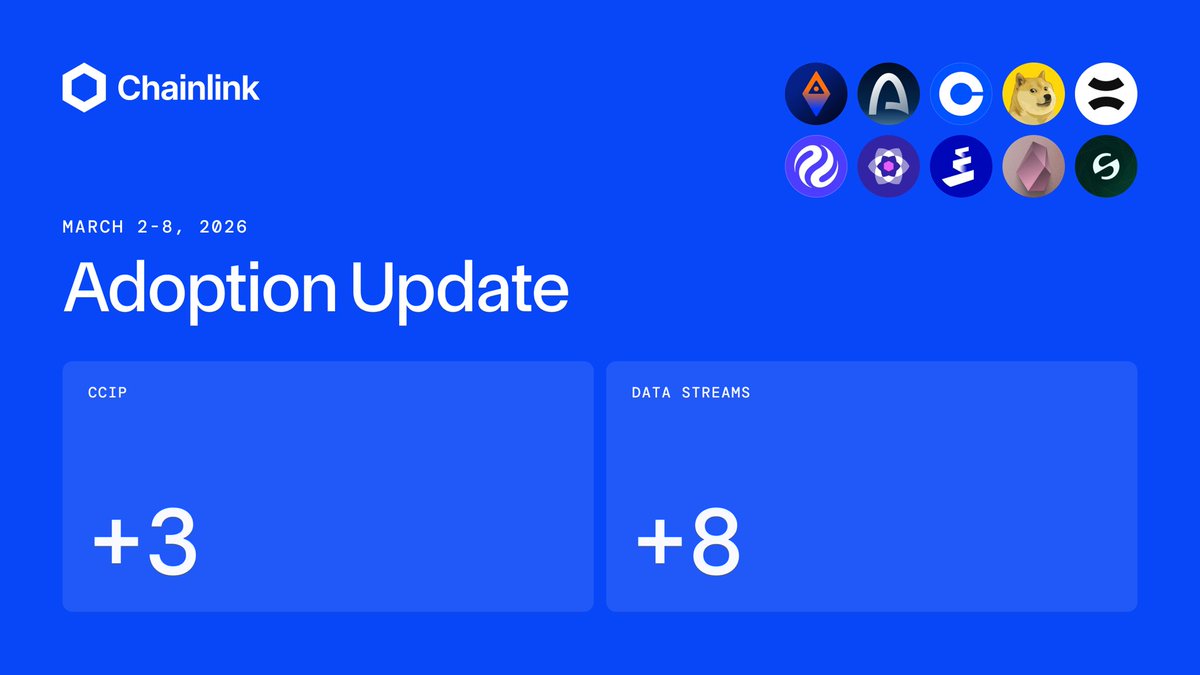
Chainlink Adoption Update ⬡
This week, there were 11 integrations of the Chainlink standard across 2 services and 11 different chains: ADI Chain, Arc, Base, DogeOS Chikyu, GIWA Sepolia, Injective EVM, Monad, Perennial, Pharos, Seismic, and Stable.
New integrations include @ADIChain_, @arc, @coinbase, @DogeOS, GIWA Sepolia, @injective, @perenniallabs, @pharos_network, @SeismicSys, and @Stable.
LINK everything.
🚨 FIVE BILLION DOLLAR LIQUIDITY PIPELINE UNLOCKED.
Chainlink CCIP is officially deployed to bridge Coinbase cbBTC directly to MONAD.
They are unlocking a potential $5B pipeline for pure BITCOIN backed liquidity.
The oracle layer is eating the entire market.
.@tempo’s Moderato and Mainnet are now indexable with The Graph’s Subgraphs. Developers building on Tempo can now transform raw onchain data into clean, queryable GraphQL APIs — no custom infrastructure required
Composability is DeFi's superpower, but composability requires shared data infrastructure. Protocols need to read each other's state. Applications need consistent APIs.
The Graph makes that possible at scale.
x402 has a gas problem. If an agent pays $0.0001 for a data query but network fees are $0.05, the economics break.
GraphTally (the micropayment system from The Graph) solved this by introducing cryptographically signed vouchers that settle in batches onchain later.
Agents can now make thousands of queries per minute without gas fees blocking every microtransaction. This same innovation has contributed to the x402 specification, making it viable for blockchain use cases.
The result: agents can pay for Subgraph queries using x402, transforming The Graph into a data marketplace for the agent economy
Last time it was: “ToKeN nOt NeEdeD”
This time it is:
“Are $LINK holders just funding Chainlink Labs salaries?”
Every couple of years, the FUD around Tokenomics comes around, and ngl, it does get in your head a bit even if you understand.
But I actually think a lot of it comes from people trying to put Chainlink into a category it doesn’t fit into.
It’s not an L1 like $ETH or $SOL.
It’s not a memecoin where price = attention.
And it’s not equity in Chainlink Labs.
Chainlink is infrastructure.
And infrastructure always looks weird early.
Yes, CLL held a large treasury and yes, they sold tokens over the years.
On the surface that looks like dilution.
But what they were actually doing was bootstrapping a network before it had users.
Every major network in history had this phase.
Credit cards had to convince merchants before customers used them.
Cloud providers had to subsidise adoption before companies migrated.
Even the internet existed before real activity showed up.
My favourite analogy, though, is railroads.
In the 1800s, railroad companies built thousands of kilometres of track before there were enough passengers and freight to justify it.
For years, it looked like capital destruction.
Investors thought they were burning money paying workers to lay tracks into empty land.
But the tracks had to exist before the economy could run on them.
Cities formed because the railways were already there. Trade scaled because transport existed first.
Chainlink is doing the same for digital assets.
Chainlink needed:
• node operators
• security research
• integrations
• and institutions experimenting with on-chain finance
before there was any real transaction volume to charge for.
So LINK hasn’t been to fund CLL, it was funding the creation of a network.
LINK is not ownership in Chainlink Labs.
It’s the security backing inside the protocol.
With staking, node operators lock LINK as security.
With CCIP, cross-chain transactions are secured by that staked collateral.
And institutions don’t even need to buy LINK, they can pay in fiat or stables, which the protocol then purchases LINK to pay operators.
That flips the normal crypto model.
Most tokens rely on speculation first and hope usage follows.
Chainlink is having usage create demand.
So the real question isn’t “are they selling tokens?”
The real question is: if TradFi moves on-chain, what connects blockchains to banks?
Instos can’t just rely on “trust me.”
There has to be a security layer backing the system, and that security needs collateral.
LINK is the collateral.
That’s the thesis.
The biggest risk in my view and the risk that has many of you stressin, is timing.
Financial infrastructure moves slowly, and markets price narratives a lot faster than they price infrastructure.
Chainlink is plumbing.
And plumbing always looks unexciting, right until everything starts running through it.
@ArjenRobijn Laat helder zijn ben het niet eens met deze ontwikkeling en vind het schandalig maar kan iemand mij vertellen waarom de politiek dit nodig vindt? Wat zijn de argumenten om deze wet in te voeren.
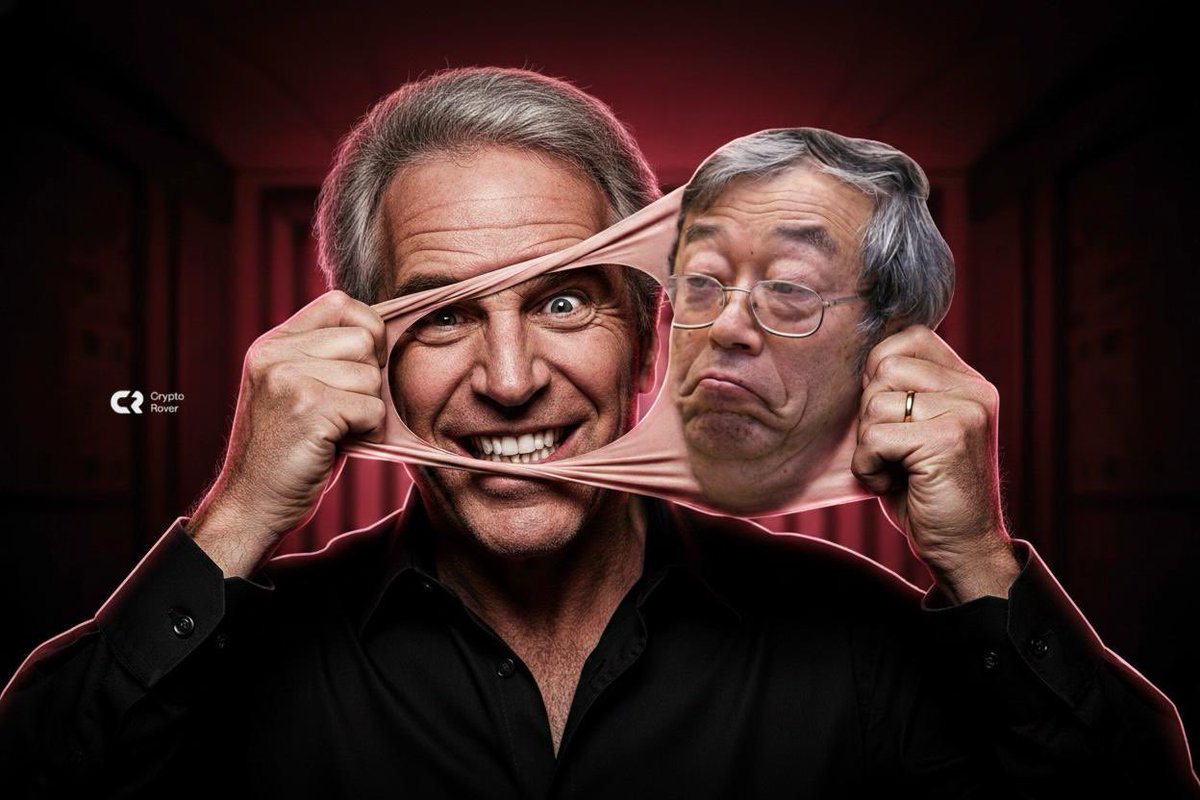
🚨 EPSTEIN IS SATOSHI NAKAMOTO?
This theory is the final boss of Bitcoin FUD.
It sounds insane enough to feel believable. But once you slow down and check actual records, it falls apart.
Start with the timeline.
Satoshi released the Bitcoin whitepaper in 2008 and was coding nonstop through 2009 and 2010.
During that same period, Epstein was either in jail or under strict state supervision in Florida. He was not secretly operating as the most disciplined anonymous cryptographer in the world.
Now the MIT funding claim.
Yes, Epstein donated to the MIT Media Lab. Yes, his name was hidden under an alias.
There is zero evidence that any of his money went to Bitcoin development or the Digital Currency Initiative. The DCI was funded later by people like Reid Hoffman and Fred Wilson after the Bitcoin Foundation collapsed.
Epstein was chasing prestige, not building Bitcoin.
Then come the emails.
In 2014 and again in 2018, Epstein was emailing Peter Thiel and Steve Bannon asking basic questions about crypto. Regulation. Taxes. Distribution.
If he were Satoshi, he would not be asking for beginner explanations ten years later. He was trying to understand the technology, not explaining it.
The networking argument also fails.
Yes, Epstein met people like Brock Pierce and Larry Summers. That was his entire pattern. Insert himself into emerging fields once they were already hot.
Meeting early Bitcoin figures in 2014 does not make you the creator. It makes you late.
Others point to contact books and travel logs as proof. Epstein collected names to inflate his importance. Being listed does not equal a secret partnership.
Epstein had no history of C++ coding. No cypherpunk writing. No early work aligned with Bitcoin’s philosophy.
What he did have was a habit of showing up late to powerful ideas, looking for leverage and ways to move money.
Now the part that really blows my mind.
I cannot believe people are selling Bitcoin because they think Epstein was Satoshi.
If that makes you panic sell, you never understood Bitcoin in the first place.
Even if the worst person on earth created Bitcoin, it would not change what Bitcoin is.
Bitcoin is open-source. Decentralized. Permissionless. It does not belong to a founder, a company, or a personality.
It exists to protect people from monetary debasement and to enable free ownership and exchange of value, regardless of identity, borders, or beliefs.
Who created it does not control it.
Who created it cannot change it.
Who created it is irrelevant.
And if an unproven theory about a dead man is enough to make you dump your BTC…
You were never a Bitcoin holder in the first place.
2025? Crypto’s horror movie sequel – crashes, scams, and more plot twists than a soap opera! 😩💥 Hibernating till 2030, skipping ’26-‘29 ‘cause they’ll be the bad remakes. But for real, we need better regs or it’s game over for all. #CryptoWinter
GOLD CANNOT PROVE IT IS GOLD
Yesterday in Dubai, Peter Schiff held a gold bar on stage.
CZ asked one question: “Is it real?”
Schiff’s answer: “I don’t know.”
The London Bullion Market Association confirms there is only one method to verify gold with 100% certainty: fire assaying. You must melt it. Destroy it to prove it.
Bitcoin verifies itself in seconds. No experts. No labs. No destruction. A public ledger secured by mathematics that 300 million people can audit simultaneously from anywhere on Earth.
For 5,000 years, gold’s scarcity was its value proposition. But scarcity means nothing if authenticity cannot be proven.
The numbers no one is discussing:
Gold counterfeiting affects 5 to 10 percent of global physical markets. Every vault, every bar, every transaction requires trust in someone.
Bitcoin requires trust in no one.
Gold market cap: $29 trillion built on “trust me.”
Bitcoin market cap: $1.8 trillion built on “verify it yourself.”
This is not speculation versus stability. This is the 21st century verification cost inversion.
When the world’s most famous gold advocate cannot authenticate gold in his own hands, the thesis writes itself.
Physical assets that cannot prove their own existence will lose monetary premium to digital assets that prove themselves every ten minutes, every block, forever.
The question is no longer “Is Bitcoin real money?”
The question is: “Was gold ever verifiable money?”
Watch institutional flows. The reallocation has begun.
What you witnessed yesterday was not a debate.
It was a funeral.