THREAD: The Kaspa Moment No One Is Ready For
(A breakdown of why $KAS may be the most important L1 of the next decade.)
1/
Most people still think Kaspa is “just a fast PoW chain.”
It’s not.
After reading the vProgs Yellow Paper, it’s clear that Kaspa is building something the entire industry has been trying—and failing—to deliver:
A sovereign ZK execution layer directly on L1.
⸻
2/
Ethereum is powerful.
Solana is fast.
Rollups are clever.
But none of them solve the “holy trinity”:
•Sovereignty
•Synchronous composability
•ZK verifiability
Kaspa does — in one architecture.
⸻
3/
What are vProgs?
Think of them as:
➡ mini sovereign blockchains
➡ running inside a faster L1
➡ each with its own rules, gas model, and prover set
➡ but all sharing Kaspa’s 1-sec PoW finality
This has NEVER existed before.
⸻
4/
Every vProg is sovereign.
Every vProg is ZK-verifiable.
Every vProg can synchronously call any other vProg.
That solves what Ethereum rollups break:
fragmentation.
delayed state.
sequencer centralization.
Kaspa keeps synchronous composability without sacrificing sovereignty.
⸻
5/
Kaspa becomes the L1 sequencer for an infinite number of ZK applications.
Not an L2.
Not a rollup.
Not a sidechain.
A true L1 ZK compute backbone.
This places Kaspa in the same category as:
•AWS for compute
•Nvidia for AI
•ETH for DeFi
But with PoW-level neutrality.
⸻
6/
Gas model breakthrough
Kaspa introduces two forms of gas:
•L2 Gas (internal execution)
•ScopeGas (impact on other applications)
ScopeGas enforces fairness and prevents DoS attacks on other apps.
This means:
No more “one heavy dApp kills the chain.”
(Yes, I’m looking at you, monolithic L1s.)
⸻
7/
Prover economy = new mining economy
vProgs require ZK provers.
Provers must:
•stake KAS
•earn fees
•perform proofs
•compete in an open market
Kaspa creates the first open ZK prover economy, powered by PoW finality.
This changes everything.
⸻
8/
Rollups? L2s? Sidechains?
All become obsolete if Kaspa’s model works.
Why?
Because vProgs provide:
•L2 flexibility
•L1 security
•ZK verifiability
•synchronous composability
•no sequencer corruption
•no MEV extraction
That’s the endgame design everyone wanted.
⸻
9/
Now let’s talk real-world impact.
ZK compute is not a fad.
It’s the core of:
•AI verification
•digital identity
•financial compliance
•CBDCs
•supply chain proofs
•cross-border settlements
•IoT trust networks
•machine-to-machine payments
These industries are trillion-dollar sectors.
Kaspa is positioning itself to be the global verifier layer.
⸻
10/
Institutions are already circling.
In December:
•HashDag presents Kaspa at a major London conference (banks, Microsoft, Google, Citi, HSBC, Deutsche Bank).
•Sutton is recognized as a top “crypto advocate.”
•Binance Blockchain Week follows immediately after.
This is NOT random timing.
⸻
11/
And then you have Wallet #1.
An entity accumulating over 1.2 BILLION KAS.
No selling.
No CEX rotation.
No panic.
No speculation pattern.
This looks like:
•ZK research entity
•AI × blockchain R&D fund
•sovereign institutional fund
•or stealth tech infrastructure investor
You don’t buy 1.2B KAS for a 30% swing.
You buy it for a 10-year infrastructure play.
⸻
12/
The entire ZK sector is moving toward:
•ultra-fast verification
•neutral base layers
•composable multi-chain compute
•real-time cross-application calls
•trustless global settlement
Kaspa is the ONLY PoW chain designed to handle ZK verification at scale.
This is why the right people are paying attention.
$kas
@binance,
Thanks for including me in the top 100 blockchain people list, appreciate the signal!
I must decline the Dubai invite though. I do not wish to disrespect, but many of the award voters are avid kaspians who rooted for my kaspa status at least as much as for my research. Let them win or count me out.
Crypto has turned from a euphoric cypherpunk project to a house-friendly casino. You may not be the culprit, but as a top player you hold the lion’s share of the responsibility to correct this, and the October crash your USDe oracle glitch helped trigger adds to what needs to be addressed.
There are three classes of crypto, as @mert put it recently: commercial crypto, casino crypto, cypherpunk crypto. <<Binance should hold a privilege policy for the latter.>> A TBTF CEX should know better and play a different game with hardcore crypto projects.
When binance lists a green frog three weeks post its “launch” but skips a fair-launched-Nakamoto-Consensus-100ms-upgrade-ATH-top-20-the-only-nonbitcoin-marathon-mined project, this is not merely binance rationally calculating; it is also binance molding the market in a way that is alas misaligned with the roots of the movement.
You may feel that kaspa’s sovereign money thesis is boring – that bitcoin is already money and that implementing an internet-speed bitcoin is useless - fine. Wrong but fine. But what’s the thesis for the green frog?
Money is a classic chicken-and-egg product. It is a scam up until one moment before tipping point, “most of the value comes from the value that others place in it.” Considering your resources and influence, I think it's safe to say you can serve as both the egg and the chicken and make it worth your while to push sound attempts towards tipping point.
@cz_binance tweeted recently that “strong projects will be listed.” But binance is part of what defines "strong", it bears responsibility for the market’s compass and impulse and definition of strong. It is not a read-only entity.
Binance listing fees are legit, they are just unfit for category cypherpunk. Kaspa devs and early supporters fairly mined less than half what satoshi and hals mined. We don’t have a 20% ZEC-style founders’ reward or protocol-enforced dev fund; this is not a jab at ZEC and the wonderful @Zooko, who was crashing in my car on a late Thursday back in the low ZEC MC days – if somebody deserves to win it is zooko – but assuming binance is not taking a maxi bet, it should revisit its relationship with hardcore crypto.
We are here through bull and bear, ICOs NFTs XYZs; and we are the source of confidence that restores faith and capital inflow post meme-induced or CEX-induced crashes.
Please fix this.
Thanks again,
hashdag
cc @michaelsuttonil
Exhibit A: Binance Innovation Zone
Exhibit B: 10 bps Nakamoto Consensus
We didn’t build @PACT_SWAP to chase trends.
We built it because cross-chain trading felt broken - slow, expensive, and full of trust assumptions most people never signed up for.
So we tried something different.
Native $BTC supported. No bridges. No wrappers.
Just smart contracts, short-term collateral, and a system that actually works.
Best part? CEX-level fees on a fully trustless DEX.
It’s not hype. It’s not perfect. But it’s real. And it’s live.
If you’ve ever wished DeFi felt simpler, safer, and more secure - try @PACT_SWAP today.
Let’s talk about interoperability - and why bragging about TVL in bridges might actually be a red flag 🚩.
In traditional DeFi, TVL is often used as a success metric. The more money a protocol holds, the more traction it supposedly has.
BUT... when it comes to interoperability - connecting different blockchains - that logic starts to fall apart.
Why?
Because the way most interoperability protocols work today is by replicating consensus. They build entirely new systems of validators to “watch” what’s happening on different blockchains, agree on it, and move tokens across.
To keep these systems secure, they have to lock up huge amounts of capital - sometimes more than 100x the value of what’s actually being transferred.
This means two things:
1. They're expensive 💸
Many bridges spend millions of dollars per month just to pay validators to maintain their security models. That’s money going into infrastructure that shouldn’t be needed in the first place.
2. They're risky 🥷
The more money you lock up in one place, the more attractive it becomes to hackers. In 2022 alone, bridge hacks accounted for the vast majority of crypto exploits - over $2B stolen. These systems create a single point of failure in an ecosystem that’s supposed to be decentralized.
So when a project brags about high TVL in their bridge, what they’re really saying is:
“Look how much capital we have at risk just to keep this thing working.”
Now imagine a different approach.
What if we didn’t need extra consensus layers?
What if we could move information and value across chains without locking up funds or paying a validator army to maintain trust?
That’s where $CWEB comes in.
Coinweb uses deterministic logic instead of trust-based consensus. It doesn’t need to “agree” on what happened - it proves it using data that’s already public and final on the connected blockchains.
Instead of copying consensus, Coinweb reacts to what’s already confirmed. No oracles, no bridges, no duplicated validation.
This model is cheaper, safer, and far more scalable.
So next time someone flexes their TVL in a cross-chain protocol, ask them:
“Why does your system need that much capital just to function?”
Because in a truly efficient design, security doesn’t have to be expensive. It just has to be smart.
Do you agree?
P.S. Thank you
for watching over us and teaching us these things.
Blockchain's endgame?
Executing collective intelligence to build the ultimate adapting blockchain.
With the:
- Decentralization of $BTC,
- Smart Contracts of $ETH,
- formal rigor of $ADA,
- anonymity of $XMR
- interoperability of $DOT and AI empowerment of $QUBIC / $TAO.
Big Tech built AI on your data.
We built AI to protect it.
At Thought, every data point is its own encrypted agent…
self-aware, self-defending, and traceable from origin to end-of-life.
Engineered by cybersecurity experts.
Powered by blockchain.
Zero guesswork. Zero compromise.
Every Thought is protected.
https://t.co/miLHu9r5Bt
@seeksahib Sounds a lot like what @CoinwebOfficial is doing. Price is very much down, but they build a crosschain infrastructure layer for real adoption and scalability. Very much focused on building something that could change the industry and facilitate mass adoption.
Most chains are decentralised at the base layer, but everything users actually touch is often the opposite.
Bridges, wallets, DeFi, NFTs riddled with upgradeable contracts and backdoors. That’s not censorship-resistance. That’s liability with a pretty UI.
The real challenge isn’t just decentralising consensus, it’s decentralising control across the full stack.
Watching @CoinwebOfficial closely. Deterministic infra that doesn’t outsource trust might be the only path to a truly permissionless future.
Bridges are bandaids.
@PACT_SWAP is surgery.
Bridges:
🚧 Lock funds
👥 Need validators
⚠️ Get hacked
PACT:
🔐 Funds stay native
🤖 Logic lives in smart contracts
💣 Collateral ensures fairness
🧠 #Coinweb powers deterministic proof
This is what cross-chain should look like.
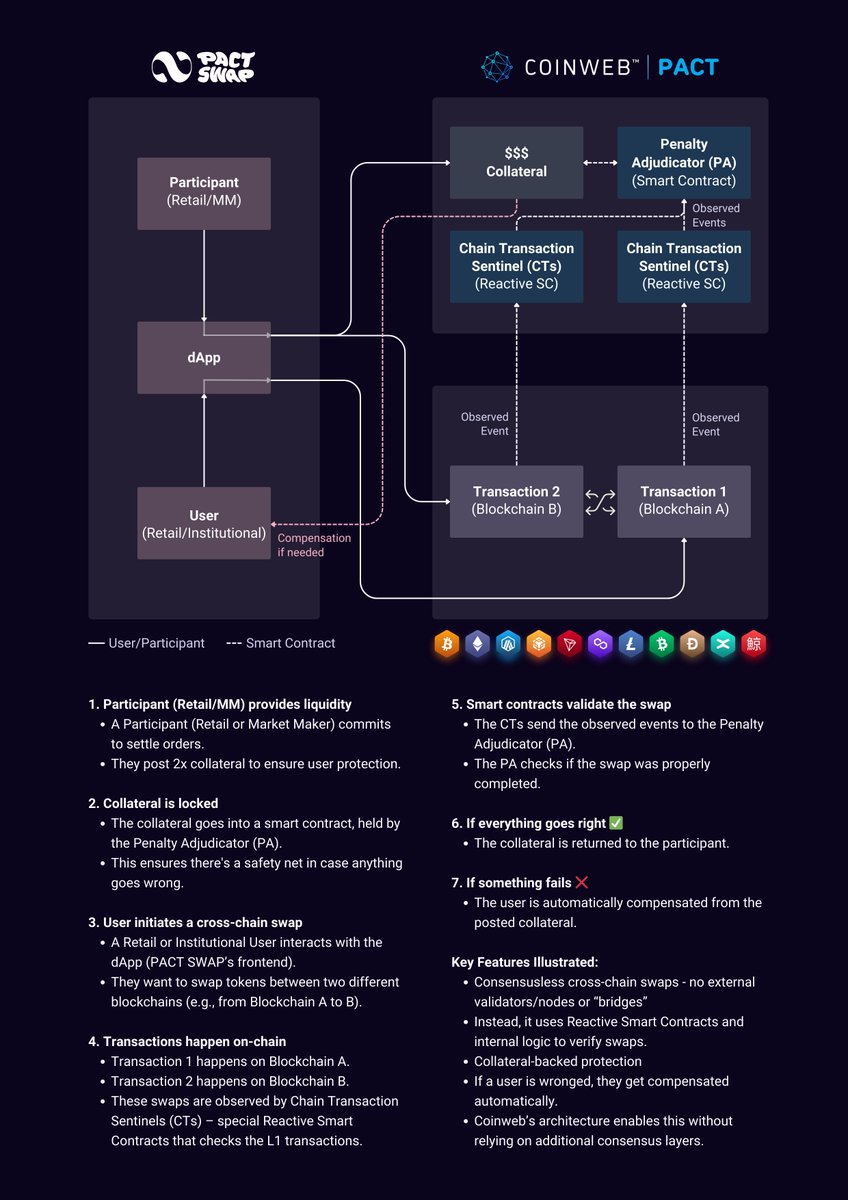
How do you build a truly trustless cross-chain DEX without the need for a blockchain between blockchains?
The answer lies in the PACT Interop Framework.
Instead of relying on staked validator sets to confirm cross-chain transactions (like most bridges do), PACT leverages deterministic proofs from the source chain, verifiable by anyone, anytime, on-chain.
That’s how PACT SWAP enables secure cross-chain swaps without trusting external parties.
Welcome to the next generation of DeFi.
ELI5 👇👇