“do things that don’t scale”
for us, that's giving customers a whatsapp group where they can text us.
in our onboarding data, users we helped get started were nearly 6x as likely to come back in week two and 8x as likely to pay. i want to see how long we can keep that direct line open as we grow.
the other day a customer dragged a pdf into idem and only the icon went through. second try worked. would you fill out a support form for that? i probably wouldn’t. they dropped a screenshot in whatsapp.
that’s why i love these groups. people tell us about the little things, and when we ask what they were trying to do, they actually answer.
i'm terrible at remembering what came out of every conversation.
idem checks the groups every hour during the day. a bug report or feature request becomes a linear task with the context from the chat. if there’s already a task, idem adds the new details there.
the coolest part is what happens when we ship. idem finds the original chat and drafts a reply for me to approve. someone can get a “hey, we fixed that thing you showed us” weeks later without having to ask twice.
if you’re here from yesterday’s post, i’m césar. i’m building @tryidem and i’m gonna share how i actually use a personal agent to run the company.
I was cooking yesterday and finishing some work using Idems live voice feature
There is still some rough edges to polish like approving/discarding approval cards with voice, but once that’s sorted out its going to be surreal
I am a huge proponent of the idea that you need to be practicing a language every single day to get good.
One of the way's I do that is that I have my idem prepare daily fun reading challenges with my new vocabulary because I detest doing flashcards every day.
Since I give my idem all the context of my Chinese lessons it is super good at showing me the words I need to learn. This is one of the biggest game-changers for language learners.
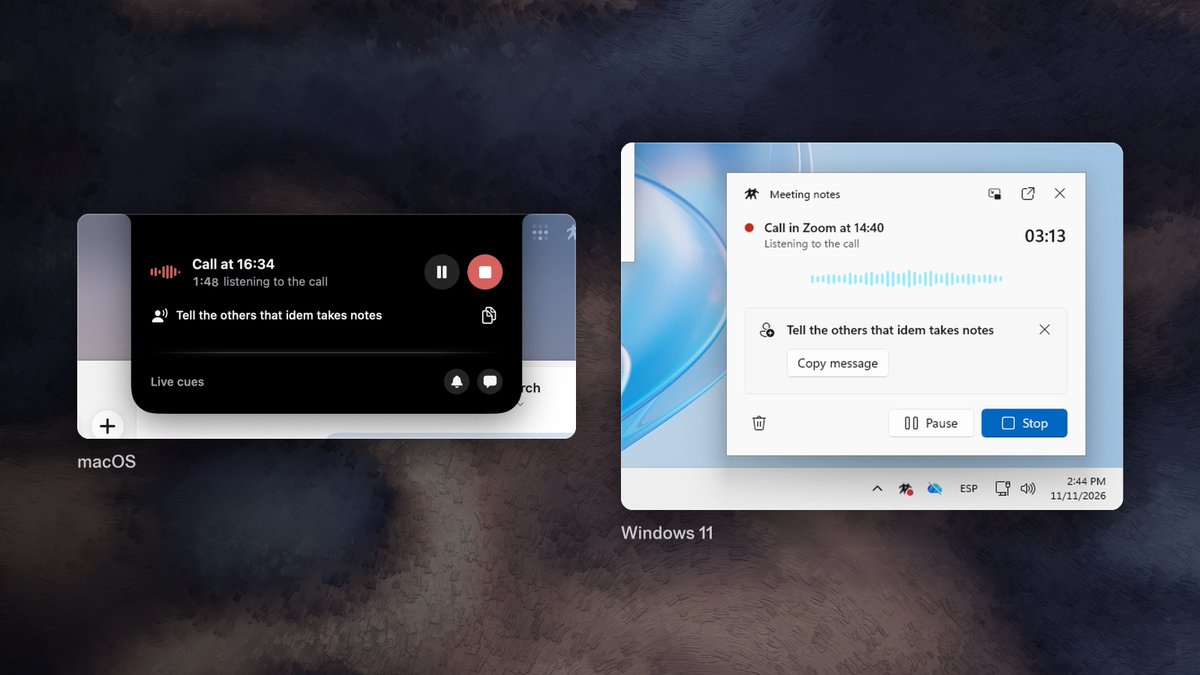
Yeah, we want to give the best experience to the user, and that experience is different depending on the OS… It should feel like it belongs to the system you’re already using.
Each client is its own, all completely independent, built from scratch woth native frameworks and components: Swift for macOS and iOS, Kotlin for Android and .NET for Windows
Only thing shared, code-wise, is the backend
We are building the same app for both macOS and Windows, but we want to keep each OS native design language.
Turns out, it's harder than we thought! Both OS solve the same problem in different ways, and not all can be translated 1:1
Here are a few challenges we had to face 🧵
exploring more ambient ai
every day i feel a little more like some kind of commander, just giving out orders and watching things happen without being too involved in the process… tasks getting done, groceries being delivered, apartment viewings appearing in my calendar
it’s macOS!
its what we started with and what we daily drive ourselves
then came Android, and now Windows
However, now that the Windows client is almost complete, all features are being implemented with each client in mind, for the most part. We also include some OS-specific features, for all OS, just because others dont support it but its still a great feature
a lot of people ask me why idem doesn't have a web ui
delivering the best user experience means we have to build native apps for every operating system
especially when our vision points at ambient ai rather than just another chatbot
this is how we're thinking about it
Our rule of thumb is pretty simple though: whenever we weren't sure how something should work on Windows, we looked at what Microsoft's own apps do (Settings, Photos, PowerToys) and just... did the same
Shortcuts weren't a simple ⌘ → Ctrl swap either.
Alt+Space already opens the window menu on Windows, so New chat is Ctrl+Alt+Space instead of ⌥Space. And Ctrl+S means Save, so hiding the sidebar is Ctrl+B instead of ⌘S.