Happy Pythagorean Triple Square Day!
Today’s date is made of 3 perfect squares and they form a Pythagorean triple: 3² + 4² = 5²
This only happens once a century.
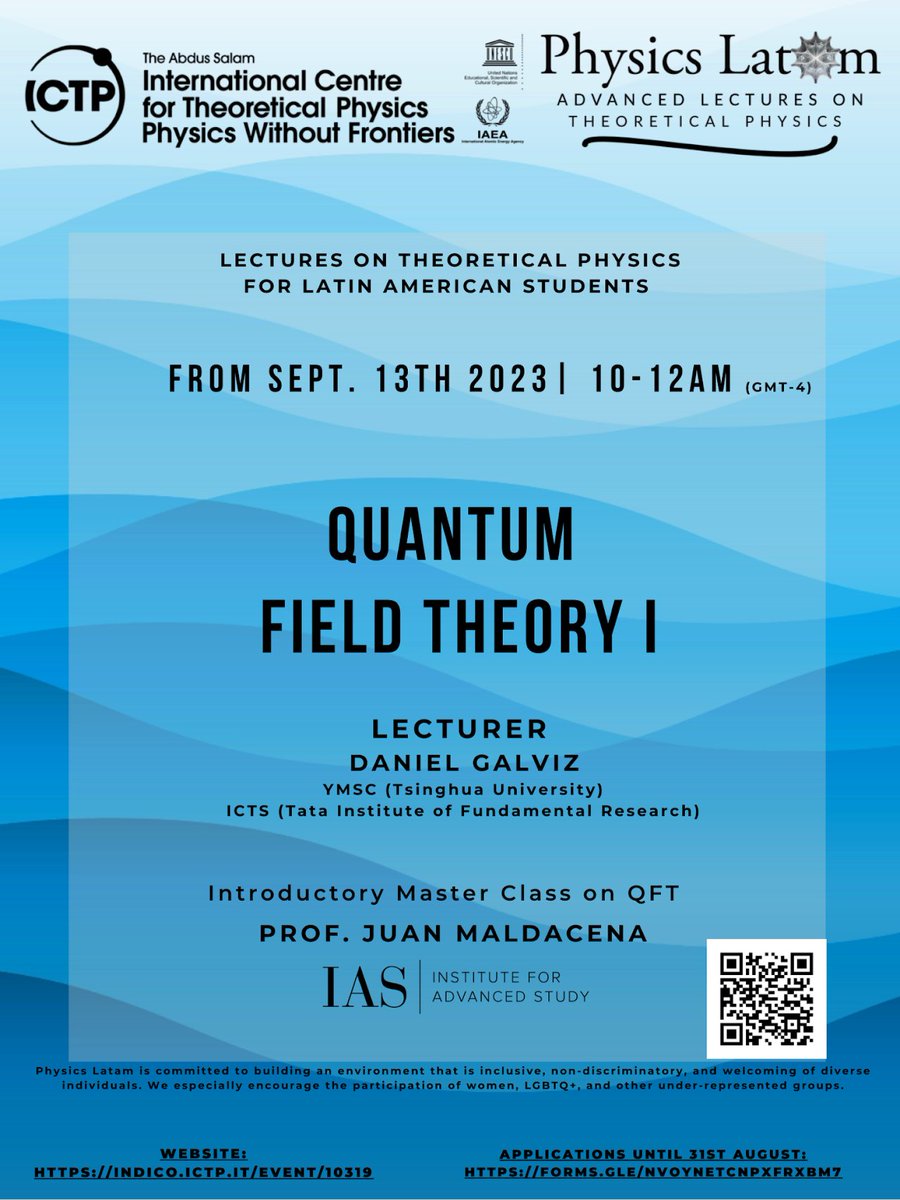
📢 Mini course announcement 🌟 (We're back!)
Don't miss a series of lectures by Porf. Pichai Ramadevi from @iitbombay
"Chern-Simons Theory and Invariants"
📅Dates: 24, 26, 27 June 2025
⌚Time: 08-1 0 am GMT-4
ℹ️https://t.co/bseSFvU5IO
Nobel prize winners often receive more awards afterward.
This is called the Matthew effect.
I also call it “the spotlight effect”.
The more you’re in the spotlight, the more you get.
1. You win more awards if you’ve already won some.
2. Securing additional funding is easier if your lab is well-funded.
3. Strong postdocs prefer labs with strong teams.
4. Publishing in top journals is easier if you’re known as a frequent ‘Nature author’.
5. You get more invited talks if you’ve been invited to conferences before.
⏹️
BUT there is another ‘spotlight effect’ in academia:
❗ Your advisor’s spotlight becomes YOUR spotlight.
- Getting a faculty position is easier if your advisor is well-known.
- Getting awards is easier if your advisor is well-known.
- Receiving invitations is easier if your advisor is well-known.
This effect results in hiring inequality. This is why many faculties in the US come from the elite (top-10) universities. There are labs that have graduated dozens of professors. It’s not uncommon to hear “This faculty is from XYZ lab, their advisor is well known.”
Of course, top universities have more money for research and their graduates have better opportunities. But it does not mean that they would perform better as faculties.
As hiring committees have no time to review everyone, they rely on recommendation letters and the visibility of an advisor to pre-select the best candidates. As a result, the ‘spotlight effect’ can define the final pool of candidates.
As Science article says:
“It shows that the system can be unfair to highly capable scientists who - through no fault of their own - don’t get to become the protégé of a top scientist” [Shulamit Kahn, Boston U.]
⏹️
I have two messages:
1. As a student, be aware that the visibility of your mentor plays a big role in your career. This is the unfortunate reality at many places.
2. As senior academics, we should strive to reduce this ‘spotlight’ effect. Recommendation letters should be given less weight. The name of the advisor should play a smaller role. We should distribute awards and recognition more evenly across the community.
#AcademicTwitter #phdchat
📢No te puedes perder los emocionantes seminarios finales de nuestros estudiantes del curso "Theoretical Particle Physics". 📚 🤓 💡
Será el momento culminante en el que mostrarán todo lo aprendido durante 6 meses de estudio.
¡Únete a nuestra sesión informativa sobre la cohorte 2024! 📅 Mañana viernes 9 de febrero a las 9:00 (CO/EC/PE) #HablemosLACoNGA es tu oportunidad de conocer nuestra iniciativa de formación e interactuar con nuestro equipo. https://t.co/9h7NtG3JJc
Quantum Information Theory Course 2024 🚨(in Spanish)
QIT focuses on understanding how quantum systems can store, process, and transmit information and how they differ from classical systems in their capacity to do so.
📅 Apply by 20 Feb.
🌐https://t.co/knAVuLbdVo #physics
Perimeter Faculty member Jaume Gomis and his team have achieved a ground-breaking milestone in the hidden world of low-energy physics!
Click here to know more about this discovery!
https://t.co/a0EBTTEner
🎉 @ERC_Research awarded a €10M Synergy Grant to a project led by Nima Arkani-Hamed, Professor in the School of Natural Sciences, and past IAS Members. They aim to create a new mathematical language to describe physical phenomena on all scales: https://t.co/n9BmFhf1fB #ERCSyG
Federico García Lorca y Salvador Dali.
Una relación de erotismo, arte y cartas sin fin.
Estos 2 amigos vivieron una de las épocas más difíciles en España donde la homosexualidad era juzgada con carcel, dos hombres besándose en la calle se enfrentaban, como poco, a perder su trabajo y la cárcel. Cuando se proclamó la Segunda República en 1931 se eliminó cualquier ley que penase la homosexualidad.
Lorca y Dalí se intercambiaban cartas entre 1923 y 1936 se intercambiaron cartas de amor que comenzaban con un "Querido Salvador" o "Querido Lorquito" y dejando entre dicho la platónica historia de amor que mantuvieron. El genio surrealista de Dalí jamás negó sus sentimientos hacia Lorca. En una carta al director publicada por el diario El País en 1986 hablaría de "un amor erótico y trágico, por el hecho de no poderlo compartir". En una de esas misivas, Dalí le dedicaría a Lorca estas palabras: 'Tú eres una borrasca cristiana y necesitas de mi paganismo... Yo iré a buscarte para hacerte una cara de mar. Será invierno y encenderemos lumbre. Las pobres bestias estarán ateridas. Tú te acordarás que eres inventor y viviremos juntos con una máquina de retratar'.
An unsent letter from Niels Bohr to Werner Heisenberg, ca. 1957 ✍️
Dear Heisenberg,
I have seen a book, “Stærkere end tusind sole” (Brighter than a thousand suns) by Robert Jungk, recently published in Danish, and I think that I owe it to you to tell you that I am greatly amazed to see how much your memory has deceived you in your letter to the author of the book, excerpts of which are printed in the Danish edition.
Personally, I remember every word of our conversations, which took place on a background of extreme sorrow and tension for us here in Denmark. In particular, it made a strong impression both on Margrethe and me, and on everyone at the Institute that the two of you spoke to, that you and Weizsäcker expressed your definite conviction that Germany would win and that it was therefore quite foolish for us to maintain the hope of a different outcome of the war and to be reticent as regards all German offers of cooperation. I also remember quite clearly our conversation in my room at the Institute, where in vague terms you spoke in a manner that could only give me the firm impression that, under your leadership, everything was being done in Germany to develop atomic weapons and that you said that there was no need to talk about details since you were completely familiar with them and had spent the past two years working more or less exclusively on such preparations. I listened to this without speaking since [a] great matter for mankind was at issue in which, despite our personal friendship, we had to be regarded as representatives of two sides engaged in mortal combat. That my silence and gravity, as you write in the letter, could be taken as an expression of shock at your reports that it was possible to make an atomic bomb is a quite peculiar misunderstanding, which must be due to the great tension in your own mind. From the day three years earlier when I realized that slow neutrons could only cause fission in Uranium 235 and not 238, it was of course obvious to me that a bomb with certain effect could be produced by separating the uraniums. In June 1939 I had even given a public lecture in Birmingham about uranium fission, where I talked about the effects of such a bomb but of course added that the technical preparations would be so large that one did not know how soon they could be overcome. If anything in my behaviour could be interpreted as shock, it did not derive from such reports but rather from the news, as I had to understand it, that Germany was participating vigorously in a race to be the first with atomic weapons.
Besides, at the time I knew nothing about how far one had already come in England and America, which I learned only the following year when I was able to go to England after being informed that the German occupation force in Denmark had made preparations for my arrest.
All this is of course just a rendition of what I remember clearly from our conversations, which subsequently were naturally the subject of thorough discussions at the Institute and with other trusted friends in Denmark. It is quite another matter that, at that time and ever since, I have always had the definite impression that you and Weizsäcker had arranged the symposium at the German Institute, in which I did not take part myself as a matter of principle, and the visit to us in order to assure yourselves that we suffered no harm and to try in every way to help us in our dangerous situation.
This letter is essentially just between the two of us, but because of the stir the book has already caused in Danish newspapers, I have thought it appropriate to relate the contents of the letter in confidence to the head of the Danish Foreign Office and to Ambassador Duckwitz.
📷 Niels Bohr Archives
Full translation: https://t.co/gb01Udywmu
Regalo de Reyes para una madre #FormatoHilo
Ser judío en la Unión Soviética en la década de 1960 era un gran “pecado” que solo se perdonaba a quienes eran brillantes en su profesión. En una universidad de primera, como la Universidad Estatal de Leningrado, no se admitían judíos,
SEMANA FINAL📢⚠️
¿Deseas aprender más sobre temas avanzados en física teórica? Participa en cursos en línea organizados por el @PhysicsLatam & @ictpPWF ¡Aplica!
Teoría cuántica de campos: https://t.co/9o6OQ5SfL4
Física teórica de partículas: https://t.co/ldWIhOjNDq