Crypto is obsessed with speed. It should be obsessed with friction.
In traditional finance (TradFi), if you make a mistake, there is a "Undo" button. It’s called T+2 or T+5 settlement. It’s a time buffer. A delay. In engineering, we call this hysteresis, a lag introduced intentionally to prevent rapid, unstable oscillations.
In crypto, we removed the lag. We made settlement instant. And what happened? We enabled the most efficient engine for theft in human history.
If a hacker drains your wallet, the money is gone in seconds. No reversible transactions. No 5-day hold to verify the identity.
We need to humble ourselves and learn from the bankers we claim to disrupt. Custodial wallets and delayed settlements (holding funds for T+5) are not "bugs." They are safety features. They are the circuit breakers that stop a house fire.
I am a proponent of "Sovereign Money," but I am also a realist. Most people do not want to run their own power plant (self-custody). They just want the lights to turn on safely.
If crypto wants to onboard the next billion users, we need to re-introduce the one thing we fought to remove: Friction.
About Binance losing more than $6B:
Who says crypto is fucked?
Crypto is not fucked.
Every heist carries a lesson that everyone learns. This is how paper money, then metal money, then computer bank money became secure.
Think of North Korea as the most severe but effective teacher.
There is a lot of grief, yes, and I would be crying too if I were a victim. Fortunately Binance can make everyone whole again.
Maybe a decade from now, after we've learned how to apply decentralization and censor-proofing where it fits, North Korea can no longer steal.
No entity can long survive by living on stolen money. History has proven several times that this manner of survival is not sustainable for long.
Milton Friedman explains why price controls don’t solve inflation, using a simple analogy involving a boiling kettle.
Freezing prices and wages while continuing expansionary economic policies is like putting a brick on a boiling kettle while turning up the heat underneath it.
You can suppress the pressure temporarily, but you haven’t addressed the underlying problem.
The worry about inflation is evident in the growth of TIPS during the past few years.
TIPS (Treasury Inflation Protected Security) from the Treasury has quietly and calmly grown by about $610B to $2.17T (from July, 2021 to September, 2026), a faster absolute growth than Bitcoin itself, which has noisily and violently grown only by $434B, to $1.187T during the same time period.
Allow me to remind you that our IRMA is just like TIPS, except that IRMA is liquid. You can redeem IRMA anytime you like, and there's no penalty for doing so, except the roundtrip fee totalling 0.8%.
We will be launching IRMA soon. Follow me for the uptodate progress reports here in X. Just remember that this is not financial nor investment advice. Investing in crypto involves risks that you need to be aware of.
We're done testing and are now submitting the code to https://t.co/zFqGv815b9 for a formal audit.
A monopoly on money issuance isn't just a political issue. It’s a structural flaw in the incentive system.
We generally accept that the government should have the exclusive right to create money.
But when you look at the mechanics of this system, you realize it is designed to overspend.
Why? Because of a simple law of behavior: Money owned by nobody cannot be managed well.
When you combine a monopoly on money issuance with a democracy, you create a dangerous feedback loop. In a democratic system, the people who are elected can only maintain their power by getting the most votes.
And how do you reliably get the most votes? You grant money to people. You expand entitlements. You fund feel-good politics.
The incentive structure is completely one-sided. There is an infinite political reward for spending, and a massive political penalty for austerity. Therefore, the system is structurally prone to overspending.
When the entity that needs your votes is the exact same entity that controls the printer, the outcome isn't a mystery. It is a mathematical certainty. The currency will be debased to pay for the promises.
This is why a government monopoly on money is inherently unstable. You cannot combine a political need for infinite promises with a centralized ledger and expect the purchasing power to survive.
We need systems where the issuance of money is decoupled from the need to win the next election.
World currencies have come and gone. Will the US dollar eventually fail also?
It looks very likely. This time, though, the plot has a twist.
F.A. Hayek's idea of multiple currencies in competition has become possible with blockchain.
When and if the US dollar starts to hyperinflate, I believe the most widely distributed stablecoin brands will dissociate from USD. The size of network effects of these stablecoins would allow them to compete with USD itself, after dissociation.
Will the politicians oppose the dissociation? A better question is whether the voters in the free world would choose to revive central bank monopolies.
"Algorithmic" Stablecoins
It is unfortunate that a class of stablecoins that have failed miserably are now called "algorithmic stablecoins". This class includes Do Kwon's notorious TerraUSD (TUSD), IRON, and others.
The fact is that all these stablecoins failed, not because they were algorithmic, but because they were at least partially backed by tokens with zero network effects (zero distribution). If your new stablecoin is backed by an equally new secondary token, it is not a stablecoin. Any new token has zero network effects.
Attempting to back your stablecoin with another new token is like a perpetual motion machine. You can have it running for a while, but not perpetually.
The US dollar is the one currency with the largest network effects. It is still the most trusted currency, accepted almost anywhere around the world "with no questions asked". Stablecoins backed by USD are therefore among the most stable and most trusted stablecoins.
Stablecoins are by their very nature, programmable. There are successful "algorithmic" stablecoins: DAI is a good example. USDe is another one, Liquity's LUSD and BOLD, etc.
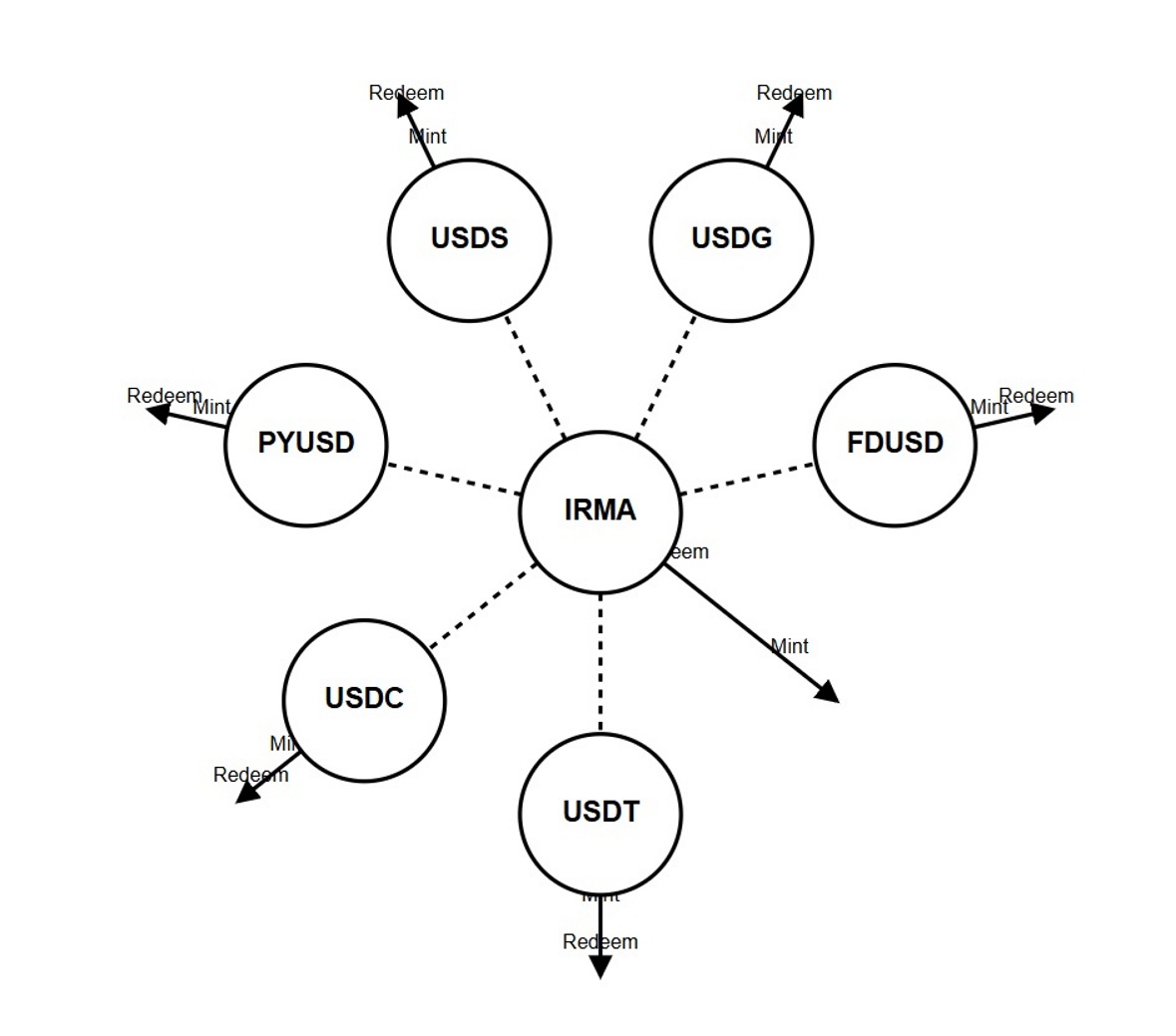
IRMA (https://t.co/KIi1gfuzxg) is algorithmic also, but it is reserve-backed by not one, but six of the most well-established stablecoins like USDT and USDC.
@GeorgeSelgin Yes, Dr. Selgin. Definitely not what he tried to convey. He's trying to tell us that banknotes were deliberate scams, and from some of your writings, you have clearly shown that banknotes were good, no-questions-asked currency.
Worried about the coming high USD inflation?
I am not a financial nor an investment advisor, so I am not giving financial nor investment advice.
What I have is a crypto product, a flatcoin called IRMA with the following simple characteristics:
A mint price that is independent of its redemption price.
The mint price always follows the formula:
mint price = (1.000 + DailyInflationRate) / ReservePriceInUSD
The redemption price is simply = TotalReserve / TotalIRMAInCirculation
IRMA will be paired with six well-established stablecoins in https://t.co/MkgKFcRoNT
If you don't own any stablecoin, buy USDC in Coinbase, connect your wallet with Meteora and swap your USDC for IRMA. You can do this as soon as we launch before end of this month of October.
Your wallet receives IRMA and your USDC is deposited into the USDC vault.
IRMA is inflation resistant because the redemption price will approach the mint price via two patent-pending mechanisms.
I will explain how IRMA works in my webinar:
https://t.co/NACyvweRa8
Come to my webinar if you have questions. I will also go through all the known risks involved.
Are you earning more SOL or USDC yet? If you are, congratulations!
Would you convert your SOL to USDC?
No? Then you are a Metsola.
There are two kinds of Liquidity Providers (LPs): Metsolas and Metstabs.
Metsolas like placing positions in pools where the quote token is SOL.
Metstabs like pools where the quote token is a stablecoin like USDC.
Which one are you?
@met_lparmy I am doing market research on Liquidity Providers (LPs) in Solana. Please do me a favor and respond to the following simple poll. How do you pick which token or pool to open positions for?