We are getting > 50 issues per day and our team is currently 7 people. Really need to hire more engineers. Strong C/C++ or Zig background required
Please apply at https://t.co/WkSiI365I0
Vercel Blob, our frontend-friendly solution for storing and serving files, is now available in public beta for Hobby and Pro customers.
https://t.co/LaJbC9LVVt
Hulu is actually now almost entirely built with @nextjs in TypeScript. Type safety has helped us as our engineering team has grown to hundreds of developers.
Problem: I'm working in an app that uses both Redux and React Query. React Query responses are copied into the Redux store. The app is buggy because it has 2 sources of state on every page: Redux and React Query. It reads and writes to these 2 spots inconsistently.
Solution: Pick *one* global state management system.
Store each piece of data in *one* spot.
Story Points don't work.
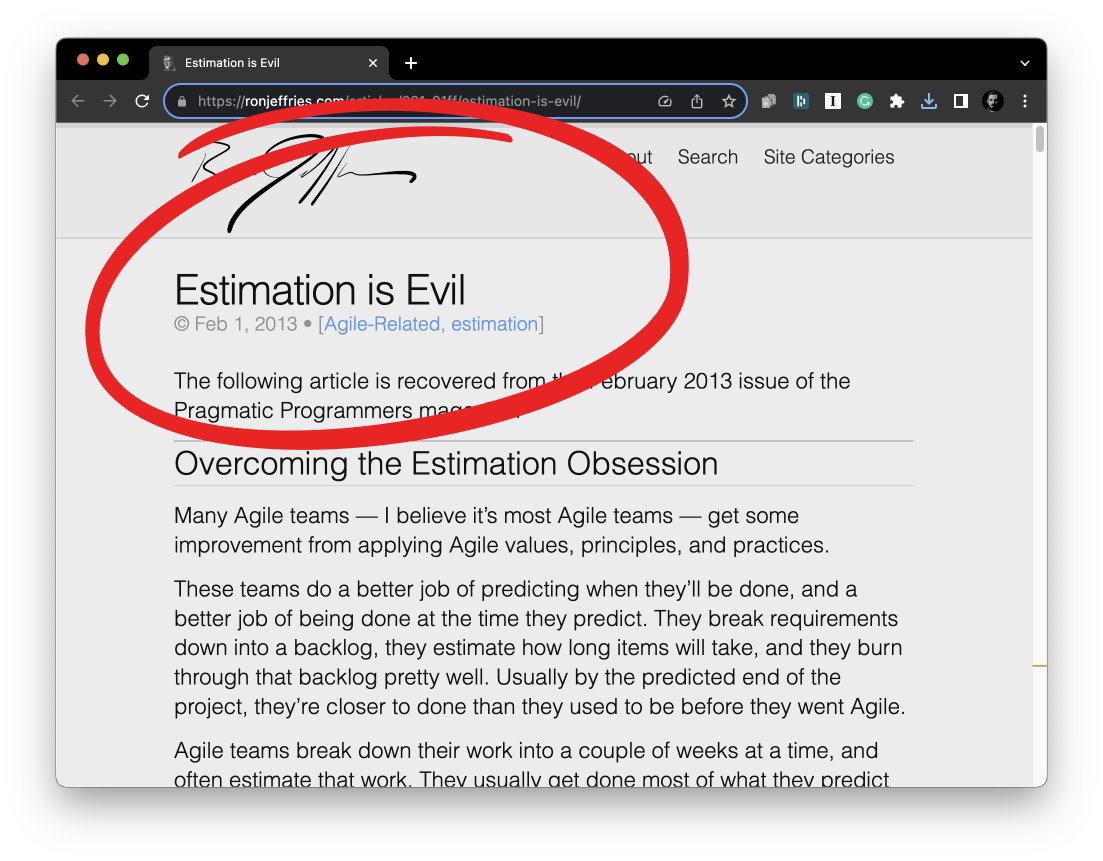
Even Ron Jeffries, who invented them, said he was sorry years ago.
And not only did he apologize, but he called the whole estimation idea "Evil."
Unfortunately, too many teams still use these points to estimate their work.
Story Points is a made-up metric to estimate work effort, not time. The goal was to prevent management from misusing estimates.
But it didn't work.
Every team I've ever met keeps a conversion table to translate back and forth between points and time. Some will never admit it, but go and talk to the folks doing the work.
Look at me and tell me I'm wrong.
But it gets worse:
Teams use points to decide how much work they can finish. But how can they do that without talking about time?
The effort to do something is not the same as the time it will take to finish it. This is especially true when planning an iteration with many people and tasks.
It's clear now: Story Points don't work.
What's the alternative?
I'll let the people who manage projects for a living offer their alternatives, but I can tell you what I've done.
As I got older and wiser, I stopped with the estimation charade altogether. I had my teams focus on short iterations with constant feedback from stakeholders.
From the "scope, budget, and time" triangle, I always tried to keep two of them variable and fix the third one.
If the customer was looking for a specific scope, we had a variable timeline and budget to finish it. We kept the scope and time flexible if the budget was non-negotiable. And if we had to deliver by a specific date, the scope and budget were on the table.
Every company is different, and this doesn't work for everyone. But if it does, I hope you stop the charade.
I'd love to hear about your experience estimating software. What crazy things does your company make you do?
To help you take on Shadow Mewtwo, we’re giving away codes for Purified Gems if we reach 150k RT! To participate:
Follow us on Twitter
RT this post with #ShadowRaids
Receive confirmation reply
If we reach our target, we’ll send participants a code for Shadow Raid–themed items!
After months of hard work and community feedback, we are excited to announce Qwik RC!
V1 is just around the corner, so we would really value your feedback on this.
Find out more on our blog: https://t.co/0MJMjzOyjw
Arc @arcinternet, a broswer that allows you to group the tabs into Space, and clip web info to the notes, and even create simple boost plugin to simplify your daily browsing experience. Thanks @browsercompany
https://t.co/YWB3F5c4ny