An MCP server for your NestJS app's production data: give your AI coding agent your releases, errors, traces and issues, so it can debug and fix production bugs.
Production context, for every agent. NestJS Observe 🔭
https://t.co/7iQ6HDaRHF
Teaching agents to walk the graph: Wikidata Search Traces 🕸️
The semantic web was the original web of agents. Agentic LLMs have barely touched it.
A new paper from PleIAs, in collaboration with AI-BRIDGES and Wikimedia Deutschland, tests a convergence between two kinds of depth: graph traversal in a knowledge graph, and recursion in Recursive Language Models (RLMs).
In an RLM, the model works in a persistent Python environment, keeps intermediate results in state, and delegates selected evidence to sub-calls.
What they built:
A method for growing multi-hop questions over a frozen Wikidata snapshot (about 48M entities, 262M facts). Named entities are replaced with nested conditions, and each expansion is certified so the target stays unique and every condition is necessary
10,235 solving traces over single-entity and multi-hop questions
An open RLM harness with 13 graph functions
What the first evaluation shows, on 100 questions:
The harness improved both models tested, compared with direct tool calling over the same functions
gpt-6-luna went from 49 to 61 correct answers, doubling multi-hop accuracy (9 to 19 out of 50)
Qwen3.8-27B, open-weight and served on a single H100, went from 60 to 74, the top score of the evaluation
The gain comes from carrying the search further along the chain of conditions: models reach the target entity more often
The traces are meant for training. The next step is fine-tuning a smaller model, around 12B parameters, on them. The authors see wider potential here: recursively exploring graphs and texts may be a skill in itself, one that can be learned with far fewer parameters. Is that a path to a cognitive core for search?
Beyond Wikidata, they plan to study RLMs as a general approach to semantic data search across sources and ontologies.
By Mohamed Chenene, Carlos Rosas-Hinostroza, Anastasia Stasenko, Shani Evenstein Sigalov and Pierre-Carl Langlais
https://t.co/nG0S7pBxNb
#Wikidata #RecursiveLanguageModels #AIAgents #OpenSourceAI #SemanticWeb
--
📩 The Year of the Graph Autumn 2026 newsletter issue is out!
Meaning, Traversal, Reasoning, Action: The Graph Stack for Agentic AI. 👇
https://t.co/YfrPw2nFzS
All things #KnowledgeGraph, #GraphDB, Graph #Analytics / #DataScience / #AI and #SemTech.
Subscribe and follow to be in the know. Reach out if you’d like to be featured
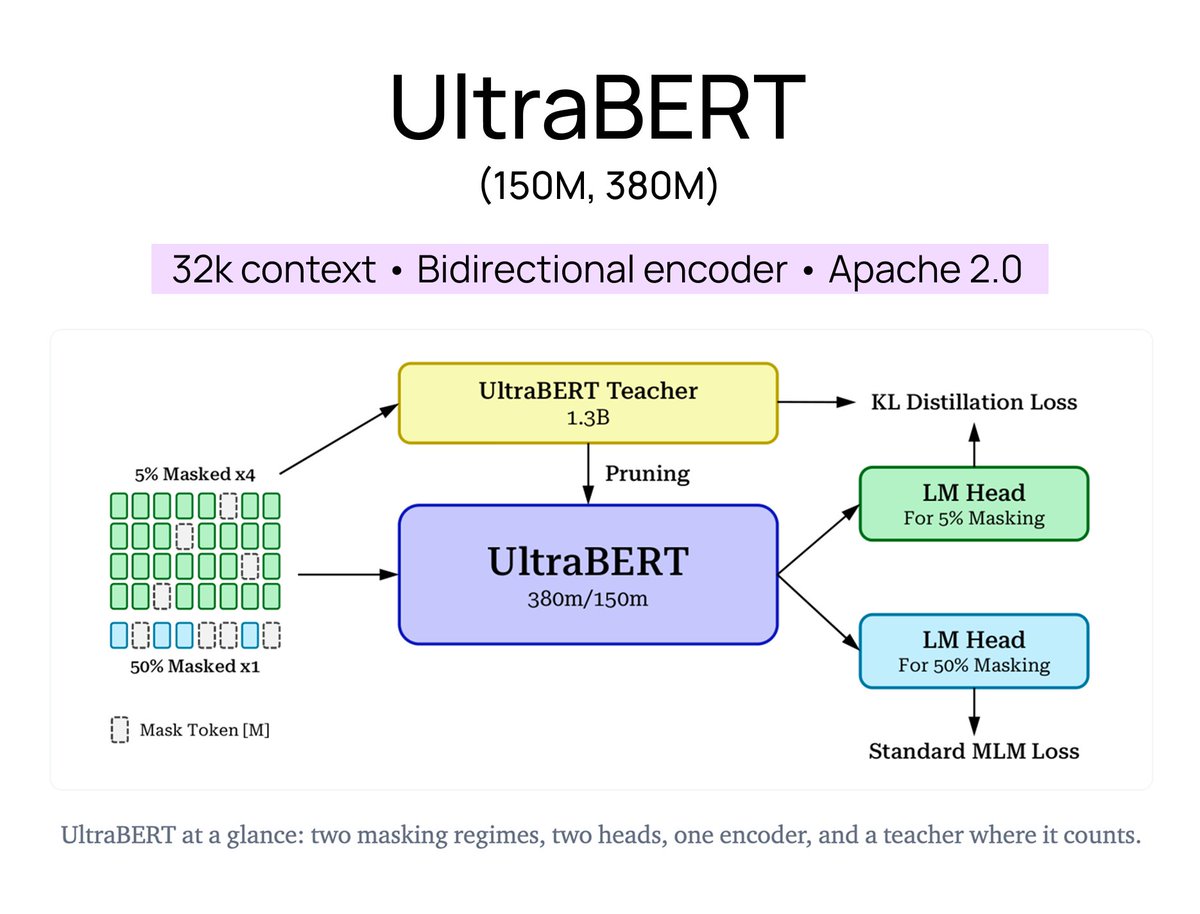
UltraBERT is here (along with super interesting lessons learned from training it)!
152M + 380M encoders, 32K context, built for classification, NER, QA, reward modeling + retrieval.
Most interesting part is the training recipe:
-5% masking for classification
-50% masking for retrieval
-Separate LM head for each
-Distillation only on the 5% sequences
Distillation findings are also really insightful. They trained a 1.3B teacher, pruned it by width to 380M and 150M, and distilled both smaller models from the teacher. But they only applied logit distillation to the 5% masked sequences.
Some other interesting training lessons:
-Encoder performance saturated early, even as loss kept falling
-Multi-stage data mixtures had little effect after fine-tuning
-32K context added during only the final 100B of 2T training tokens
-Distillation not automatically useful across every capability
Strong size-to-performance tradeoff too:
-380M leads the authors’ comparison on GLUE + BEIR
-150M matches RoBERTa-large on classification at 2.3x smaller
-~8 point lead on code + math retrieval
-99%+ Passkey recall through 32K
Great open source release! Long live BERT ✌️
@huggingface weights: https://t.co/fff2oCzPwo
Paper: https://t.co/QSc2COtSik
Introducing DocJev - a lightning-fast OSS library for document classification and splitting with jev ⚡️
Give a document alongside some natural language category rules. Jev will predict the document category (classify) or the boundaries between sub-documents (split).
It is 6x faster than gpt-5.6-luna with equivalent accuracy.
You can choose between different OCR backends:
liteparse: the fastest/most accurate free+OSS text parser out there. Perfect for digitalized documents. The speedups vs. luna above are inclusive of liteparse times.
LlamaParse: the most advanced VLM-based solution for complex docs. Using this will of course add latency on document preprocessing. But it’s a good option if you want to cache the digitalized representations of documents for a variety of downstream tasks.
Check it out: https://t.co/PVE4hbEyFR
If you want to dive deeper into liteparse or LlamaParse check the links below:
liteparse: https://t.co/JNER0mVcB8
LlamaParse: https://t.co/XYZmx5TFz8
L’alliance entre le Canada et l’Europe ne se définit pas par ce à quoi nous nous opposons, mais par ce que nous défendons : la liberté, la solidarité, la prospérité et le développement durable. Une alliance suffisamment forte pour que personne ne puisse nous dicter nos choix.
Individuellement, l’Europe et le Canada sont forts. Ensemble, ils le sont encore plus.
Ce fut un honneur de m’adresser au Parlement européen aujourd’hui.
BERLIN: DAS PROBLEM SIND NICHT NUR 5,8 TERABYTE. DAS PROBLEM IST, DASS MAN EINIGE DIESER DATEN NICHT EINFACH ÄNDERN KANN.
Eine technische Einordnung des Berliner Datenleaks.
Beim Berliner Cyberangriff konzentriert sich die öffentliche Diskussion bislang erstaunlich stark auf die schiere Datenmenge, personenbezogene Daten, Passwörter und die Frage, wer jetzt informiert werden muss. Das alles ist wichtig. Aber es ist nicht das größte Problem.
Das wirklich Beunruhigende beginnt dort, wo Berichte über Schwachstellenanalysen der Berliner Trinkwasserversorgung, Dokumente zu kritischer Infrastruktur, Notfallunterlagen und andere interne Sicherheitsinformationen zutreffen. Denn damit reden wir über eine völlig andere Klasse von Daten.
Ein Passwort ist ein Secret. Ein Secret kann ich ändern. Eine Infrastruktur ist eine Struktur. Und Strukturen kann ich nicht einfach rotieren.
Wenn ein Passwort veröffentlicht wird: Password Reset. Ein Token: Revoke. Ein Zertifikat: Re-Issue. Ein Key: Rotate. Ein Account: Disable. Alles unangenehm, teuer und arbeitsintensiv, aber technisch lösbar.
Was aber mache ich mit einer veröffentlichten Schwachstellenanalyse eines Wasserwerks? Mit dokumentierten Abhängigkeiten, Notfallkonzepten, Zuständigkeiten, bekannten Schwachpunkten, Betriebsabläufen, Eskalationswegen oder Sicherheitskonzepten? Ich kann schlecht sagen: „Wir rotieren am Montag unsere Trinkwasserversorgung.“
Genau deshalb sind solche Informationen so sensibel.
Ein professioneller Angreifer beginnt einen Angriff nicht mit dem Angriff. Er beginnt mit Reconnaissance. Er möchte wissen: Wie sieht das Ziel aus? Welche Systeme existieren? Welche Abhängigkeiten gibt es? Wer ist verantwortlich? Wo befinden sich kritische Übergänge? Welche Schutzmaßnahmen existieren? Wo wurden Schwachstellen festgestellt? Welche Prozesse greifen bei einem Ausfall? Welche Dienstleister, Mitarbeiter und Organisationseinheiten spielen eine Rolle?
Normalerweise muss ein Angreifer diese Informationen mühsam zusammensuchen: OSINT, Social Engineering, Scanning, Phishing, Credential Harvesting, interne Reconnaissance nach dem Initial Access. Das kostet Zeit, erzeugt Risiko und produziert Spuren. Eine interne Schwachstellenanalyse kann einen Teil dieser Arbeit bereits erledigt haben. Für den Verteidiger. Und jetzt möglicherweise auch für den Angreifer.
Das ist der eigentliche Security-Super-GAU an solchen Leaks.
Die Veröffentlichung einer Schwachstellenanalyse bedeutet selbstverständlich nicht automatisch: „Jetzt kann jemand die Berliner Wasserversorgung abschalten.“ Das wäre unseriös. Wir wissen weder vollständig, welche Dokumente tatsächlich enthalten sind, noch wie aktuell sie sind oder welche darin beschriebenen Schwachstellen inzwischen beseitigt wurden.
Aber genau deshalb muss jetzt Assume Compromise gelten. Nicht nur für Accounts, sondern für INFORMATION.
Man muss davon ausgehen, dass relevante Dokumente kopiert, lokal gespeichert, indexiert und mit anderen Informationen korreliert werden. Und man muss davon ausgehen, dass diese Daten noch Jahre später ausgewertet werden können.
Das Internet vergisst einen solchen Dump nicht.
Nach der Veröffentlichung ist die Anzahl der Kopien unbekannt. Damit existiert kein realistisches Szenario mehr, in dem Berlin sagt: „Wir haben die Quelle gelöscht. Problem erledigt.“ Die Vertraulichkeit ist irreversibel verloren.
Systeme kann man recovern. Veröffentlichte Information nicht.
Und dann kommt ein zweites Problem hinzu: 1,44 Millionen Dateien – sofern sich diese Angabe bestätigt – sind nicht einfach 1,44 Millionen Dokumente. Sie bilden einen Datensatz. Und Datensätze lassen sich korrelieren.
Ein Organigramm allein mag harmlos sein. Eine Telefonnummer ebenfalls. Ein Vertrag vielleicht auch. Setze aber Personen, Funktionen, Telefonnummern, E-Mail-Adressen, Dienstleister, Verträge, Credentials, Systeminformationen, Organisationsstrukturen, Notfallprozesse und Schwachstellenanalysen zusammen, und daraus entsteht etwas völlig anderes:
INTELLIGENCE.
Das ist exakt der Punkt, den die Betrachtung als bloßer „Datenschutzvorfall“ verfehlt.
Ein Angreifer braucht möglicherweise kein sensationelles Geheimdokument. Die Stärke liegt in der Korrelation. Wer arbeitet wo? Wer administriert was? Wer entscheidet? Welche Unternehmen liefern welche Leistungen? Welche Fachverfahren existieren? Welche Systeme hängen zusammen? Welche Menschen besitzen privilegiertes Wissen? Wie kommunizieren Behörden miteinander? Welche Prozesse werden in einer Krise aktiviert?
Damit wird auch Social Engineering erheblich gefährlicher. Die klassische Phishing-Mail lautet: „Sehr geehrter Mitarbeiter, bitte Passwort bestätigen.“ Leicht zu erkennen. Eine Mail mit realen Namen, realen Vorgängen, realer Terminologie, echten Dienstleistern und echten organisatorischen Zusammenhängen spielt in einer völlig anderen Liga.
Und genau hier kommt ein Punkt ins Spiel, der in der deutschen Sicherheitsdebatte regelmäßig unterschätzt wird:
DAS PERSONAL.
Nicht nur Administratoren. Nicht nur SOC, CISO und IT-Security.
Das gesamte Verwaltungspersonal.
Jeder Mitarbeiter mit Mailkonto, Fachverfahren, Dokumentenzugriff oder Telefon ist Teil der Sicherheitsarchitektur. Security Awareness ist deshalb kein jährliches Pflichtvideo mit fünf Multiple-Choice-Fragen. Mitarbeiter müssen Phishing erkennen, ungewöhnliche Vorgänge hinterfragen, sensible Informationen richtig behandeln, Berechtigungen ernst nehmen und Auffälligkeiten sofort melden.
Wenn Beschäftigte Security als lästige IT-Vorschrift behandeln, Credentials weitergeben, Anhänge sorglos öffnen, Daten lokal herumkopieren oder Warnungen ignorieren, entsteht eine Verteidigungslücke, die kein SIEM der Welt vollständig schließen kann.
Technik kann menschliches Fehlverhalten begrenzen. Sie kann es nicht vollständig eliminieren.
Und deshalb ist Cybersecurity immer auch Sicherheitskultur.
Wenn eine öffentliche Verwaltung diese Kultur nicht vom Sachbearbeiter bis zur Behördenleitung etabliert, haben wir nicht nur ein Berliner Problem.
Dann haben wir ein Problem in Deutschland.
Die technische Antwort auf den Leak ist ohnehin unangenehm. Berlin kann nicht einfach ein paar Passwörter ändern und anschließend Entwarnung geben. Man muss den veröffentlichten Informationsbestand selbst als Threat-Intelligence-Quelle gegen die eigene Infrastruktur behandeln: Was weiß ein zukünftiger Angreifer jetzt über uns? Welche Informationen sind noch gültig? Welche Schwachstellen existieren noch? Welche Prozesse müssen verändert werden? Welche Trust Relationships müssen überprüft werden? Welche Architekturinformationen ermöglichen Rückschlüsse auf den Blast Radius? Welche Notfallverfahren müssen angepasst werden? Welche Informationen erleichtern Social Engineering?
Und bei welchen Informationen bleibt nur eine Möglichkeit:
DIE DARIN BESCHRIEBENE REALITÄT ÄNDERN.
Genau dort wird es teuer.
Eine Schwachstelle kann man patchen. Eine historisch gewachsene Infrastruktur möglicherweise nicht. Einen Netzwerkpfad kann man ändern. Ein Wasserwerk nicht. Credentials kann man austauschen. Physische Standorte nicht. Software kann man ersetzen. Versorgungsabhängigkeiten nur mit erheblichem Aufwand.
Man muss gegebenenfalls nicht die Datei ändern.
Man muss die Welt ändern, die in der Datei beschrieben wird.
Und hier beginnt das politische Versagen.
Deutschland führt mit erstaunlicher Ausdauer Debatten darüber, welche Kommunikation der Staat überwachen, welche Plattformen er regulieren und welche zusätzlichen digitalen Kontrollmöglichkeiten Behörden erhalten sollen. Chatkontrolle lässt grüßen.
Das ist eine bemerkenswerte Prioritätensetzung für einen Staat, der gleichzeitig offenbar fundamentale Probleme damit hat, die Vertraulichkeit seiner eigenen Informationen sicherzustellen.
Informationskontrolle ist nicht Informationssicherheit.
Eine Suchmaschine dazu zu bringen, einen Link nicht anzuzeigen, macht einen veröffentlichten Datensatz nicht wieder geheim. Eine Plattform zur Löschung aufzufordern, rotiert keine kompromittierte Infrastrukturinformation. Wer ernsthaft nach diesen Daten sucht, braucht Berlin nicht um Erlaubnis zu fragen.
Die entscheidende Sicherheitsbarriere hätte VOR der Exfiltration stehen müssen. Nicht hinterher vor der Suchmaschine.
Das ist vielleicht die bitterste Erkenntnis dieses Vorfalls: Wir diskutieren politisch immer häufiger darüber, wie der Staat Informationen anderer kontrollieren kann. Dabei wäre die wesentlich dringendere Aufgabe, den Staat endlich in die Lage zu versetzen, seine eigenen Informationen zu kontrollieren.
Dafür brauchen wir keine weitere paternalistische Digitalpolitik. Wir brauchen professionelle IT-Security: Asset Management, Data Classification, Least Privilege, PAM, Segmentierung, Zero Trust, EDR/XDR/NDR, SIEM, 24/7 SOC, Egress Monitoring, DLP, Lifecycle Management, Patch Management, Threat Hunting, Red Teams, Purple Teams und Incident Response.
Und wir brauchen Security Awareness und Security Culture in der gesamten Verwaltung.
Denn der teuerste Security-Stack hilft wenig, wenn der Mensch davor glaubt, Sicherheit sei ausschließlich Aufgabe der IT.
Security scheitert daran, dass Legacy-Systeme weiterlaufen, Verantwortlichkeiten zerfasern, Budgets fehlen, bekannte Risiken akzeptiert werden, niemand abschalten will und Mitarbeiter nicht verstehen, dass sie selbst Teil der Verteidigung sind.
Die größte Lehre aus Berlin lautet deshalb nicht: „Wir müssen verhindern, dass Menschen die veröffentlichten Daten finden.“
Das ist nach einer Veröffentlichung dieser Größenordnung weitgehend vorbei.
Die Lehre lautet:
WIR MÜSSEN VERHINDERN, DASS DER NÄCHSTE DATENBESTAND ÜBERHAUPT DAS NETZ VERLÄSST.
Und bei KRITIS muss zusätzlich gelten: Informationen, die einem Angreifer helfen könnten, kritische Infrastruktur zu verstehen, dürfen niemals denselben Blast Radius besitzen wie gewöhnliche Verwaltungsdaten.
Need-to-know muss technisch erzwungen werden, nicht in einer Richtlinie stehen. Segmentierung muss existieren, nicht in PowerPoint. Logging muss ausgewertet werden, nicht nur gespeichert. Alerts müssen Konsequenzen haben, nicht nur Tickets erzeugen. Mitarbeiter müssen wissen, warum das alles wichtig ist. Und Management muss Risiken tragen, nicht nur Administratoren.
Denn wenn sich die Berichte über die veröffentlichten KRITIS-, Schwachstellen- und Notfallinformationen bestätigen, hat Berlin nicht einfach Dateien verloren.
Dann hat Berlin potentiell Wissen darüber verloren, wie Teile des Staates funktionieren, wie sie geschützt werden, wo ihre Schwächen liegen und wie sie sich im Notfall verhalten.
Ein Passwort kann man ändern.
Einen Staat kann man nicht mal eben rotieren.
Und eine Sicherheitskultur kann man nicht installieren.
Man muss sie aufbauen.
Vielleicht sollte ein Staat, bevor er die Chats seiner Bürger kontrollieren möchte, zunächst beweisen, dass er seine eigenen Daten kontrollieren kann.
Und damit kommen wir zum politischen Schluss dieses Desasters.
Die derzeit Verantwortlichen haben beim Schutz elementarer staatlicher Infrastruktur offensichtlich keinen Grund zur Selbstzufriedenheit. Sollte ihnen nun eine Regierung folgen, die ihre Prioritäten weiterhin stärker bei Regulierung, Kontrolle und paternalistischer Digitalpolitik setzt als beim Aufbau einer robusten, professionellen Sicherheitsarchitektur, wird sich das Problem nicht lösen. Es wird nur unter anderem politischen Vorzeichen weiterverwaltet.
Das wäre vielleicht die bitterste Pointe: Die einen haben es versäumt, den Staat digital verteidigungsfähig zu machen. Und die nächsten könnten denselben Fehler wiederholen, weil sie Sicherheit erneut mit Regeln, Zuständigkeiten und Kontrolle verwechseln.
Cybersecurity interessiert sich aber nicht für Parteiprogramme.
Ein ungepatchtes System bleibt ungepatcht. Eine schlechte Segmentierung bleibt schlecht. Ein ungeschulter Mitarbeiter bleibt ein Angriffspunkt. Ein unerkannter Datenabfluss bleibt ein Datenabfluss – ganz gleich, welche Farbe die Senatorin oder der Senator im Parteibuch trägt.
Wenn Deutschland nicht endlich begreift, dass digitale Souveränität zuerst bedeutet, die eigene Infrastruktur, die eigenen Daten und die eigenen Mitarbeiter verteidigungsfähig zu machen, dann wird Berlin nicht der letzte Fall dieser Größenordnung gewesen sein.
Dann werden wir weiter über Datenschutz reden, während unsere Daten gestohlen werden. Über Regulierung, während unsere Systeme veralten. Und über Informationskontrolle, während andere längst unsere Informationen kontrollieren.
Die Zukunft könnte tatsächlich düster werden.
Nicht weil die Angreifer unbesiegbar wären.
Sondern weil wir ihnen seit Jahren dabei helfen, indem wir Security verwalten, statt sie zu betreiben.
Selbstverständlich gehören auch alle anderen Religionsgesetze weg und das Konkordat gekündigt.
Aber es besteht kein Grund beim Islam, der am wenigsten mit einer liberalen, republikanischen Demokratie vereinbar ist, zu beginnen. 2/2
Absurde Debatte.
Das Kopftuch ist nicht nur ein Symbol, sondern ein materielles Werkzeug der Unterdrückung.
Die IGGÖ ist eine politische Organisation. Das Islamgesetz gehört abgeschafft. Alle Privilegien abgestellt. 1/2
ICYMI: #Bloom can now run graph algorithms across an entire database, not just the current Scene – a big deal if you’ve ever been limited to local, on-screen views for centrality or community detection. Jeff Gagnon walks through the difference with a concrete example (pepper vs butter as recipe ingredients), showing how whole-graph results can tell a very different story than a local one.
https://t.co/qQRO9qtjUj
"Memory records what happened. An ontology turns what happened into knowledge. Distillation turns that knowledge into something an agent can run."
This weekend's favorite read is @lyonwj on agent memory and skill distillation.
https://t.co/Mh4DVwWafg
Build durable AI pipelines inside Azure HorizonDB. The create_pipeline function chunks, embeds, and stores vectors asynchronously as data lands. See it in action. https://t.co/VgKrEfwLbH Run enterprise PostgreSQL workloads on Azure HorizonDB with 3x the throughput of self-managed deployments — zone-resilient by default, no architectural trade-offs. Call AI models directly from SQL, build durable vector pipelines inside the database, and deliver high-accuracy similarity search at massive scale with DiskANN and AI re-ranking, all without leaving PostgreSQL. #AzureHorizonDB #microsoftazure, #ai, #azure, #cloudcomputing, #generativeai
@TomMayerEuropa Gerade zum Thema eine spannende Podcast Folge gehört. Stichwort „Demographisches Trillema“ und noch viele weitere Aspekte - recommended:
https://t.co/jGwjgr8IvS
LinearRAG: Linear Graph Retrieval Augmented Generation on Large-scale Corpora
Relation extraction may be the weakest link in your GraphRAG pipeline.
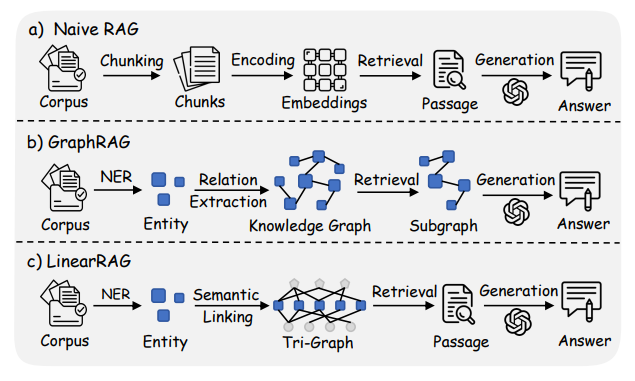
A new paper, LinearRAG, traces the recurring underperformance of graph-based RAG systems back to one step: turning passages into subject-relation-object triples via an LLM. The authors show this process is both expensive and unreliable — negation gets flipped, so a sentence stating a fact wasn't true can be misrepresented as though it were, and unrelated categories get linked as if they were hierarchical, introducing structural noise before retrieval even runs.
Their fix: drop relation extraction entirely.
LinearRAG builds what it calls a Tri-Graph, connecting entities, sentences, and passages using only lightweight named-entity recognition and semantic linking, with no LLM calls required during indexing. Retrieval then runs in two stages: local semantic bridging to activate relevant entities, followed by personalized PageRank over the activated subgraph to surface the most important passages.
The results, benchmarked against HippoRAG2, the strongest triple-based system tested:
→ 66.95% vs 58.85% accuracy on 2WikiMultiHopQA
→ Indexing time cut from LightRAG's 4,933 seconds to 249.78
→ Zero LLM token cost during indexing
The takeaway for anyone funding a graph-based RAG build: relation extraction isn't a given. Audit whether it's earning its keep, or just adding latency and hallucination risk on top of a system a simpler entity-only index would beat.
By Luyao Zhuang, Shengyuan Chen, Yilin Xiao, Huachi Zhou, Yujing Zhang, Hao Chen, Qinggang Zhang, and Xiao Huang
LinearRAG: Linear Graph Retrieval Augmented Generation on Large-scale Corpora https://t.co/s0ScSsETaL
#RAG #GraphRAG #NLP #LLM #MachineLearning
--
Join the Conversation
Subscribe to the Year of the Graph newsletter for quarterly insights on #KnowledgeGraphs, #GraphDB, Graph #Analytics, #AI, #DataScience and #SemTech .
📧 Subscribe: https://t.co/7pg6gqWYvw
💼 Sponsorship inquiries: https://t.co/LCvoLhhBBt
New in Claude Code: your sessions can now message each other.
Instead of having to re-explain yourself in another session, you can now tell Claude to do it. It sends a summary (not your history or files), and the other session picks it up mid-task.
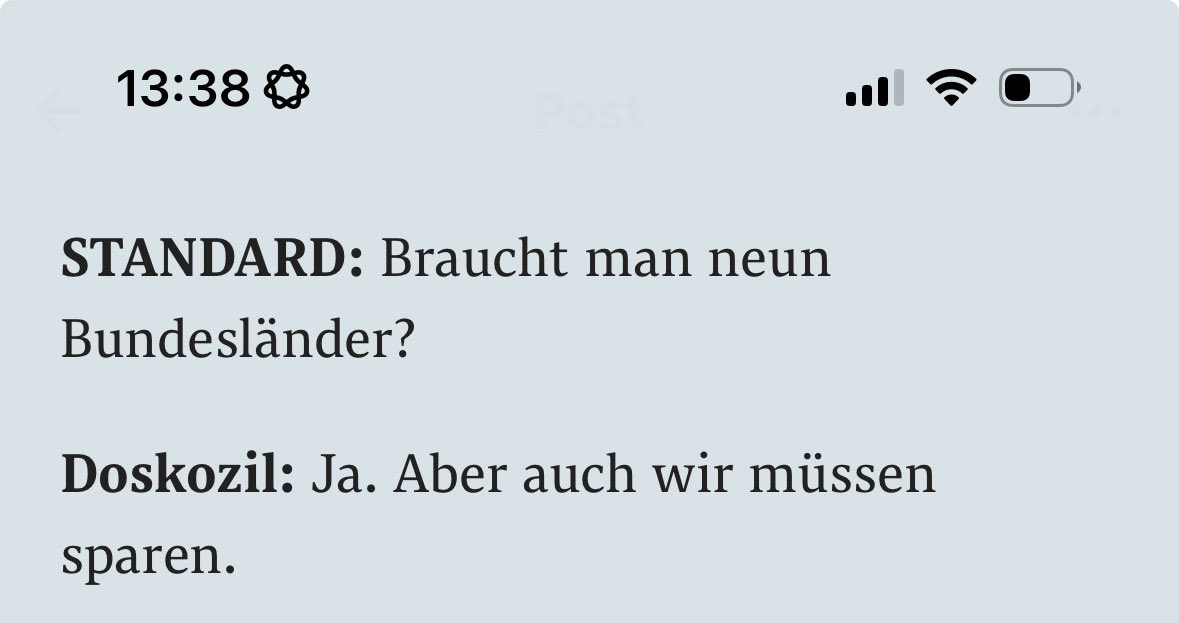
@i_am_fabs Hab ich mir auch heute gescreenshoted. Sparen, aber ja nicht beim fettesten Apparat überhaupt - dem BL.
Ich könnt‘ mich soviel ärgern über die Wappler.
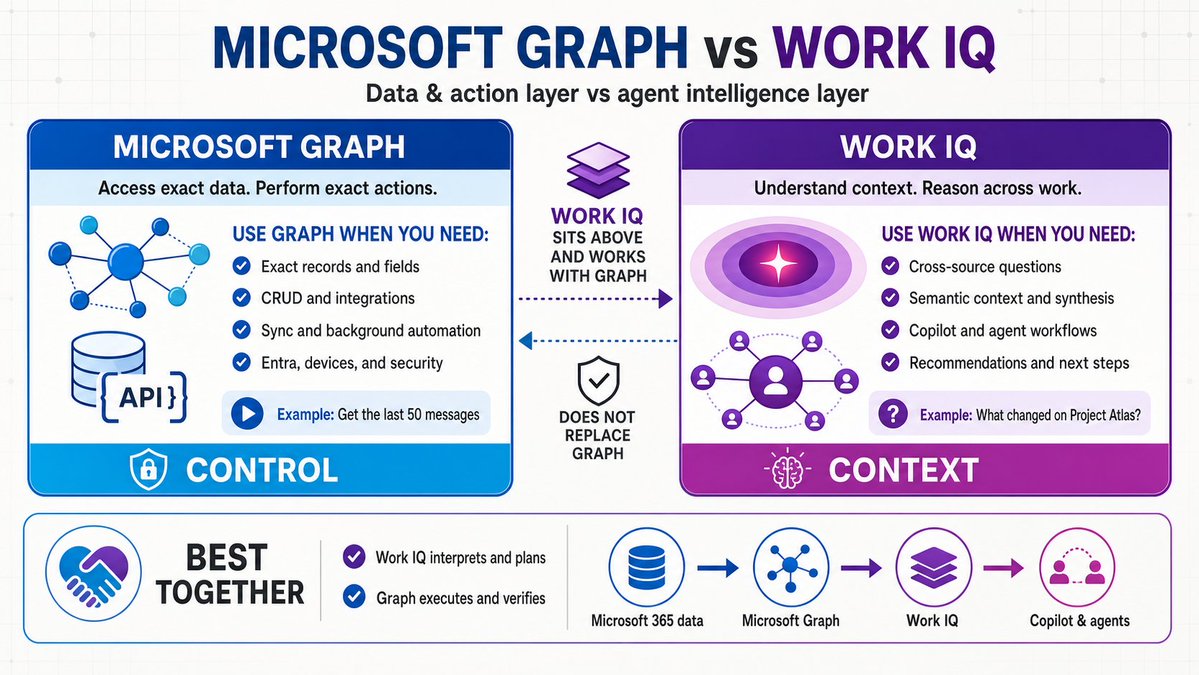
I've noticed a lot of people still don't understand Microsoft Graph vs Work IQ.
Microsoft Graph is the data and action layer.
Work IQ is the agent intelligence layer.
> Graph: exact records, CRUD, integrations, background automation.
> Work IQ: cross-source context, synthesis, recommendations, agent workflows.
Work IQ sits ABOVE Graph. It does not replace it.
The winning pattern uses both:
- Work IQ interprets and plans.
- Graph executes and verifies.
Which layer are you building on?
Today we're introducing Web Skill Factory: a pipeline that turns solved web tasks into reusable, verified code.
Most agent "skills" are notes a model rereads and reinterprets every run. Ours are programs.
On a WebArena subset with gpt-5.4, reusing the library moved accuracy on held-out instances from 55% to 70%, and cut average steps from 17.1 to 14.7.
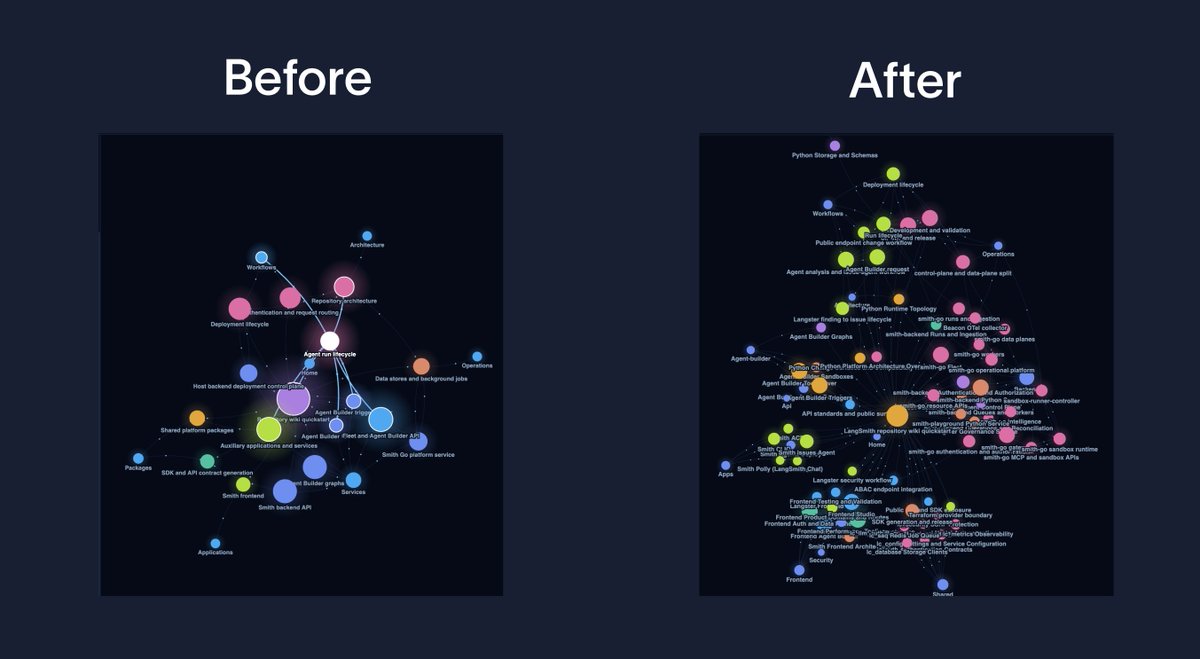
I just rewrote OpenWiki's entire prompt in v0.3 to generate more detailed & accurate wikis. Eval results:
- 📈 28.57% success increase (35% to 45% @ n=2)
- 🪙 14% fewer tokens
- 🧰 26% fewer tool calls
per successful task
And as you can clearly see from the graphs, the wikis contain much more data now.
Try out the new and improved OpenWiki: https://t.co/aZONneVM8A
npm install -g [email protected]