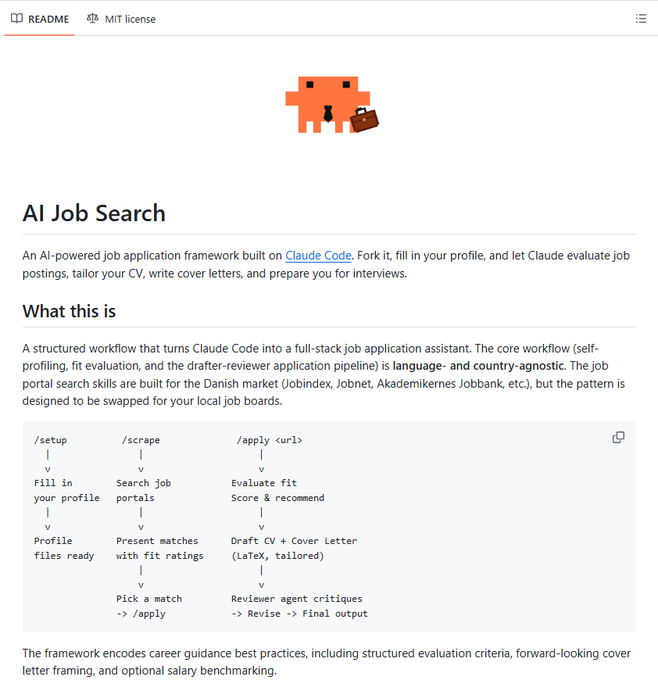
UN CIENTÍFICO DANÉS PROGRAMÓ A CLAUDE PARA QUE BUSQUE TRABAJO POR ÉL Y LO ACABA DE HACER PÚBLICO
Mandar CVs es uno de los trabajos más absurdos del mundo: copiar, pegar, adaptar, personalizar, repetir. Todo manual, todo lento, todo para que lo lea un algoritmo antes que un humano.
→ Analiza la oferta de trabajo automáticamente
→ Genera un CV personalizado para cada puesto
→ Redacta la carta de presentación adaptada al contexto
→ Todo lo hace Claude por debajo, sin que toques nada
→ Open source, ya en 3.5k stars en GitHub
El tío que debería estar buscando trabajo ha construido la herramienta que lo busca por él.
Aquí te explico cómo funciona 👇(repoo al final del hilo)
Harvard, Andrew Ng, and Karpathy will teach you AI engineering for free. Most people just do it in the wrong order:
Almost all of it is free, and the order matters as much as the resources.
1. Start with Python. It's the language the AI field runs on, and Harvard's CS50P teaches it better than most paid bootcamps.
2. Once the basics click, learn how Python is used in AI. Andrew Ng's "AI Python for Beginners" is a free four-part course that bridges writing code and building with models.
3. From there, get a feel for how LLMs work under the hood. 3Blue1Brown's visual explainers make transformers and attention click.
4. When you want to go deeper, build a small model yourself. Andrej Karpathy's "Zero to Hero" series takes you from one neuron to a working model, line by line.
5. Next, learn how AI agents actually work. Anthropic's "Building Effective Agents" is the most grounded guide, and its lesson is to use composable patterns, not heavy frameworks.
6. For hands-on practice, take the CrewAI short course. It teaches you to treat agents like a team of people working together.
7. After that, connect your agents to the real world. That's what MCP does, wiring models to tools, APIs, and databases, and the official docs are the cleanest place to start.
8. Now build real projects. The open-source ai-engineering-hub repo has dozens of working examples across LLMs, RAG, and agents you can adapt into your own work.
9. Finally, read one book instead of ten. Chip Huyen's "AI Engineering" covers what you need to ship real applications.
The throughline is simple. Frameworks come and go, so don't build your skills around them. Master the fundamentals once, and everything on top gets easier, and you'll stay ahead of the people chasing the framework of the week.
Github acaba de ☠️ al vibe coding
Acaba de publicar spec-kit y en pocos días tiene 95k estrellas y 8.3k forks
Esto no es un proyecto cualquiera. Es GitHub diciéndote cómo se programa con IA de verdad.
El problema con los agentes de IA no es el modelo
Es que le mandas una idea en texto y él interpreta lo que quiere
Spec-kit resuelve eso con 6 comandos que convierten tu idea en una especificación estructurada antes de escribir una sola línea de código
✅ /speckit.constitution → las reglas del proyecto: calidad, testing, arquitectura
✅ /speckit.specify → describes QUÉ construir, no el stack
✅ /speckit.clarify → el agente pregunta lo que no entiende antes de empezar
✅ /speckit.plan → ahora sí eliges la tecnología
✅ /speckit.tasks → lista de tareas ordenada por dependencias
✅ /speckit.implement → el agente construye
El entregable ya no es código generado a lo loco
Es una especificación viva que tu IA lee, valida y ejecuta paso a paso
Funciona con Claude Code, Cursor, Copilot, Codex, Gemini CLI y más de 25 agentes
La diferencia real es esta
Antes: "hazme una app de tareas" y rezas para que el agente no se pierda a mitad
Ahora: especificación primero, código después
El agente sabe exactamente qué construir, en qué orden y por qué
95k estrellas. 8.3k forks. Publicado por el propio GitHub. Licencia MIT.
el repo aquí ⬇️
Met someone whose agents ship more code in a week than my whole team does in a month.
I asked him what actually made him this good - which loop framework, which prompt pack.
He laughed and sent me a Stanford lecture. Andrew Ng - CS230, Intro to Deep Learning. Free, an hour long.
"Everyone memorizes loop tricks," he said. "Almost nobody understands the thing the loop is wrapped around."
I watched it last night.
Halfway through, I realized I'd spent a year duct-taping agents together without ever understanding what was happening underneath any of it.
Bookmark it. Watch it today - then the loop guide below finally clicks.
I conducted many ML interviews as a lead MLE in a remote startup and attended some calls as a candidate.
If you want to become an ML Engineer, follow these resources by @chipro.
Overall interview prep:
https://t.co/nivUSR1ZTY
You must read the two books by the same author for fundamentals in classic ML and Gen AI.
From my experience:
- Prepare ML system design in depth
- Arrays, strings, two pointers, sliding window, basics of trees and linked lists
- Explain project lifecycle and trade-offs
- Research the company's ML team and product
For mid-senior level:
- MLOps intermediate questions
- Distributed systems for ML
- User-centric scenarios for ML system behavior
You have to explain what you know and how you can solve problems in ML interviews. Clarity matters more than textbook answers.
Karpathy's Agentic Engineering finally has proper tooling!
(built by Google)
Karpathy defined agentic engineering as the discipline that separates production agent work from vibe coding. The core skills he listed were spec design, eval loops, and security oversight.
The problem has been that practicing this still requires a different tool for every phase:
- editor for code
- a terminal for scaffolding
- a browser for testing
- a cloud console for deployment
- and a separate framework for evals.
Every transition is a context switch.
The solution to production-grade Agentic Engineering is now actually implemented in Google’s Agents CLI.
It covers the entire workflow in one place for scaffolding, evaluating, and deploying ADK agents.
One setup command injects 7 ADK-specific skills into a coding agent's context, which lets it handle scaffolding, evals, deployment, and enterprise registration through natural language.
I tested this end-to-end by building a RAG agent from scratch using Claude Code.
It scaffolded the full project from the ADK agentic_rag template, generated 20 eval scenarios with LLM-as-judge scoring, and returned a quantitative scorecard.
Finally, it also deployed everything to Agent Runtime and registered the agent to Gemini Enterprise, so the entire org can discover and use it.
The video below shows this in action, and I worked with the Google Cloud team to put this together.
Agents CLI GitHub repo → https://t.co/oOBGTVLKv8
(don't forget to star it ⭐ )
I wrote up the full build covering all six steps from install to enterprise registration.
It includes the eval scorecard, the instruction loophole the eval caught before deployment, and what the deployment process actually looks like end-to-end.
Read it below.
UN SOLO ARCHIVO CLAUDE.md ESTÁ CAMBIANDO CÓMO LA GENTE USA AGENTES DE CÓDIGO.
y el concepto es ridículamente simple.
un agente de codificación sin instrucciones toma por defecto el promedio de todo lo que ha visto.
ese promedio es mediocre.
se detiene antes de tiempo. inventa librerías. pide permiso para cosas que debería hacer solo.
CLAUDE.md lo cambia todo.
se carga en el contexto del modelo antes de leer tu solicitud. actúa como un contrato permanente que anula ese comportamiento por defecto.
es la diferencia entre contratar a un desarrollador sin instrucciones… y uno con las especificaciones pegadas en la pared.
mismo agente. resultado completamente diferente.
y lo mejor: funciona con Claude Code, Cursor, Codex CLI, Gemini CLI.
un solo archivo. enlazado con symlinks. editas una vez, todos los agentes se actualizan.
las ideas vienen de Karpathy y Garry Tan. el archivo es de código abierto. lo copias, pones tu nombre, y empiezas.
🔖 guarda esto antes de que lo necesites
A SINGLE CLAUDE SKILL JUST HIT 58,000 STARS IN ONE WEEK ON GITHUB.
58,000 stars. 2.9k forks. free.
Bookmark this before you forget. Your Claude will start working differently.
It makes Claude think like the laziest senior dev on the team.
54% less code. 20% cheaper. 27% faster.
swap it into your Claude Code today.
Link below.
Claude → Ponytail → Less Code → Lower Cost → Money
This is the EXACT architecture OpenAI uses to build AI agents.
They just dropped a 34-page guide, I compressed it into one page.
6 stages, one loop, everything you actually need.
Read it, then go to the step by step guide on building LOOPS for your agents below.
This is an official ANTHROPIC 33-page PDF blueprint for building "Effective AI Agents."
Not theory. Architecture patterns with real case studies from Claude, Coinbase, Stripe, Intercom, and others.
Perceive → Decide → Act → Evaluate → Repeat
Five patterns, from simple to complex:
• Single agent: one model in a loop. Handles 80% of use cases. Don't over-engineer.
• Sequential workflow: fixed steps, each agent hands off to the next. Predictable and auditable.
• Parallel workflow: fan out tasks across agents at once, merge results. Speed through concurrency.
• Hierarchical: a supervisor delegates to specialists. Like a team lead managing experts.
• Evaluator-optimizer: one agent generates, another pushes back. 2-4 cycles until quality is met.
The key insight:
multi-agent systems outperform single agents by 90.2% on complex tasks. Match complexity to value.
Read it now, then explore the article on agentic "Loop engineering" below.