Òkú ń sunkún òkú, Akáṣọlérí ń sunkún ara wọn.
In May 1990, during the burial rites of the great Hubert Ogunde, Dr I-Show Pepper (Ishola Ogunsola) led the dirge and procession while the prolific chanter Ogogo (Taiwo Hassan) carried the powerful oríkì and chants that day.
I-Show Pepper himself later joined the ancestors on 28 December 1992.
The same Ogogo who led those chants for Ogunde died yesterday (23 August 2026) and will be buried today, 24 August 2026, in his hometown Ilaro.
Who will now chant for him?
Delivery day at our Microsoft DCs as the first production Vera Rubins arrive. A huge thank you to our partners at @nvidia and our Azure hardware and datacenter teams for all the incredible work that brought us to this milestone!
Introducing GEN-1.5, a one-shot learner.
It can learn new tasks in a few seconds. Show it what to do, and it generalizes.
This capability emerged from pretraining on physical data at scale, as a step towards our mission of building general intelligence for the physical world.
Local minima are extremely rare in high dimensional spaces, so if you ever feel stuck in a rut it’s probably just because you aren’t considering a wide enough set of orthogonal options
@JesusFerna7026 Super interesting.
I'm not sure I would describe Niger and Nigeria as experiencing a fertility collapse.
Projecting that they will have lower fertility than OECD countries also seems heroic?
Thanks!
A couple of thoughts:
1) Niger and Nigeria are probably extreme cases of late response. That is why I picked them: the worst-case scenario for our paper.
2) We use UN WPP data for the estimation. My educated guess is that both countries' real TFR is probably much lower. Recall my post the other day about Congo.
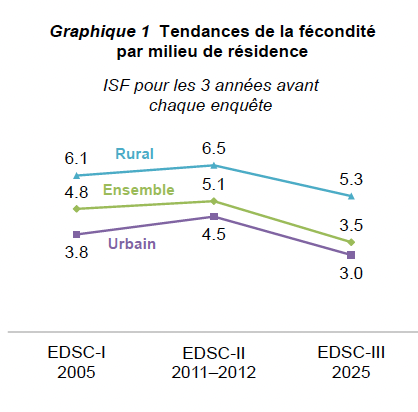
3) Guatemala has gone from 3.8 in 2005 to 1.9 in 2024. These changes can happen really fast.
Last week I posted a new paper with Patrick Norrick: “Terra Incognita: The Economics of a Shrinking World.”
We chose the title deliberately. No society in history has experienced the fertility levels now seen in South Korea, China, Thailand, Colombia, Chile, and many other countries. Our knowledge of the causes (and of the economic consequences) remains far more limited than most public discussion acknowledges. Much of what we write is, at best, educated conjecture.
The paper also struggles against a space limit. We wrote 20,000 words, far from the 250,000 or so we would need to address some issues in more detail (if I had the time and resources to hide away for a year, I could do that, but not now). That means some ideas are only sketched.
Nonetheless, we emphasize several important points.
First, fertility has fallen very fast everywhere: rich and poor countries, east and west, north and south, conservative and liberal societies, religious and non-religious societies (with the exception of the Jewish population of Israel; fertility has also collapsed among the Muslim population within the pre-1967 borders), you name it. Even in sub-Saharan Africa we see fast and unprecedented drops in fertility (alas, from a high initial level).
Second, and this is really interesting, the fertility collapse has been concentrated in poor and lower-middle-income countries much more than in rich countries. By now, income per capita and fertility are positively correlated within OECD countries. We conjecture this will hold globally in a few decades.
Third, and related to the second point, the fertility collapse has been concentrated among poor and lower-middle-income women within countries. In countries such as the U.S., the rich and highly educated now have more children than the poor and less educated.
Fourth, we document why we do not understand the data from the U.N. World Population Prospects. See, for example, Tables A.1 and A.2.
Fifth, we explain why some proposed mechanisms struggle when confronted with the data.
A more subtle point is at work here. Many commentators do not seem to understand the difference between proximate causes and ultimate causes. Yes, births might have gone down because fewer women are in long-run relationships. That is the proximate cause. But you need to explain why fewer women are in long-run relationships (the ultimate cause), and saying that they spend more years in school, to take one example, does not get us very far. Why do they spend more years in school? Once you start down the whole chain of reasoning, things become much harder than they seem.
The paper can be found here:
https://t.co/VrCHr0lBPa
Comments always welcome!
Twitter, I need your help finding a childhood friend!
We met in 2001 on the Bournvita / British Airways
Children's Magic Flight to Paris. Unfortunately, I don't remember his name.
Retweets are highly appreciated! Thank you.
Omarchy Quattro is out!! This is one of the greatest software releases in my professional career. I hope you enjoy using it just as much as I did building it ✌️ https://t.co/81wLStgH7P
The most reliably predictable trend of the next 100 years: every year, humanity will use significantly more computing power than the previous year.
Someone should start an ETF based on that thesis (it's not just $NVDA and $AMD, it's cloud services, the data center industry, nuclear power...)
Enjoyed this Esquire feature on the Churchwell brothers. IMO, they are among the last elegantly dressed men in the United States. Notably, neither are "fashion influencers." They are both distinguished doctors with great taste and a lifetime relationship with the same tailor.
we built pdf-inspector so agents can process PDFs without waiting on OCR. it classifies any PDF in ~20ms and extracts clean markdown locally
→ 200 PDFs processed in 2.8s
→ top quality in extracting tables + graphs
→ built in rust
→ open source
https://t.co/Wjp9kpTHXJ
Releasing the model weights and technical report of Kimi K3.
Kimi K3 is our most capable model: a 2.8T MoE model with native visual understanding and a 1M-token context window.
New model architecture: 2.5x the intelligence per unit of compute, not just more params.
Alongside Kimi K3, we're opening up more of the stack behind it — high-performance attention kernels, MoE communication library, and infrastructure for running agent environments at scale.
Model weights: https://t.co/7m7eEg6Y0B
Tech report: https://t.co/yeu6cjpMCT
Tech blog: https://t.co/YTfiMSNM1f