A lot changes when people start relying on what you build.
Over the past few years, Cubist has gone from helping teams experiment onchain to running systems that institutions depend on to move billions of dollars. Rohan stepped away from a compelling role as CEO of Gemini's prediction market to help Cubist meet rising institutional demand, and we’re honored by the conviction behind that choice.
We shared a blog post today about this moment and why welcoming Rohan as President feels like the right step as banks and enterprises move tokenized deposits, stablecoins, and onchain workflows into regulated production.
We believe that systems can have your back. Security isn't just a checklist for us: strong signing operations are built for real life and can say "no" when people can't.
What do you believe in?
Our customers kept wanting to restrict key usage based on core application logic: needing to check state on a different chain before signing, compute over sensitive data, or tie approvals to an external system.
Those kinds of rules don’t fit neatly into a predefined menu—especially when handling keys programmatically—because they’re unique to every product.
That’s what led us to develop Cubist Confidential Cloud Functions (C2F): instead of prescribing a narrow set of rules to govern signing logic, it gives developers the freedom to write their own.
🔍 On-chain verification — check blockchain state before signing (e.g., confirm a burn or liquidity event).
🛡 Cross-chain enforcement — “watch here, act there” logic (e.g., Bitcoin event authorizing action on Ethereum).
🔗 Integrations with external systems — tie approvals to KYC/AML services, fraud monitoring, oracles, LLMs, etc.
🧪 Transaction simulation — run simulations and gate signatures based on the result.
🚦 Smart contract upgrades — require that upgrades are signed by CI pipeline builds and/or approved by auditors.
🔒 Privacy-preserving policies — enforce sensitive approval logic off-chain without exposing it publicly.
🔑 Secret-handling policies — run logic over sensitive data (e.g., trading strategy, cross-chain order book, API keys, etc.) that is dangerous to include in an onchain smart contract.
🧩 Composable attestations — accept or reject transactions based on attestation evidence from trusted enclaves or validators.
The takeaway: for most Web3 use cases, infrastructure security needs to be programmable. Confidential Cloud Functions make key management as expressive as application code.
Bridges don’t just pass transactions across chains. To function securely, they must reconcile entirely different models of computation across entirely different consensus mechanisms.
This translation layer is fragile, and bridge failures can show up in many ways: compromised signers, smart contract bugs, exploitable serialization code, and forks that undo transaction finality. These look like siloed problems, but they all stem from the same issue: bridges are forced to mediate between systems with no shared assumptions.
All bridges should be running a second layer of defense. We developed Bascule Drawbridge for exactly this: if Bascule detects a request that would imbalance funds on either side of the bridge, it pulls up the “drawbridge” before the suspicious transaction is processed. This prevents unbacked mints/withdrawals, double spends, and real funds being sent to the wrong recipient.
Hashi will enable lending, borrowing and yield on native Bitcoin through onchain financial services.
Cubist is glad to support the infrastructure layer helping BTC move into and out of these institutional workflows responsibly.
https://t.co/L1KS4Tk2Qo
Introducing Hashi: a new era of Bitcoin finance on Sui.
Bitcoin's market cap exceeds $1 trillion. < 0.5% of it is used in DeFi.
Hashi is here to change that, with commitments from industry leaders including BitGo, Bullish, Erebor Bank, FalconX, Fordefi, Ledger, and more.
Hashi creates a transparent framework for BTC-backed collateral flows on @SuiNetwork.
We’re glad to have Cubist infrastructure enabling the movement of BTC in and out of Hashi when used as collateral and serving as an engine to maximize collateral efficiency.
Cubist is live on @tempo.
Institutions building on Tempo can now use Cubist's high-performance infrastructure to safely and privately automate digital asset operations:
🔐 wallets
🪙 tokenization
⚡️ payments
🤐 private smart contracts
Cross-chain without smart contracts.
Excited to see this off-chain approach from @squidrouter. Using Cubist tech, their new settlement protocol can extend to any chain and any token—including chains that don’t have smart contracts—without services like Axelar or LayerZero.
A novel design that is built to scale:
• A Trusted Execution Environment (TEE) powered by @cubistdev, settled with onchain proof.
• No smart contracts. No third-party messaging. Protocol agnostic.
• Independent from third party services such as Axelar or LayerZero.
• Any source, any destination.
We rebuilt the rails.
Skate 1-Click is a good example of the seamless UX that becomes possible when Cubist Confidential Cloud Functions (C2F) are used as cross-chain smart contracts.
@skate_chain is using C2F to allow users to deposit from Solana, Sui, and other altVMs into top EVM yield protocols.
2/ @cubistdev shared how onchain systems became mission-critical in 2025, supporting regulated finance, consumer wallets, and DeFi at scale.
🔗 https://t.co/Z1OAqVgXyG
Great demo by @skate_chain showing how they're using Cubist Confidential Cloud Functions to simplify the UX for their upcoming cross-chain yield product. In a single click, users approve transactions on multiple chains without having to switch wallets or bridge assets.
Congrats to our partner @Lombard_Finance on a first-of-its-kind live asset migration. Maintaining continuity while upgrading core infrastructure sets a strong example for how digital asset systems can evolve with the right operational controls quietly working in the background.
One for the history books.
The industry's first live asset transition is complete✅
BTC.b now runs on Lombard's architecture.
3,785 BTC were migrated with minimal user disruption. All functions are operational and all tokens, balances, and integrations remain unchanged.
The industry’s first migration of live digital asset infrastructure has successfully completed.
Upgrading the infrastructure powering a live financial asset—while it remains in active use by customers and integrated systems—is not a routine exercise. It requires tight operational controls to manage risk and maintain continuity.
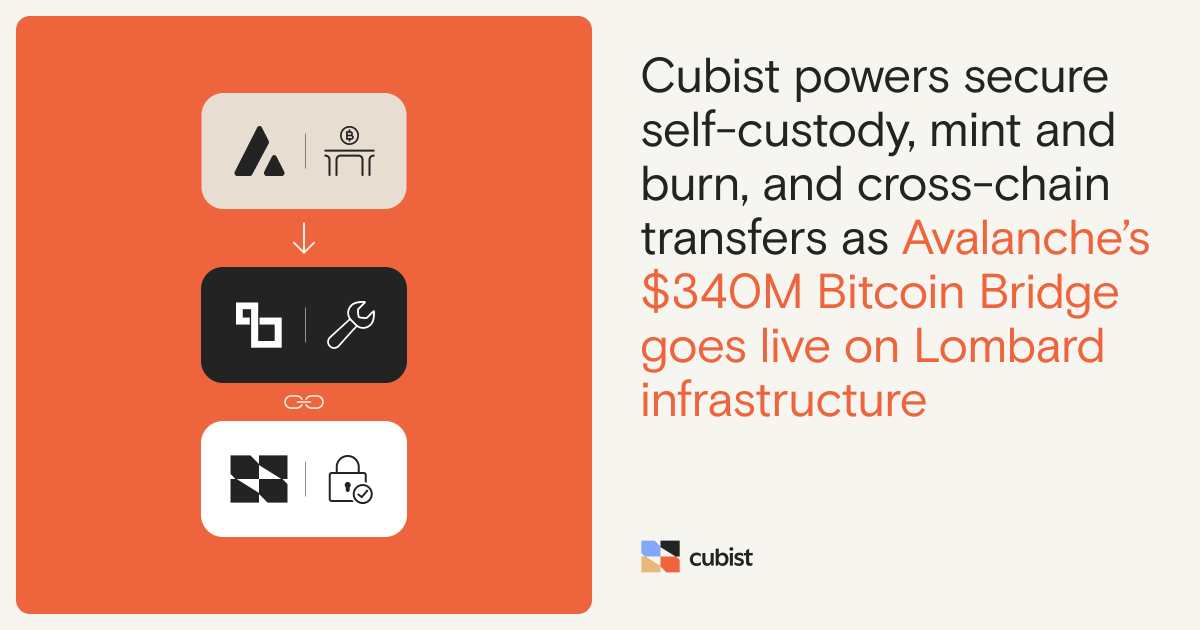
Following @Lombard_Finance's acquisition of the wrapped Bitcoin asset BTC.b from @AvaLabs in October, BTC.b continues to operate without disruption and, as of yesterday, is now running on Lombard’s infrastructure.
This type of live infrastructure transition mirrors the familiar challenges financial institutions face when modernizing core systems while keeping services running and risk tightly controlled.
Cubist’s digital assets operating platform supports Lombard with institutional-grade security and operational controls for BTC.b.
CubeSigner, Confidential Cloud Functions, and Bascule Drawbridge enable Lombard’s trust-minimized, multi-layered security model, powering secure self-custody, mint and burn, and cross-chain transfers without institutional gatekeepers.
This is what production-grade digital asset operations look like when approached with rigor and accountability.