The five takeaways from Lift:
1. Nobody is self-made.
2. Look for the person who sees your strength.
3. Build a small circle that tells you the truth.
4. Learn the rules of the room before you follow them.
5. One honest voice. https://t.co/kDvLJtHji0
The final chapter in my book Lift tells the story of the Baghdad Airlift, the rescue by two pilots of thousands of Iraqi Jews. It is a stunning story told to me by one of the pilots.
Lift was named a USA Today best seller and selected by Malcolm Gladwell, Daniel Pink for the Next Big Idea Club must read.
https://t.co/g7tDD7tVUH
It's official: Italy 🇮🇹 has written the IHRA definition of antisemitism into law, 147 to 93.
In response, Amnesty calls it "a bleak day for freedom of expression."
For Italian Jews, the bleak days are the ones spent being targeted. Amnesty's priorities are showing.
@Handre Ending apartheid liberated Blacks in South Africa. If that failed to produce better conditions, and the economy failed afterwards, that is at the hands of the elected leaders, not history.
What is so strange is that the 'keep schtum' is the prerogative of the embarrassed political leader, and now it is the educator who has found common cause with silence.
🚨 MAJOR EXPOSÉ — MIT PRESIDENT SALLY KORNBLUTH: FROM THE DUKE RESEARCH SCANDAL TO THE DAVID M. SABATINI ORDEAL
At @DukeUniversity, Sally Kornbluth, then Vice Dean for Research at the School of Medicine, faced serious criticism over her role in the institution’s handling of the Anil Potti cancer-research scandal, including warnings about research subsequently exposed as fraudulent.
She later publicly emphasized the importance of timely, independent investigations.
NOW THE SAME PRINCIPLE IS BEING TESTED UNDER HER OWN LEADERSHIP AT @MIT.
⚖️ October 16, 2026: A Massachusetts jury found Kristin Knouse liable for defamation and tortious interference with Professor @DMSabatini's professional relationships, awarding him $6 million in damages, plus substantial prejudgment interest.
📑 Separately, court documents revealed that MIT Dean of Science Nergis Mavalvala, who subsequently chaired the committee recommending Sabatini's tenure revocation, had previously declared “complete alignment” with @WhiteheadInst Director Ruth Lehmann concerning the controversy.
Following the verdict, approximately 50 scientists called on MIT leadership to reconsider Sabatini's case.
Yet MIT has not publicly announced an independent reopening of its tenure-review proceedings.
THIS IS NO LONGER SIMPLY ABOUT WHAT HAPPENED TO SABATINI. IT IS ABOUT WHAT MIT'S PRESIDENT WILL DO NOW THAT THE EVIDENCE IS PUBLIC.
The jury established Knouse's civil liability for defamation and tortious interference. The verdict creates an urgent basis for examining whether false statements, manipulation of evidence, or improper outside influence affected MIT's institutional decisions.
THE DUKE SCANDAL RAISED QUESTIONS ABOUT KORNBLUTH'S HANDLING OF INSTITUTIONAL WARNINGS. THE SABATINI ORDEAL NOW DEMANDS ANSWERS ABOUT HER LEADERSHIP AT MIT.
🔱 ScienceGuardians™ Legal and Investigative Team
@SciGuardians 🔱
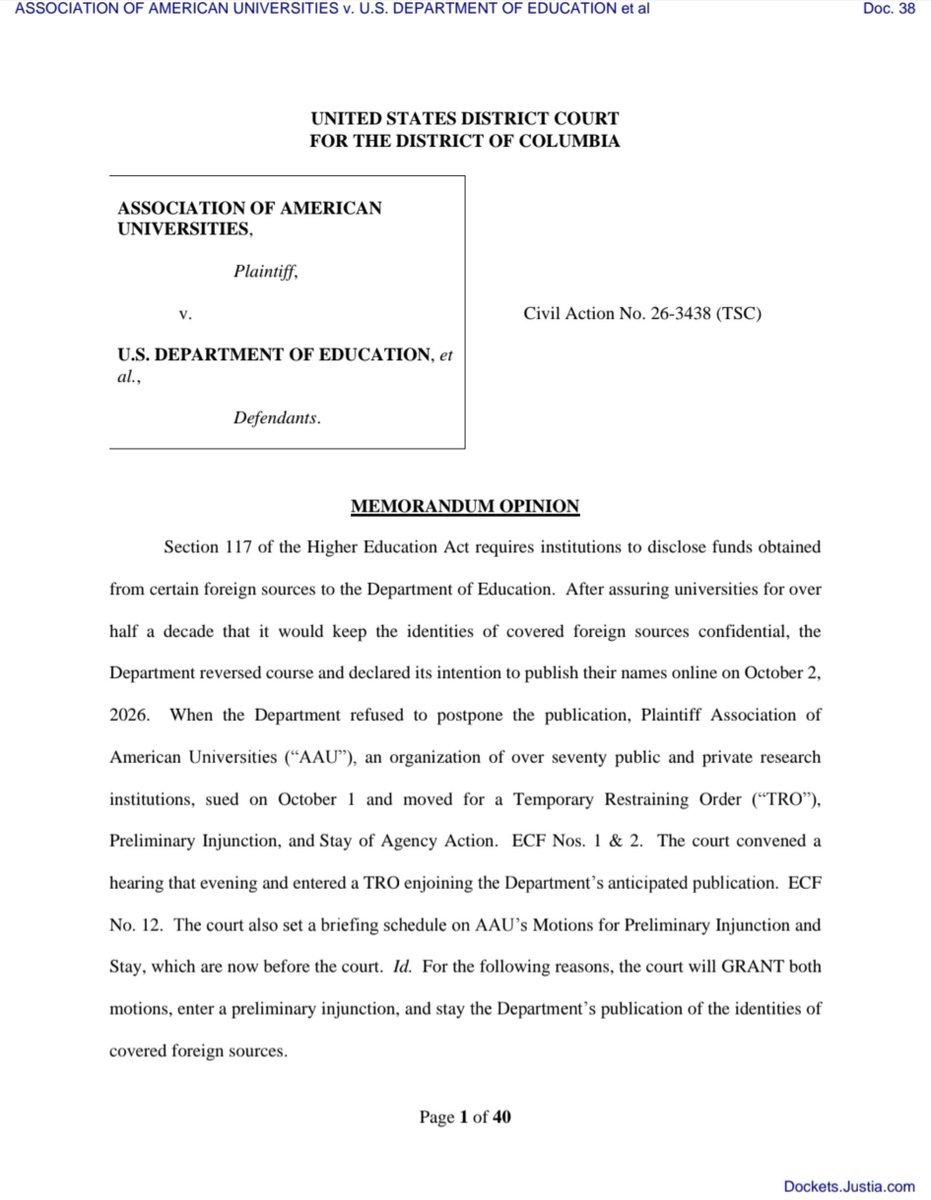
BREAKING: On Nov. 13, a federal court blocked the Education Department from publishing the names of top foreign donors to major U.S. universities.
This will allow foreign governments to continue pouring billions into American universities with virtually no transparency
What Would Warren Do?
In the 1950s, Swarthmore College psychologist Solomon Asch, known for experiments on the dangers of conformity, found that three out of four people followed a group to an obviously wrong answer at least once.
The problem is that the herd is louder now. It lives in your feed, and it has worked its way into your unconscious thinking. The real danger? You aren't aware of it. In 2005, Gregory Berns, a neuroscientist at Emory University, scanned people's brains while a group around them gave wrong answers. In the people who went along weren't lying. Brain scans proved they saw what the group told them to see.
When that happens in business, there is loss, of money or of life.
In 2022, Sequoia Capital, one of the most respected investors in Silicon Valley, wrote its $213.5 million stake in FTX down to zero. Two partners, Alfred Lin and Michelle Bailhe, championed the deal. Bailhe rallied the others, "No, it's worth it. Cancel your afternoon." During the pitch, the chat filled up: "I LOVE THIS FOUNDER." "I am a 10 out of 10." "YES!!!" Nobody in the chat said no.
In January 1986, the night before Space Shuttle Challenger launched, engineers at Morton Thiokol, the company that built its rocket boosters, warned that the seals could fail in the cold. They recommended no launch below 53 degrees. That was inconvenient: the forecast low was 18 degrees. Thiokol's management told the head of engineering, "Take off your engineering hat and put on your management hat."
Seven astronauts died.
You've been there: in every conference room, at every major decision, the leadership team has spoken. If you don't have at least one person in your life who tells you no, the herd will tell you go ahead and launch.
The people I write about in Lift, from a Nobel Prize winner to an Olympian to a four-star general, all relied on at least one person who would tell them no, some of them often.
In my own life, I call the habit What would Warren do? It's the question you ask before you act, once your mind is made up. Whether to put your children's savings into AI stocks. Whether to send them to a state school or to a private college at nearly four times the tuition. Buffett left Wharton and graduated from the University of Nebraska. #WhatWouldWarrenDo
In 1972, Warren Buffett balked at paying $25 million for See's Candies. Charlie Munger, the partner Buffett called "the abominable no-man," pushed him to pay it. See's has since earned Berkshire more than $2 billion before taxes.
What would Warren do? He'd ask Charlie.
Three moves:
1. Ask Dr. No before you decide.
2. Think for yourself, not by yourself.
3. Put the herd on silent.
@SMUMustangAlum I find this all the time with early stage even after they grow to unicorn and 1000x unicorn. They get comfy with power. Boards aren't doing their job.
The administration of CUNY, of which Hunter is a division, has reportedly fostered a climate of antisemitism for some time. There’s no way the current government of NYC or NYS will lift a finger to fix this.
"The FAA is a major government department that is still using floppy disks. Think of that when you hear people suggest the government should also be in charge of a technology like AI."
- Chris Lynch (@ALargeRegular)
https://t.co/KZ6NdxtvIU