Jane Street holding $990M in spot Bitcoin ETFs while digesting a reported $15B July hit highlights how market makers operate. That $828M IBIT stash reflects core inventory and hedging flow rather than a simple directional bet https://t.co/OYnfiE2FLh
This year has been a huge W for satoshi and the whole blockchain space IMO. Instead us trying to build infrastructure for the convenience of traditional giants, they are adapting to our tech and coming with huge retail users and onboarding them onchain.
The retail we always wanted.
If you are building a Fintech product or a Neobank, it just got way easier to integrate trading using just 1 API
We can also provide you with the best consultations and integrations on other parts such a Card Issuance, vIBANs etc.
Check the API here: https://t.co/zfanLR6z02
One of the most important things in whatever you do is to not get attached to one approach even when it isn’t working. Knowing when to pivot from a losing strategy to a winning one is equally important.
Specifically sales
Crazy feeling buying an NFT and there are already GIFs, stickers, and memes built around it.
That’s when you know the brand has escaped the collection.
@pudgypenguins is doing things right.
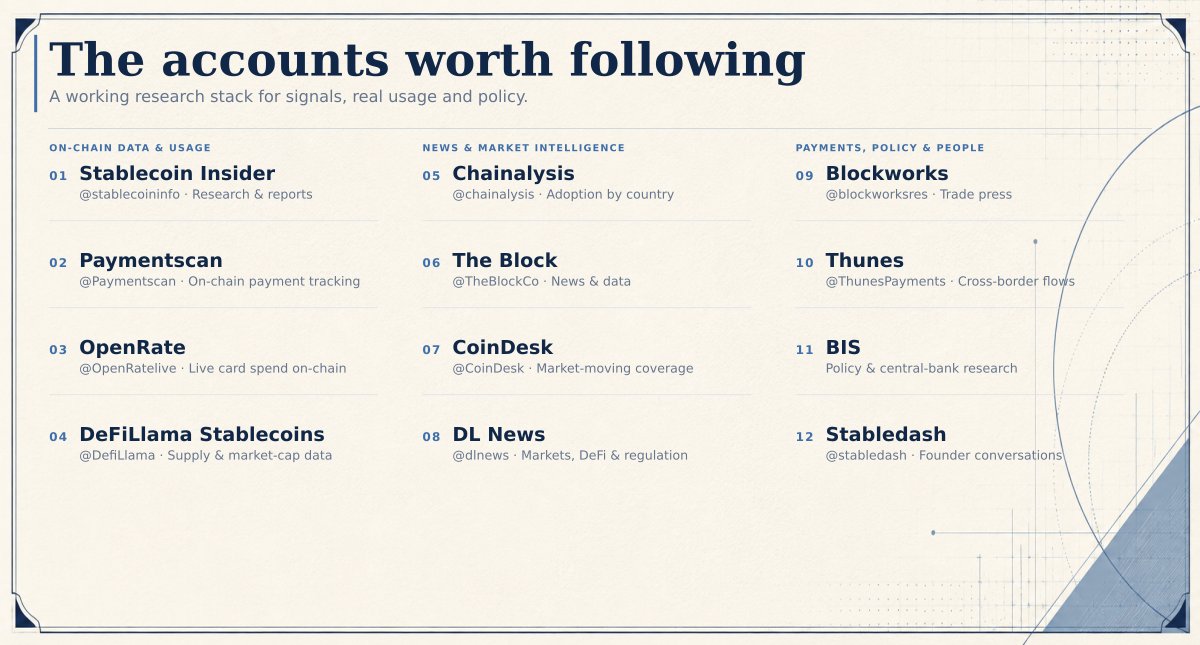
Here are some of the best stablecoin news and data tracking accounts you should follow:
1. @stablecoininfo (https://t.co/leZvyIn87L)
The most consistent depth in the sector. Their reports flag which of their own figures are load-bearing and which are directional, which almost nobody else does.
2. @Paymentscan (https://t.co/CP32JICALA)
On-chain payment tracking.
3. @OpenRatelive (https://t.co/tRQ6T1DsyO)
Tracks real card spend on chain, daily. The clearest view of whether stablecoin cards are actually being used rather than just announced.
4. @DefiLlama Stablecoins (https://t.co/jwJLxkskGK)
The default for supply and market cap.
5. @chainalysis (https://t.co/odPbfnPo5P)
The standard for adoption by country. Their regional reports show which markets are actually moving volume rather than which ones are talking.
6. @TheBlockCo (https://t.co/I3oYusXWtd)
7. @CoinDesk (https://t.co/5rkczIV2ko)
8. @dlnews (https://t.co/kYNCPEBjAW)
9. @blockworksres (https://t.co/0OQcO3BIL6)
The trade press. Fast on news, best read with the volume caveat above in mind.
10. @ThunesPayments reports (https://t.co/WPBd4c2Sc9)
The clearest view of cross-border flows and how stablecoins fit into payment rails that already exist.
11. BIS (https://t.co/meGrfmyQbV)
What regulators are reading. If you want to know how a central banker sees this market, read what they publish.
Stabledash Podcast @stabledash
Founders talking directly, which is often where the mechanics get explained better than in written coverage.
Day 1 of the Unemployment arc. Officially up for grabs.
Quick rundown of the last 5 years:
• In the space since 2021
• First BD and Sales hire at Surgence (leading growth agency). Built the funnel 0 to 1, $600k+ in revenue
• Partner-facing roles with Seedify (OG launchpad)
• Most recently BD and Partnerships with Paladin (security firm)
• 50+ dealflow and co-marketing partnerships closed across operators, funds, fintechs and protocols (Circle, DWF Labs, Ava Labs and more)
• Fluent across the whole growth and sales funnel: outbound, partner-led, content, PR and co-marketing
• Well connected across the space, funds, service providers, MMs, leading protocols and always in touch with new teams
• Built and executed AI-assisted processes across sales, BD and partner management
• Events BD, put together a 250+ attendee GC for Consensus
• Wrote content to build authority and pull in inbound
I like ownership in my work, wearing multiple hats, and figuring shit out by doing.
Recently I've been spending more of my time learning fintech, stablecoins and payments. Want to join an early team building the money layer, on BD/Sales and partnerships.
DMs are open.
Stablecoin balances sit idle inside a lot of fintech products. There are now several ways to earn 4-12% on them, and choosing between them looks like a rate comparison.
For a crypto-native user base it more or less is. Those users can assess what they are being paid for and price the risk themselves.
For neobanks targeting Web2 users, I think it is a different question. It comes down to how well you can explain the risk. If you have to talk about funding rates or contract exploits, most users won't really get it, unless someone builds a dumbed-down earn product for them.
Exploring products from @ethena, @aave and @Morpho. Article on my Substack later this week. Incase you have a earn product want to be featured, please drop docs under the tweet.
Almost everyone I know who works from this side of the world quietly thinks they are not good enough for the rooms they want.
That feeling is not a flaw in you. It is an accurate reading of a rigged signal.
Wrote about why, and about the one thing that actually breaks it.
The best sales trick is not a trick. It is being genuinely interested in helping the other person, not just closing the deal and disappearing after you get paid.
This matters even more when the market is bad, because upselling becomes your biggest cheat code. And upselling only works when your relationship with old clients is still alive.
A well regulated company is now on a acquisition spree to become the fintech giant (but with regulations). Either they see the potential in these businesses and think they would compliment the current infra, or it may be to boost the valuation before the IPO
@Payward, the company behind @krakenfx, has been buying aggressively ahead of a potential listing, and the pattern looks deliberate. Bitnomial and Reap give it licences, compliance reach, derivatives infrastructure, and payment rails.
Backed, Magna, and Magic Labs give it product surfaces: tokenized equities, token lifecycle tooling, and embedded wallets. Put together, this looks less like Kraken adding random businesses and more like Payward trying to become regulated crypto infrastructure.
Last week I was cleaning up my bookmarks and found over 50 articles saved across X, Chrome and Substack. I realised I wasn't building knowledge. So I built Lens (what I am calling my Hermes agent from @NousResearch).
Instead of bookmarking, I drop every interesting article into an Observation Vault. Each one becomes an observation to revisit, challenge and form an opinion on before deciding whether it's worth writing about. It has also changed what I read. The best observations rarely come from staying inside the Crypto Twitter bubble. They come from reading founders, researchers and operators with deep domain expertise, even if they're in completely different industries. The goal isn't to consume more information. It's to compound better thinking.
Saw that @stripe is in talks to acquire @OpenRouter for nearly $10 billion, less than two months after OpenRouter was reportedly valued at $1.3 billion.
If the deal goes through, it would be one of the largest acquisitions in AI infrastructure this year.
Agentic payments are still tiny. AI agents settled roughly $73 million across 176 million blockchain transactions in the year through April. A $10 billion valuation suggests Stripe is paying for where it believes the market will be in five to ten years, not where it is today. If agentic commerce scales as expected, it could look like a bargain.
If adoption takes longer, it may prove to be a very expensive bet.
One of the best ways to understand where banking is heading is to look at where cloud computing ended up.
Cloud didn't stop innovating because people stopped talking about it. It became the invisible infrastructure behind nearly every modern internet business. Banking is beginning to follow a similar path, with stablecoins quietly evolving from a novel technology into the financial rails underpinning the next generation of products.