ANTARCTICA, SCIENCE, AND A LESSON IN HOW GOOD RESEARCH WORKS
One of the most frightening climate scenarios involves Antarctica. The concern is that warming oceans and air temperatures weaken floating ice shelves, exposing massive ice cliffs behind them. Some earlier models suggested that once these cliffs exceeded about 90 meters in height, they could collapse under their own weight, triggering a runaway retreat of the Antarctic Ice Sheet and accelerating sea-level rise.
This study revisits that assumption and asks a simple but crucial question:
Does the speed at which an ice shelf disappears matter?
The answer is yes—dramatically.
Previous models largely assumed that once support from an ice shelf vanished, the newly exposed ice cliff would respond almost instantly and fail. But the researchers found that ice behaves differently depending on how quickly that support is removed.
If an ice shelf disappears extremely rapidly—within less than an hour—the exposed cliff can crack in a brittle manner and collapse. In that scenario, even relatively small cliffs around 90 meters tall may be unstable.
But nature rarely works that way.
Using observations from Antarctica and detailed physical modelling, the researchers found that actual ice-shelf collapse usually takes days, weeks, or longer. When support is removed over these longer timescales, the ice has time to adjust. Instead of shattering, it slowly deforms and flows, much like very thick honey. Scientists call this ductile or viscous deformation.
Under those more realistic conditions, the critical height for collapse rises dramatically—from about 90 meters to roughly 540 meters. Most exposed ice cliffs would therefore bend and flow rather than trigger a runaway chain reaction. The study concludes that many scenarios of rapid Antarctic collapse may have overestimated the role of ice-cliff failure because they ignored the timescale over which ice shelves disappear.
Beyond Antarctica, this paper offers a broader lesson about science itself.
Good science is not about defending dramatic predictions. It is about testing assumptions. Here, scientists challenged an influential idea, added a missing variable—time—and discovered that the outcome changes substantially. The result is neither climate denial nor climate alarmism. It is a refinement of understanding.
Climate change remains real. Antarctic ice loss remains a serious concern. Sea levels will continue to rise. But this research reminds us that accurate predictions depend on understanding not only what can happen, but also how fast physical processes unfold.
Nature is often more complex than our first models suggest. Science advances when those models are continuously questioned, improved, and brought closer to reality.
Antarctica’s Collapse May Have Already Begun
Antarctica is melting and one of its largest glaciers is collapsing from underneath. Thwaites could trigger a wider collapse of the full West Antarctic ice sheet, raising sea levels by 5 meters.
Credit: Russell Arnott ― New Scientist
Antarctica is melting and one of its largest glaciers is at risk. In our latest video, we speak to the scientists involved in an international effort to better understand Thwaites glacier, and learn why its potential collapse is much worrying than we pr... https://t.co/VNGSBytt8V
Evacuation warnings are in effect for several mountain zones east of San Diego for the Border 6 Fire.
The blaze has burned over 700 acres as of Wednesday morning.
Impacts to State Road 94 are possible. #CAwx
🌡️ W Europe, parts of the Atlantic & Mediterranean saw unusually warm conditions in late May.
🛰️ Based on @CMEMS_EU data, sea surface temps exceeded seasonal avg by 5°C+ in some areas. These data help monitor marine heatwaves.
🔗 https://t.co/1BqWJ8r3l3
#ImageOfTheDay#EUSpace
AFRICA RECORD HEAT
Record heat is allover: Oceania,East Asia,Central Asia,Western Asia,Northern and Southern Africa,North and South America.
HISTORIC HOT NIGHT IN NIGER
Those Minimums are the highest ever in June:
32.5 Goure
32.1 Birni N Konni
30.6 Magaria
🚦🛣️ A Saharan dust highway in the Atlantic.
Two clearly distinct lanes, the haze going one way and the haze returning the other, with the Azores anticyclone orchestrating this curious traffic.
The loop is completed on Friday... 🔁👀 https://t.co/5U7ikkTEno
The historic May #Europe#heatwave has propelled Mediterranean temperatures into record territory with spots up to 6°C/ 11°F above normal with an ongoing Marine heatwave underway… 1/
The Arctic is warming at a rate up to four times faster than the planet as a whole and has lost a third of its sea ice volume in just two decades: https://t.co/I7YnTcqbvX
There is a no time to wait. #ActOnClimate#climate#energy#renewables#GreenNewDeal
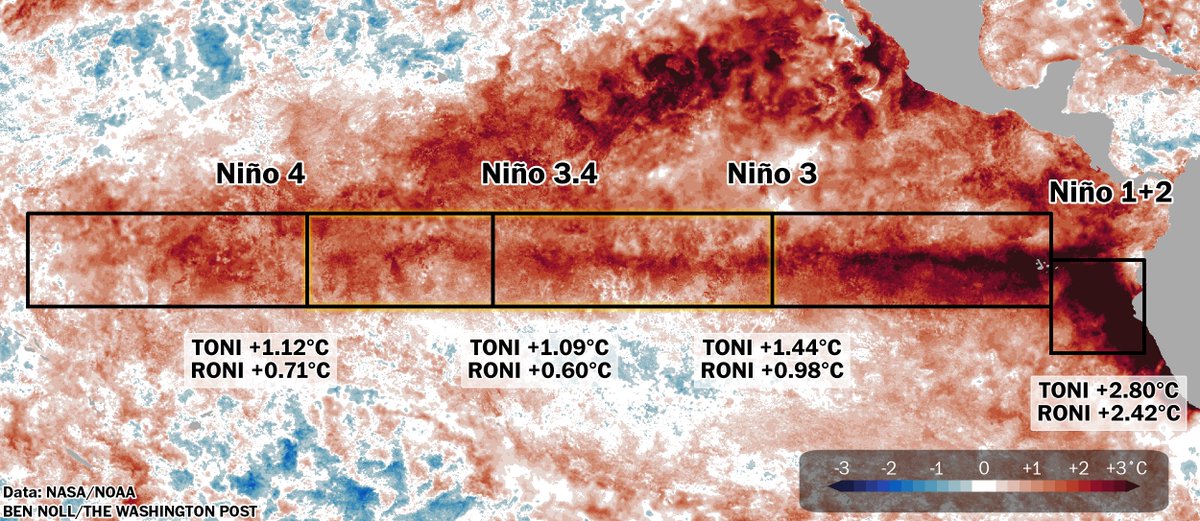
An El Niño Costero is rapidly strengthening near Peru, with the Niño 1+2 Index approaching +3˚C.
Water temperatures have so far reached a maximum of 6.4˚C above average about 90 km offshore of Santa Rosa, Peru.
A similar situation was unfolding at this time in 1997.
A solar flare measuring M9.3 was detected around Earth facing sunspot region 4455 peaking at 01:36 UTC (June 3). A further update will be provided if a CME is associated with this event. So far it appears that an eruption with this event would likely be minor. More to follow.
🚨🌊 THIS IS STARTING TO LOOK VERY SERIOUS.
We now have +5°C ocean temperature anomalies showing up off the coasts of Peru and Ecuador.
That is the birthplace of the world's strongest El Niño events.
The Pacific is heating up at a pace that should have everyone's attention.
🔥 Massive amounts of heat are building in the eastern Pacific
🌊 Warm water continues surging eastward
🌍 Global weather patterns are beginning to respond
If this trend continues:
🌡️ Historic heatwaves could spread across multiple continents
🌾 Crop failures and agricultural stress could intensify
📈 Food prices could surge globally
💧 Droughts and water shortages could worsen
🌧️ Flooding risks could increase in vulnerable regions
The atmosphere hasn't fully coupled with the ocean yet.
That's the scary part.
The Pacific is still loading energy into the system.
And if a full-blown Super El Niño emerges, the second half of 2026 could become one of the most extreme weather periods of the modern era.
Buckle up fellers...
IT'S SHOWTIME. 🌊🔥
#ElNiño #SuperElNino #Climate #Weather #Heatwave #FoodCrisis #Drought #Floods #GlobalWeather
AMOC TIPPING POINT TRIGGER COULD BE CLOSE
Sudden Huge Expansion of North Atlantic Cold Blob
Recent research finds the cold blob is caused by the slowing AMOC. We could be triggering AMOC tipping point – of future collapse. Copernicus Pulse. #AMOC#climatechange#globalwarming
Warm day in British Columbia, particularly near the coast.
30.4°C Bella Coola
29.8°C Delta
28.4°C Stewart & Terrace
27.8°C Bella Bella & Prince Rupert
27.6°C Cathedral Point
27.5°C Fanny Island
27.4°C Masset
27.1°C Vancouver Harbour
26.9°C Victoria-Gonzales
26.0°C Vancouver YVR
It's Saharan dust season in the Atlantic, the time of year when dust clouds from the Sahara Desert are carried westward across the Atlantic to affect the United States. Some of the dust could reach parts of Texas and Louisiana by the weekend.