You don’t need a husband or a wife.
You need just 1 great prompt.
Here’s how to use @perplexity_ai or @grok to replace your spouse forever!
Less bickering and more happiness!
I stole this idea and now use it with every single employee.
It’s the best illustration I’ve seen of teaching someone to be high agency.
It says there are 5 levels of work:
Level 1: “There is a problem.”
Level 2: “There is a problem, and I’ve found some causes.”
Level 3: “Here’s the problem, here are some possible causes, and here are some possible solutions.”
Level 4: “Here’s the problem, here’s what I think caused it, here are some possible solutions, and here’s the one I think we should pick.”
Level 5: “I identified a problem, figured out what caused it, researched how to fix it, and I fixed it. Just wanted to keep you in the loop.”
Using this framework, here’s what I say to every new employee…
You will live at Level 4 from Day 1 and as we build trust you will rise to Level 5.
Being high agency doesn’t just mean tackling problems in this way. It means your entire way of working should be oriented to being a Level 4+ employee.
Plz feel free to steal it as well.
And ty @stephsmithio for the framework!
I just spent 60 minutes grilling an ai cybersecurity expert with questions.
Here's everything I learned:
1. All of cyber boils down to ONE thing: don't let the business get compromised. every acronym, tool, and tactic ladders up to that.
2. It splits in two: AppSec (securing your code before it goes live) & ProdSec (securing the system once it's live).
3. White hat vs black hat. A white hat finds the bug & tells you for free. A black hat says "pay me & i'll show you." If someone holds a vulnerability hostage, that's the tell.
4. Key acronyms in the space:
SAST: scan your source code for bugs before you ship
SCA: check your open-source dependencies for known vulnerabilities
DAST: attack your own live app to see what breaks
WAF: a firewall that stops your site from getting flooded with fake traffic
Pen Test: you pay a hacker to break in & tell you how they did it
5. AI is the best defense AND the best offense. What used to be human-level attack & defense now happens at thousands of times the scale & speed.
6. You have to assume attackers WILL find the bug now. It used to be "they might not find it." Today it's cheap, fast & AI-enabled.
7. Prompt injection is the new #1 attack vector. One crazy example: a guy ran an AI agent that traded crypto & held his wallet keys. An attacker hid instructions in MORSE CODE in a tweet, got Grok to "translate" it, and because the reply came from Grok (a trusted source) the agent drained ~$170k from the guy's wallet.
8. It's not just attacks on randos. Salesloft's AI chat agent had Salesforce credentials baked in. one prompt injection let attackers pull customer Salesforce data, AWS keys & Snowflake tokens, and it cascaded to ALL of its customers.
9. Pen tests alone aren't enough anymore. @octane_security reviewed code pen tested 8-10 times & still found 5-7 critical bugs. Quarterly testing can't keep up when AI ships code daily.
10. Their AI found a bug that could've taken down 40% of Ethereum (a $320B network then). the cause? Two arrays where nobody checked one wasn't longer than the other.
11. How to use AI agents (like @openclaw and Hermes Agent) without getting wrecked: permission on a needs-only basis (don't auto-grant everything), assume your laptop gets stolen at Starbucks & ask what the agent could reach, and keep it away from your most sensitive data at the source.
12. Your people are the easiest way in. Social engineering is the most common attack. OpSec training & "don't leave your laptop open" aren't sexy tools, but they're effective.
13. You have to fight fire with fire. You need AI to secure the AI you're building, because the attackers are already using it.
14. Authentication remains a major vulnerability. "cross-tenant access" = one customer being able to reach into a different customer's data. They've caught free self-serve signups that could gain access to Fortune 500 accounts' data.
15. When to actually hire for security: pre-seed, B2B, selling to a few trusted companies? You're probably fine to wait. The second you launch self-serve or store highly sensitive data, your risk surface explodes & you need someone who owns it.
ty @giovignone for the masterclass.
Ajay Shah calmly bulldozes the "sovereign AI" rhetoric.
I fear, this won't get the attention it deserves as it doesn't pander to the peanut gallery.
Read this.
JENSEN HUANG PULLED THE NEW $249 JETSON OUT OF AN OVEN ON CAMERA AND SAID HE "COOKED IT TOO LONG, IT SHRUNK". THEN HE READ THE SPECS.
70 trillion ai operations per second. 25 watts. $249. runs everything the hgx systems run, large language models included.
the joke is the box came out of an oven. the real joke is the chip inside.
last year an h100 cost $30,000 and lived in a datacenter. now a board the size of a wallet pulls 25 watts under load and runs llama 7b in your kitchen.
the ceo of the most valuable company on earth just demoed the death of the ai subscription on a baking tray.
every dollar paid to chatgpt plus from january forward is a vote against the kitchen.
I genuinely don't understand why everyone isn't using this yet
Andrej Karpathy, a co-founder of OpenAI, posted a simple idea that hit 16 million views: stop using AI to write code, use it to build a second brain.
You point Claude Code at a folder, drop in any source, an article, a transcript, a PDF, and Claude reads it, links it, and files it into a living wiki of everything you know. It compounds like interest, the more you feed it, the smarter it gets.
Here's the whole thing:
> Install Obsidian, create a vault, open it in Claude Code
> Paste Karpathy's wiki idea file and tell Claude to build it
> Claude makes three folders: raw for sources, wiki for its pages, a CLAUDE.md that runs it
> Drop any source into raw and say "ingest this"
> Ask questions across everything, forever
Five minutes to set up, and you never start from a blank chat again.
Full step-by-step guide with Claude and Obsidian, link below.
Bookmark this
Technical implementation of Midjourney Medical image scanner fascinating.
It’s “just sound waves, a bath of water and 60 seconds”.
▫️step in shallow pool
▫️body passes rings of underwater sensors at 5cm/sec
▫️rings are made of 500,000 tiny squares (grain of sand) that act as both a speaker and microphone
▫️sensors send ultrasonic waves from every angle to form image of body (it “sees” like dolphin using echolocation)
▫️squares create terabytes of data each second (1 second of data scan equal to 500 hours of HD internet video)
All of the images create “3D map of your body down to a fraction of a millimeter, that looks a lo like today’s MRIs but nearly 100x the speed”.
MidJourney plan to have 50,000 of scanners avaialble worldwide by 2031 to do 1 billion scans a month. Most of global population have access. Make it as easy as going to a spa.
***
Full read here: https://t.co/IuFYA6TrdN
This is painful to see.
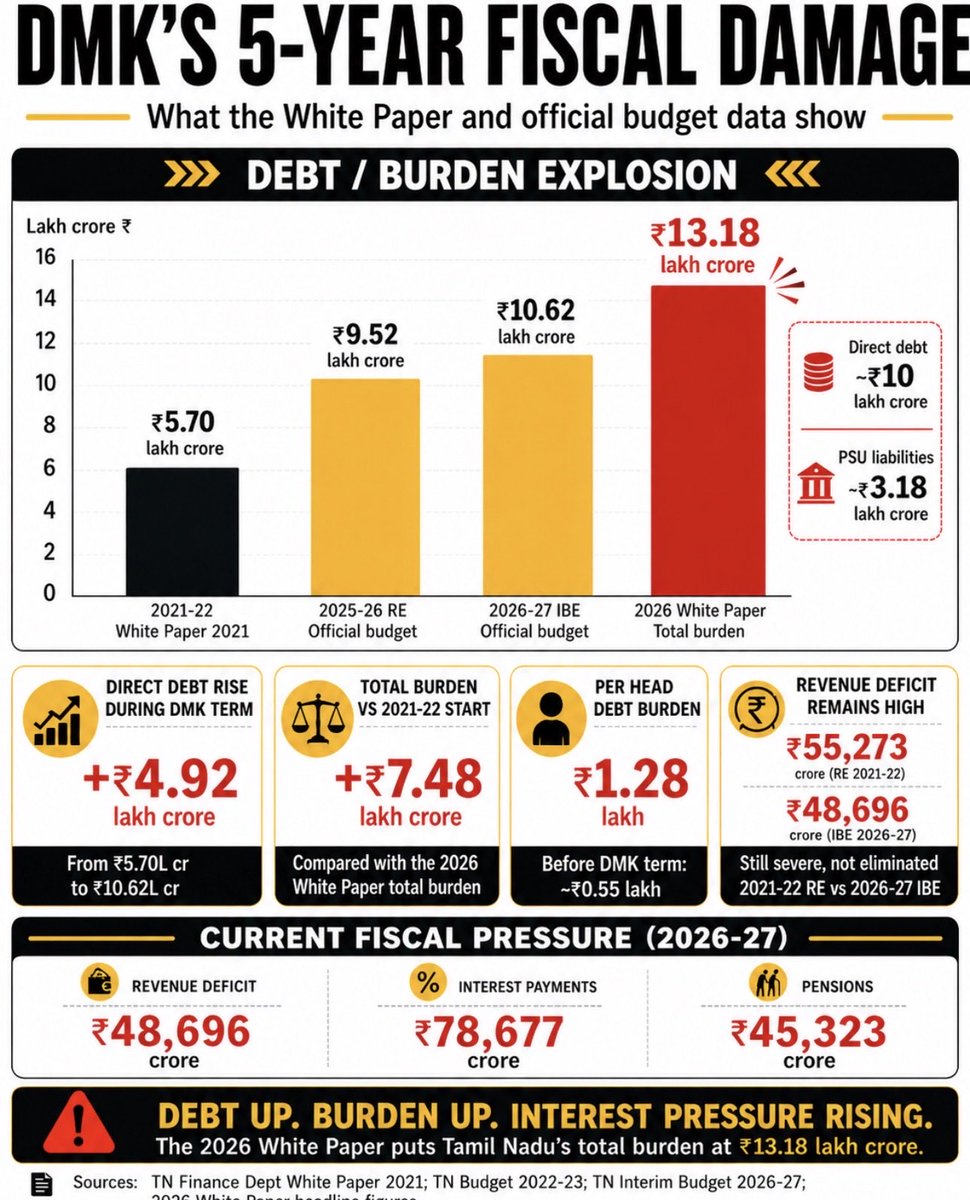
Tamil Nadu’s debt burden has reached a level where every common person is carrying the cost.
₹13.18 lakh crore total burden.
₹1.28 lakh per head.
Governments change, but the people are the ones who finally pay the price.
#TamilNadu#WhitePaper
Arnold Schwarzenegger's rule on complaining:
“No complaining about a situation unless you're prepared to do something to make it better. If you see a problem and you don't come to the table with a potential solution, I don't want to hear your whining about how bad it is. It couldn't be that bad if it hasn't motivated you to try to fix it.”
Major cheat code for life: Master the art of the fresh start. From a bad morning. From a bad interaction. From a missed workout. From a poor decision. The goal isn't to avoid the fall. It's to shorten the time between the fall and the reset. Fast recovery compounds.