Can diffusion transformers do in-silico neuroscience?
In a new preprint, we train models to generate neural (fMRI) time series. We condition per time step by injecting conditioning tokens directly in context. We evaluate on hundreds of unseen task conditions.
Some results! 🧵
The human amygdala is essential for rapidly acquiring cued-conditioned threat responses and forming memories resistant to extinction.
https://t.co/X7sidRTDjb
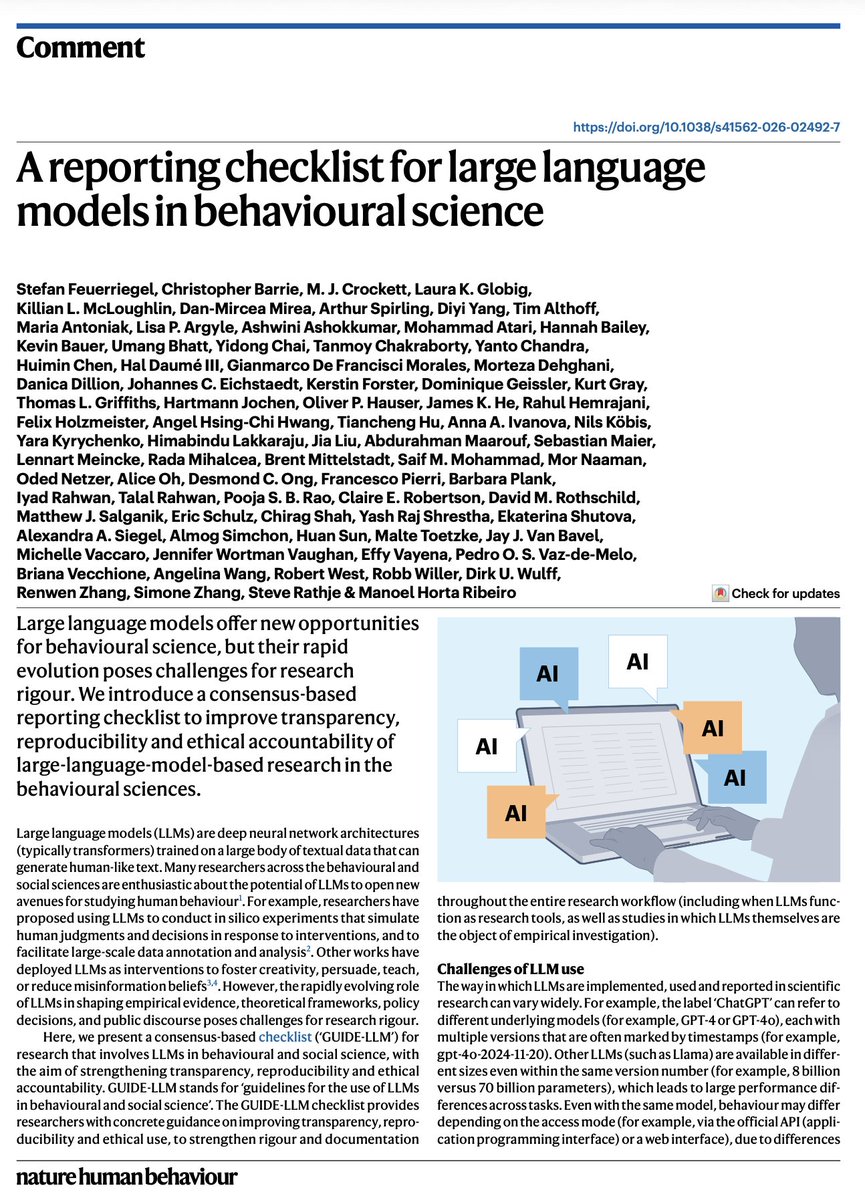
Large language models offer new opportunities for behavioural science, but their rapid evolution poses serious challenges for research rigour.
We published a consensus-based reporting checklist to improve transparency, reproducibility and ethical accountability of large-language-model-based research in the behavioural sciences in Nature Human Behaviour.
https://t.co/ELCU5h6uQe
Here is a link to our checklist for research transparents: https://t.co/XH0FxupT6D
It supports researchers in clearly describing how LLMs were used, why specific methodological choices were made, and what steps were taken to ensure responsible research practices.
This project was led by @stfeuerriegel and included a large list of expert coauthors from across numerous fields.
I just completed my service in my NIH study section. Some thoughts - with the disclaimer that these are personal, subjective impressions and do not reflect the opinion of any official body. Other than the one attached to my head. (1/10)
Trends in Cognitive Sciences
Machine understanding
This paper discusses what it means for a machine or AI system to “understand” something.
The authors argue that AI understanding should not be treated as a simple yes-or-no question. Instead, we should ask what kind of understanding an AI system shows, and to what degree.
They emphasize that strong performance on tasks does not necessarily mean true understanding. To evaluate machine understanding, we need to look at factors such as flexibility, generalization, explanation, world models, and sensitivity to meaning and context.
In short, the paper argues that AI can show different forms of understanding, but these must be carefully defined and evaluated rather than assumed from performance alone.
https://t.co/Bh9o8xuc4U
Computational models are a key part of science but discovering new ones is hard!
DataDIVER discovers concise models from data, surfacing new mechanistic ideas and generating clear predictions for future experiments
Preprint from @GoogleDeepMind Neuroscience Lab + collaborators
Cuanto más similar es la actividad neuronal de dos personas antes de conocerse, más probable es que terminen haciéndose amigos.
Los amigos están literalmente «en la misma onda».
NEW RELEASE:
Today we're releasing CortexMAE: a family of fMRI foundation models trained on 2.1K hours of open fMRI data.
We're also releasing Brainmarks: an open benchmark suite for evaluating fMRI foundation models.
Full paper is on arXiv (accepted to ICML 2026)
A thread:
Never in modern American history have we seen this level of politicization of science.
Federal research grants may now need to “demonstrably advance the President’s policy priorities.” Peer review will take a back seat to political approval.
Scientists cannot remain silent.
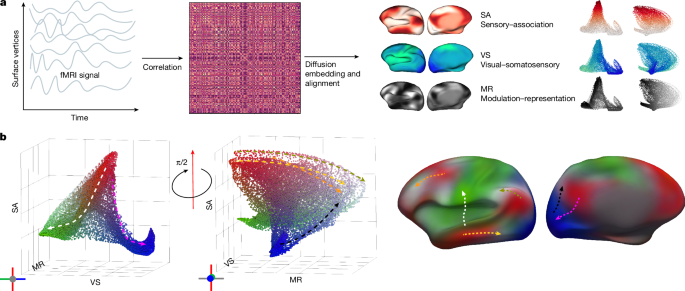
A new atlas reveals that functional connectivity patterns in the human neocortex shift dramatically from birth through old age, organizing brain regions along three dominant axes: sensory-to-association, visual-to-somatosensory, and modulation-to-representation.
https://t.co/A4XyHA9Jpv
Trends in Neurosciences
Cellular and molecular mechanisms of astrocyte plasticity in learning and memory
This review argues that astrocytes are also plastic and actively involved in learning and memory.
Traditionally, memory was mainly explained by synaptic plasticity in neurons. However, the authors suggest that astrocytes also change with experience through calcium signaling, metabolic support, gene expression, and regulation of neurotransmitters.
The paper proposes that learning should be understood as plasticity across the entire neural cell network, not only in neurons.
https://t.co/oR21xjuV9f
Visual attention relies on coordinated activity across brain areas.
Computational neural dynamics of goal-directed visual attention in macaques
https://t.co/9DLUTajt9J
#neuroscience
OUT NOW in @EJNeuroscience
Foundation Models for Neural Signal Decoding: EEG‐Centered Perspectives Toward Unified Representations Kwon - 2026
From Seoul National University @SeoulNatlUni@FENSorg@WileyBrainPsych
https://t.co/1LfGoRkEbe
I'm proud we are releasing LAION-fMRI, a densely sampled 7T fMRI dataset of natural images, with very broad stimulus sampling for testing countless hypotheses & deeply exploring brain representations. It is now available at
https://t.co/hOnILHonf9
What does LAION-fMRI offer? 🧵