American works are taking home a smaller percentage of corporate profits than ever before.
Employee compensation as a % of corporate GDP has fallen to ~54%, the lowest since records began in 1948.
In other words, workers are receiving ~54% of the income generated by corporations, while the remaining ~46% goes to profits, interest, taxes, depreciation, and other corporate income components.
At the same time, US corporate profits as a % of GDP are up to ~11.5%, the highest on record.
Since 2001, employee compensation as a % of corporate GDP has declined -10 points.
Over the same period, the corporate profits proportion of GDP has doubled.
Workers are keeping less of what they produce than at any point in history.
The world is hitting tank‑bottom oil inventories by September.
Oil inventories work like blood in the human body: you can donate a bit, but below a certain level your blood pressure tanks and organs start failing. You don’t die because blood hits zero, you die because circulation collapses
That’s where we are with oil. We began the year with more than 8 billion barrels in storage, yet only around 10% was actually usable without pushing the system into stress... that safety margin has now been drawn down.
The next stage is dropping to operational floor levels, where pipelines and refineries start failing – that’s the real tank bottom.
Failing to react at a well-defined support area is as useful information as bouncing flawlessly off it. The difference in the average trader’s reaction is that we love when the market does what we expect and have prepared for and we absolutely hate when it doesn’t.🥲
We have no control over the market’s reaction, but we can very well learn to manage our own.☺️
I was bullish on wheat futures and made some nice money on the upside. I bought the support area (not a single level, but a broader zone), but it then failed to react positively to it, and I surely didn’t love seeing that.😶
Failing to cut your losses at the first signs of real weakness usually means you will cut them later, when they are bigger. Not a 100% rule of course, as nothing in trading gives you certainty all the time, but surely a positive expectancy pattern.😊
Cut your losses short.
As @paxtrader777 cleverly stated: I’m right or I’m out.😌
#Wheat #Grains #FuturesTrading
JUST IN: $12 TRILLION CHARLES SCHWAB JUST SAID LIVE ON BLOOMBERG THAT THE #BITCOIN BOTTOM IS IN
"BTC IS BACKED BY ENERGY"
"MINER COSTS HAS HISTORICALLY SERVED AS A PRICE FLOOR"
WALL STREET IS TELLING YOU 🔥
Global food price inflation is accelerating:
Thailand's white rice prices surged +20% in May, the biggest monthly increase in data going back to 2008.
This benchmark used for Asian rice prices has surged +26% since April, to ~$480 per ton, while Chicago rice futures prices jumped +15% last month.
Rice is a staple food for over half the global population, estimated at 3.5 to 4 billion people.
Prices are expected to rise even further with fertilizer prices experiencing more pressure, as rice is a fertilizer-intensive grain.
Nitrogen fertilizer prices in Thailand, Cambodia, and the Philippines have soared up to +50% since the start of the Iran War in February.
Food price pressures are intensifying globally.
The U.S. Strategic Petroleum Reserve (SPR) is less than 10 days away from falling to its lowest level since August 1983- over 15,625 days ago- a level not seen since the SPR's initial fill-up that began in 1977.
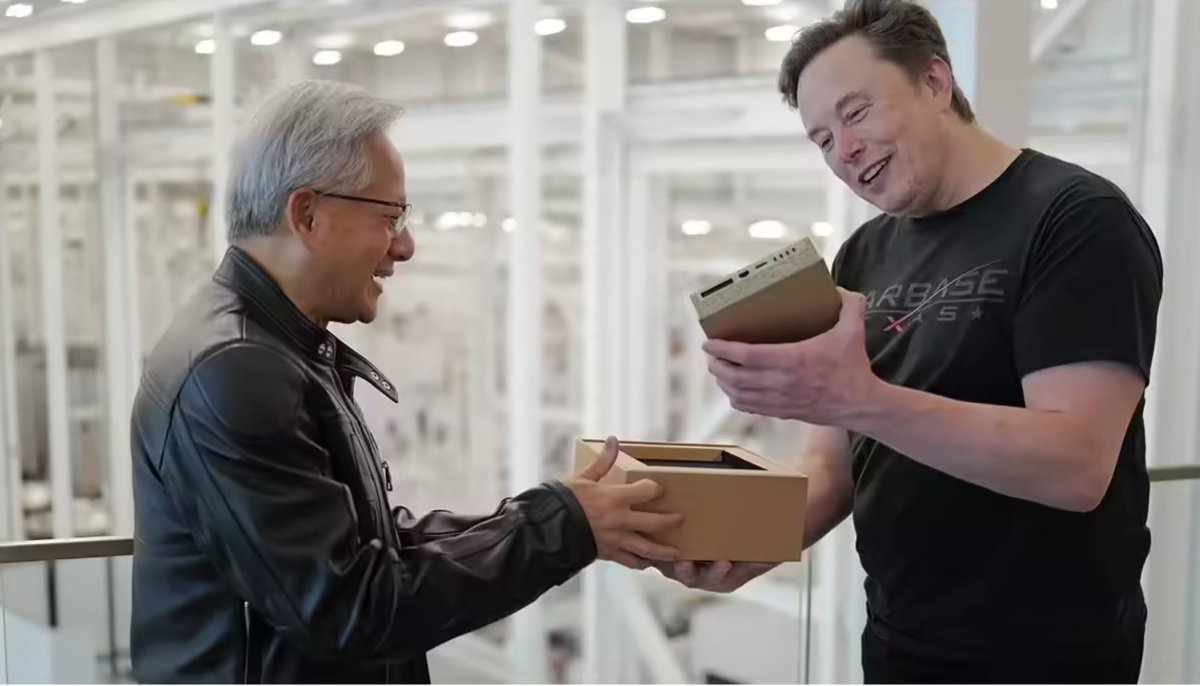
🚨Michael Burry just said Elon Musk and Nvidia's deal is built on fake numbers.
Burry published a detailed breakdown calling the entire structure "Fugazi", his word for fake.
He is alleging that billions of dollars in Nvidia chips are being hidden off balance sheets, and that American retirees are unknowingly funding the whole thing.
Nvidia, the world's largest AI chip company sold $5.4 billion worth of its most advanced GPUs, the GB200, to a company called Valor.
Valor is not a real operating business. It is a special purpose vehicle, a shell company created specifically to hold these chips and nothing else. Nvidia also invested $1.9 billion of its own money directly into Valor on top of the sale.
Those 100,000+ chips are now physically inside xAI's data center. xAI is Elon Musk's artificial intelligence company, the one that builds Grok. xAI is using every single one of those chips right now to run its AI models.
But here is what Burry is flagging.
Neither Nvidia nor xAI owns those chips on paper. Valor, the shell company holds legal title. That means $5.4 billion in GPU assets do not show up on Nvidia's balance sheet as inventory.
They do not show up on xAI's balance sheet as assets. They are legally invisible to both companies.
Nvidia gets to book the $5.4 billion as a completed sale and record it as revenue. xAI gets full use of the chips without owning them. And the risk disappears into a shell company in the middle.
Now here is where American retirees enter the picture.
Valor needed $3.5 billion in debt to fund this structure. Apollo provided it. Apollo is one of the largest asset managers on earth with $1.03 trillion under management and $834 billion specifically in private credit.
Apollo raised the $3.5 billion, packaged it into debt securities, and sold those securities to Athene.
Athene is Apollo's own insurance company. It sells fixed and indexed annuities, retirement savings products, to ordinary Americans.
When a retiree buys an Athene annuity, they believe their money is sitting in safe, stable investments. That money is now inside a structure funding Elon Musk's AI data center.
The numbers inside Athene are most alarming.
Athene holds $74.2 billion in reserves. It has moved $217 billion in assets into a captive insurer based in Bermuda, meaning those assets sit outside normal US insurance regulation and oversight.
Of the entire portfolio, 34.7%, equal to $103 billion, is classified as Level 3 assets.
Level 3 is an accounting classification that means there is no observable market price for these assets. No outside party can independently verify what they are actually worth.
The leverage sitting on top of those unpriced assets is 16 times.
Burry's says:
Every step of this structure is technically legal and publicly disclosed. But the entire thing was deliberately engineered across 8 to 12 steps to move credit risk off balance sheets and away from any market pricing.
- Nvidia books the revenue.
- Apollo collects the fees.
- xAI gets the computing power.
- And retirees sitting at the bottom of a 16x leveraged Bermuda insurance structure, holding $103 billion in assets with no market price carry the risk without knowing it exists.
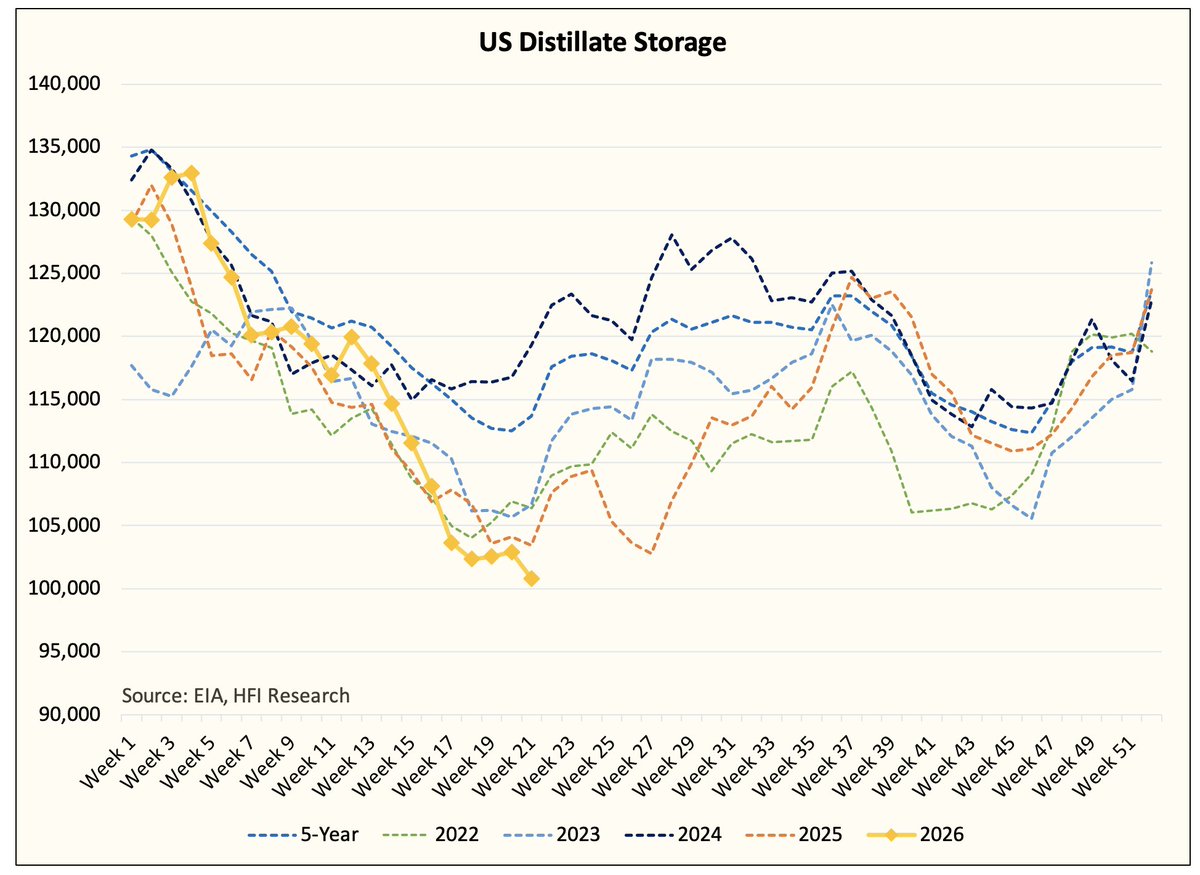
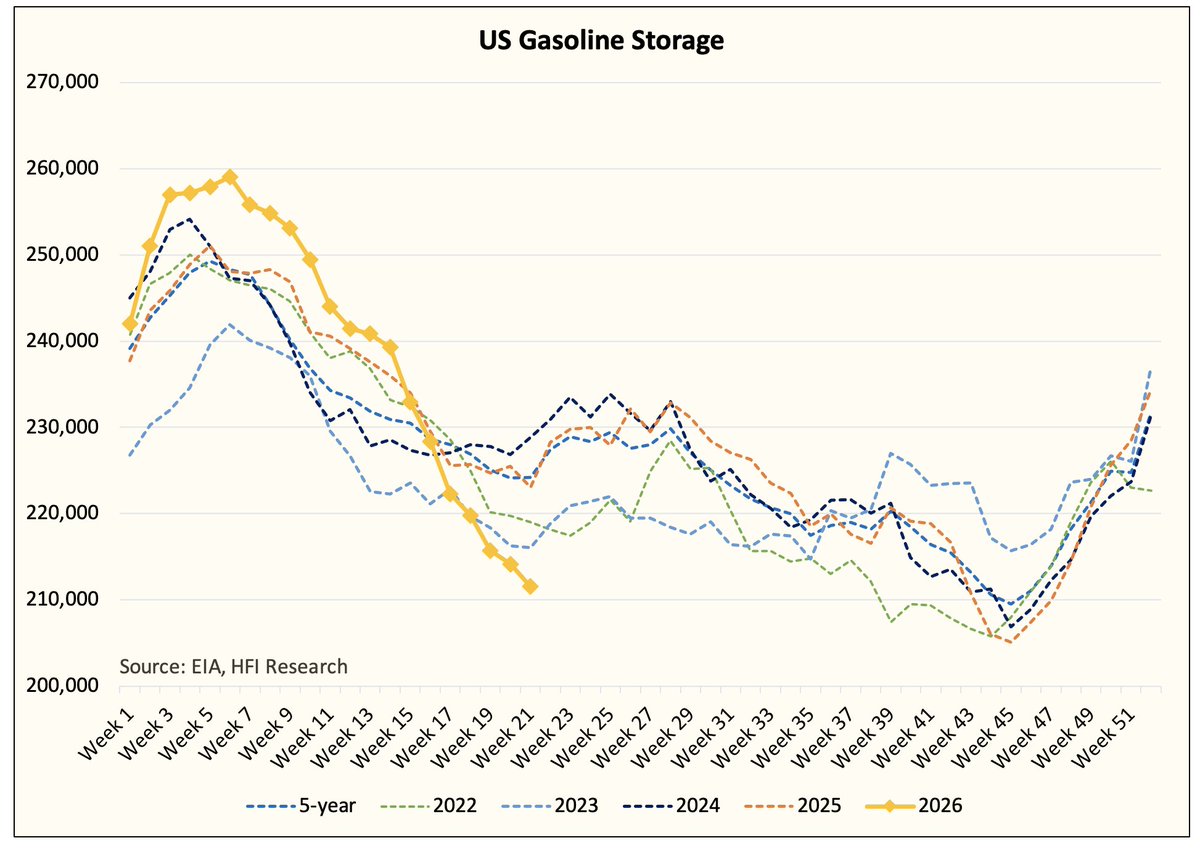
We are ~9 million bbls away from hitting a storage level that's the equivalent of living paycheck to paycheck for gasoline and distillate.
Once we get there, even a minor disruption (any sort of outage) will result in gasoline lines at gas stations.
I guess we are really doing this.
Jamie Dimon, complaining about the Clarity Act and Coinbase CEO Brian Armstrong this AM: “He’s spending hundreds of millions of dollars in Washington in this thing.”
Maria: “He said he’s representing the whole —”
Dimon: “He’s full of shit.”
Maria: “…well.”
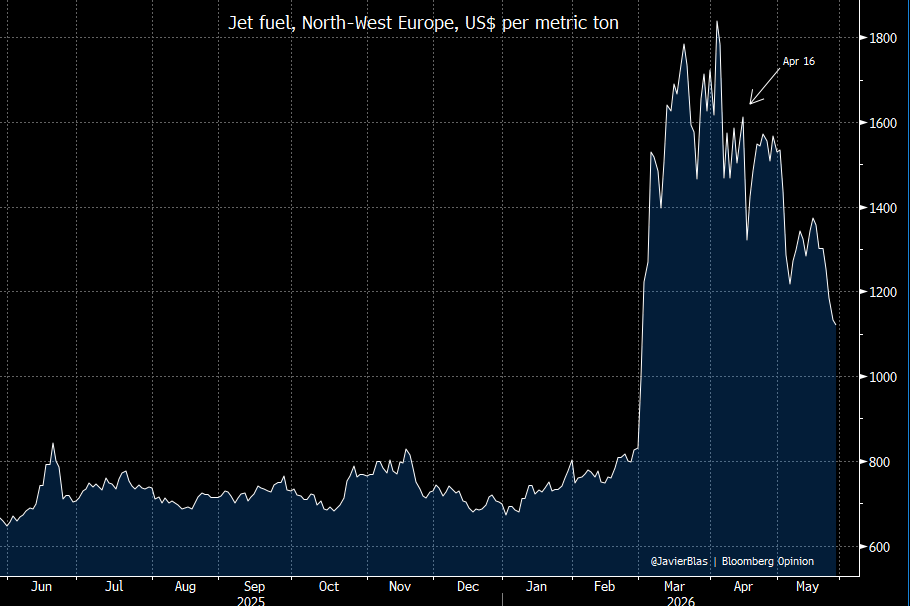
CHART OF THE DAY: On Apr 16, the IEA made a headline-grabbing warning: Europe had "maybe 6 weeks or so of jet fuel left." It's week seven; the planes are still flying. Since those headlines, European wholesale jet fuel prices have fallen ~30% to a ~3-month low.
Holy shit! They changed the rules for Elon again...
They waved the profitability rule & are adding SpaceX to indices only 5 days after IPO... normally it's 90
This forces 401k retirement & passive funds to buy SpaceX at elevated IPO pricing, holding the bags the entire way down
Chevron's Mike Wirth said we're weeks away from oil shortages. He sees US gasoline prices potentially rising considerably in the next two months. Listening to market strategists and then talking to commodity producers is an exercise in cognitive dissonance. @ferrotv@annmarie
The AI bubble math doesn't add up.
Anthropic spends $3 to make $1 and that’s before you include any and all other costs like staff or electricity.
Microsoft dumped $300B in capex, made ~$18B in AI revenue. OpenAI and Anthropic alone make up 43-54% of Microsoft, Google, Amazon and Oracle's entire revenue backlogs.
Enterprises are burning through annual AI budgets in 4 months with zero measurable ROI.
This is the most expensive science experiment in history, funded by your SaaS subscriptions.
Part 2. When a baby queen bee chews her way out of her cell, the very first thing she does is hunt down her sleeping sisters and sting them to death, one by one, often before they have even hatched. She is less than a day old. This is how every queen in every honeybee hive on Earth begins her life.
The queen and every worker bee in her hive share the exact same DNA. They are genetic twins. The only thing that turns one fertilized egg into a queen and another into a worker is what the baby gets fed in its first few days of life. Larvae chosen for the throne are flooded with royal jelly, a milky substance secreted from glands in the heads of nurse bees. It contains a fatty acid (10-HDA) that flips chemical switches inside the larva's cells, turning on a different set of genes without changing the underlying DNA. This entire field of biology, where diet rewires which genes activate, exists partly because scientists were trying to figure out how honeybees pull this off.
A queen develops in just 16 days, faster than any other bee in the hive. She emerges with a smooth, curved stinger built specifically for killing other queens. Workers have barbed stingers that rip out and kill them after one sting. The queen's stinger is reusable. She walks the comb making a high-pitched piping sound that beekeepers can actually hear with their ear pressed to a hive. Her unhatched sisters, still trapped in their wax cells, pipe back. She uses the sound to find them, slices a hole in the side of each cell, and stings them through the wall.
Once she has killed everyone, she flies out once in her life to mate. Then she returns to the hive and never leaves it again for 2 to 5 years. She lays up to 2,000 eggs a day, more than her own body weight every 24 hours, sometimes over a million eggs total in her lifetime. The whole time, she leaks scent chemicals from glands in her face that drift through the hive on the bodies of workers grooming her. Those chemicals chemically castrate her daughters, shutting down their ovaries so they cannot lay eggs of their own. The worker bees around her live just 6 weeks in summer. She lives 20 to 40 times longer.
She is not actually in charge of anything. The workers run the colony. The moment her egg-laying drops or her scent chemicals weaken (which happens if she gets infected with a virus or simply ages), the workers vote her out. They start building emergency queen cells, raise replacements, then murder her. The execution method is called "balling." 15 to 50 worker bees pile on top of her in a tight ball and use their own body heat to cook her alive from the inside. In commercial American beehives, over half of queens get replaced within 6 months. The mother of the entire colony is disposable the second she stops producing.
The new queen then chews her way out, kills her sisters, mates once, and the cycle starts again. A honeybee colony is not really ruled by a queen at all. It is a 50,000-female democracy that grows its own monarchs the way humans grow vegetables, then composts them when they wilt.
Absolutely incredible:
Over the last 6 years, the S&P 500 has risen +130% while US Consumer Sentiment has collapsed by -55%, to its lowest since data began in 1952.
We are witnessing the formation of the biggest wealth divide in modern history.
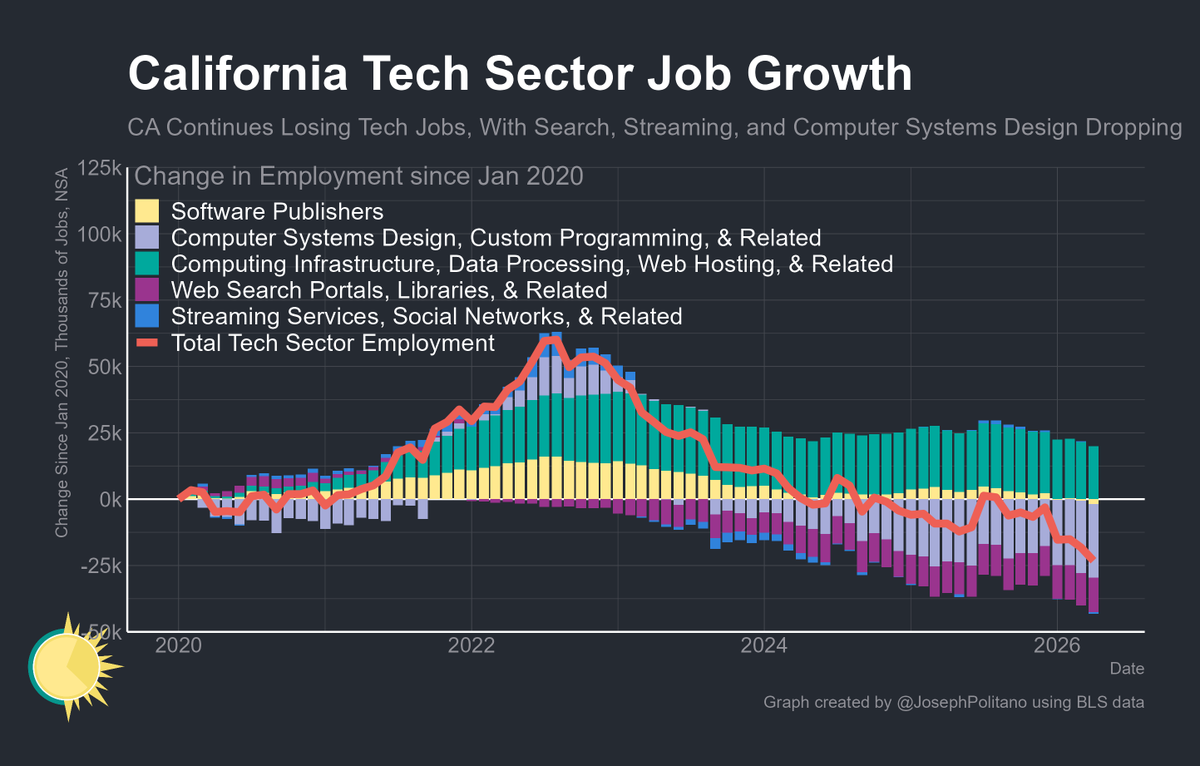
California continues losing tech jobs—in data released yesterday, the Golden State lost more than 14k jobs over the last year and more than 23k since 2020
Here's a question that, IMO, is yet to attract sufficient analysis:
Where will all the funding come from for the mega IPOs and the projected surge in both sovereign and corporate bond issuance this year?
This comes at a time when foreign investors have been reducing their US Treasury holdings—primarily to meet heightened foreign-exchange demands triggered by the fallout from the Middle East War.
This shifting landscape is highlighted by this morning’s Bloomberg report, which notes that “Turkey offloaded almost all of its US Treasuries in March as it stepped up efforts to support its currency during the first month of the Iran war, according to Bloomberg calculations based on US Treasury data.”
#economy #bonds #markets #Turkey
Food is set to become even more expensive:
World fertilizer prices have surged +44% since the start of the Iran War, to the highest since 2022.
This comes as ~33% of globally traded fertilizers pass through the Strait of Hormuz, which remains effectively closed.
This includes 23% of global ammonia, 34% of urea, the world's most widely used nitrogen fertilizer, and nearly 20% of global phosphate supply.
Furthermore, the Bloomberg Agriculture Subindex has increased ~9% since the Iran war.
The index tracks the futures prices of key agricultural commodities, including wheat, corn, soybeans, sugar, coffee, and cotton.
In the past, world fertilizer prices have acted as a leading indicator for agricultural output prices, as rising production costs eventually force farmers to reduce supply, pushing crop prices higher.
A new wave of global food inflation is imminent.