In case you missed it: yesterday we shared some big news — Redeeming Babel is becoming Good Faith.
And today, on Giving Tuesday, I want to take you one layer deeper. In this video, I share more about why we made the change — and why Good Faith isn’t just a new name for our work, but a name for the kind of people we’re trying to become. Before we can redeem Babel, we need a faith that is truly good — for the world, for our neighbors, for each other. One marked by humility, curiosity, and love.
From the podcast to The After Party, from The Anxiety Opportunity to all the small group resources — everything now lives together under this unified banner.
Same team. Same nonprofit. Same mission. Just a name that better fits the story already unfolding.
And on this Giving Tuesday, I want to say thank you. Your generosity makes this work possible — the conversations, the courses, the quiet encouragement that helps people keep going. If Good Faith has been a gift to you, today is a meaningful time to give back as we step into this new chapter.
Thank you for walking with us.
Thank you for giving with us.
Together, in Good Faith.
Our discussion of the ODYSSEY was one of my favorites! An introduction to the work and why it’s still matters now even more than the movie as good as I hope it is!
Confession: I hadn't read The Odyssey. Not once—not even for the papers I wrote confidently invoking "Scylla and Charybdis."...
So when Christopher Nolan's adaptation showed up on the calendar for next week, I did what any self-respecting former student does: I called @hootenwilson and asked for the abridged version! I regret nothing.
Well, one thing. For years my only mental image of the Greek gods arguing with each other was Laurence Olivier in 1980s Clash of the Titans, swirling smoke machines and all. Nolan has some ground to make up there.
But here's what I didn't expect. Reading the actual poem, not just knowing the plot, handed me an image no screen could have given me: my own memory of nearly drowning in the Pacific, which is exactly what showed up on the page in Book Five. A camera can show you a shipwreck. It can't show you yours.
And then we found out Nolan directed Memento, which means he already knows how to pull off an unreliable narrator on film. So now I'm actually hopeful!
Jessica and I get into all of it this week: why Homer keeps you guessing about who's lying, why Penelope has her own odyssey that nobody talks about, and what it means that God let this myth exist before he ever revealed himself. Listen in!
https://t.co/ss4ZIcOYfR
I've spent years trying to understand what it means to be truly American—and what it means to be American as an immigrant. This essay asks the question that never quite leaves you once you've named it: "But do I really belong?" And then it invites us to see why that ache might point all of us, native and foreign-born alike, toward a truth we need.
https://t.co/hppyBf7NgV
Turns out some of our closest colleagues have legs.
We confirmed this in person at Pepperdine's Thomas H. Olbricht Christian Scholars' Conference, where several Good Faith regulars materialized beyond the confines of a laptop screen — including someone who will be a first-time guest very soon!
What if the question of alien life is ultimately a theological question?
This week on @_good_faith , Andy Crouch and I explore UFOs, extraterrestrials, human identity, power, and what it means to bear love rather than domination into the cosmos.
One line from Andy I can’t stop thinking about:
“Very likely, we will want to re-establish ourselves as the apex predator in the cosmos, rather than the bearers of love to the cosmos.”
A fascinating and surprisingly personal conversation. https://t.co/TWg9FzlIx2
Don't miss our last info session of the month! 30 minutes: a brief walkthrough of The After Party and a chance to ask any and all of your questions. Join us. https://t.co/vaAFlEtN9w
Most of us spend a surprising amount of energy resisting the fact that we’re getting older.
But what if aging isn’t the enemy of a meaningful life? What if it’s actually one of the ways we’re invited more deeply into it?
I recently sat down again with psychologist Dr. Dan Allender. Dan is 73 now — and somehow more alive, more honest, and more curious than many people half his age. Our conversation moved quickly past the usual clichés about aging and into something much more unsettling and hopeful: what happens when we stop pretending we’re immune to mortality.
Dan said something that has stayed with me:
“The closer you get to death, the less the things that owned you seem to matter.”
I think he’s right. There’s a kind of freedom that can emerge when we finally stop fighting the reality that our lives are finite. The endless striving, the image management, the need to prove ourselves — some of it begins to loosen its grip.
New episode out now.
Have questions about The After Party?
We’ve set aside two live Q&A gatherings this week — tonight at 8pm ET and tomorrow at 4pm ET — simply to talk with people who are curious, interested, hopeful, uncertain, or somewhere in between.
Maybe you’re already planning to lead a group. Maybe you’re still trying to discern whether this might fit your church, small group, or community. Or maybe you’ve just heard about The After Party and want to understand what it actually is beyond the headlines and descriptions. Wherever you are, you’re welcome.
We’ll walk through what the course looks like in practice, how people are using it in different settings, what kinds of conversations tend to emerge, and what we’ve been learning along the way. Mostly, though, this won’t feel like a formal presentation. Think of it more like a conversation around the campfire with our team.
If this week is packed already, we’ll host one more session on Thursday, May 28. But if you’re free tonight or tomorrow, we’d really love to see you there.
Sign up here:
https://t.co/P9W5xkLXZ5
That kind of church doesn’t happen automatically. It’s something we become, over time, as we follow Him together.
So it’s worth asking: What does it mean to be the Church right now? (2/2)
We use the word “church” all the time.
But depending on the week, it can start to mean very different things. A place. A tribe. A set of shared instincts. A group we feel aligned with. Jesus had something deeper in mind.
A people being formed. A body learning to love. A community that exists not just for itself—but for others. (1/2)
We’re not just remembering something at communion, we’re being reshaped by it.
In this episode, Hannah Miller King unpacks how the table of God forms us to resist consumer culture, receive grace, and carry hope into a weary world. https://t.co/QXvFdMlPfg
For others. Not just people who agree with us. Not just people who feel safe or familiar. Not just people on “our side.”
If we’re honest, it’s easy for faith to slowly turn inward—to become about protecting, preserving, defending…us. And over time, even our politics can start to reflect that.
Less about loving our neighbor. More about securing our place.
But Jesus keeps pointing us outward. Toward the stranger. Toward the difficult person. Toward the one we’d rather avoid.
So it’s worth asking: Do our lives—and our public lives—look like they exist for others? Or have we made the church about ourselves?
So much of our parenting (and honestly, our inner lives) is shaped by the quiet assumption that capability is something we have to build from scratch—that courage, resilience, and strength are things we have to summon when life gets hard. What if that’s not the starting point?
It’s easy to believe the stakes are so high that we have to match the tone of the moment. To fight louder. To draw sharper lines. To treat people like enemies instead of neighbors.
But Scripture keeps pulling us back to something deeper. The real battle isn’t against each other. And the way of Jesus doesn’t look like the way of the crowd.
Different battle. Different weapons. The question is whether we still believe that.
I recently had the chance to sit down with David—and somewhere between talking about our kids and comparing notes as newly minted empty nesters, we found ourselves in a deeper place than I expected.
There’s something about that season of life that clarifies things. You start to see more clearly what you could control, and what you never could. That’s where our conversation turned to resilience.
David made a point that has stayed with me: in a world where we’re trying to give kids every possible advantage, we may also be quietly removing the very conditions that help them grow strong. It’s a hard tension. As parents, we want to help. But at what point does helping become shielding? And what does it look like to raise kids who can actually face disappointment, take risks, and keep going?
These are the kinds of questions that don’t have quick answers. But they’re worth sitting with. I’m really grateful for David’s wisdom, and I think you will be too.
Give this conversation a listen.
https://t.co/prM3W3R6D2
Kids have never had more support, and yet they’ve never been more anxious. So what’s going wrong?
David Thomas joins Curtis to talk about the hidden ways modern parenting can undermine resilience—and how a Christian vision can help and grow into who God made them to be.
@DavidAFrench said this in a conversation with Allie Beth Stuckey when he brought up The After Party. And he wasn’t just making a point, he was practicing it in that conversation.
In real time, he was sitting across from a fellow Christian he disagrees with, speaking plainly about conviction…while refusing to question her motives, dismiss her faith, or turn the conversation into a fight.
That’s the how. Not avoiding disagreement. Not softening beliefs. But choosing to engage with clarity and charity at the same time.
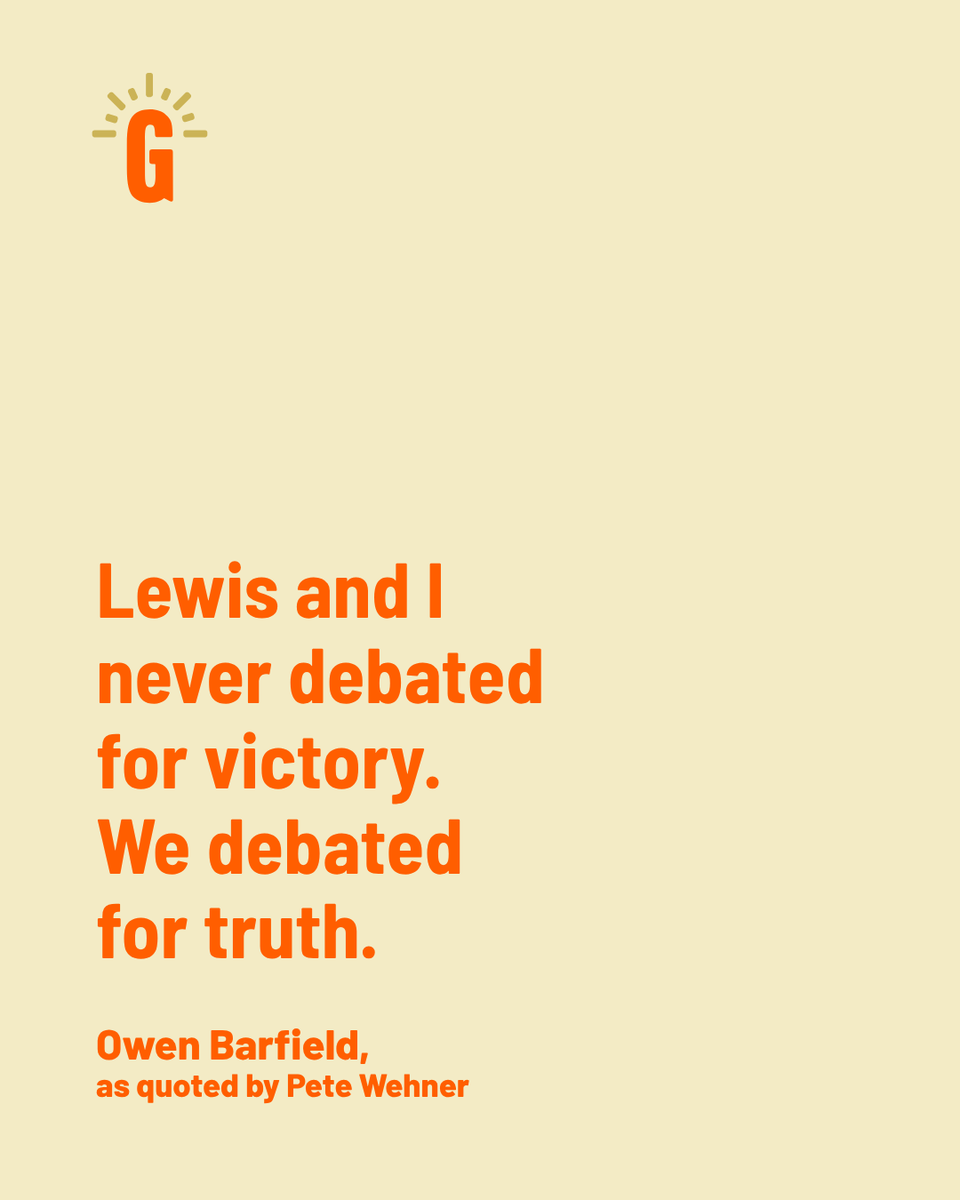
In a cultural moment where the goal often feels less like discovering truth and more like winning the exchange, a line from Owen Barfield—reflecting on his friendship with C.S. Lewis—lands with unusual weight.
It’s less a clever observation than a quiet correction.
In our recent conversation, guest Pete Wehner brings that insight to bear on questions of Scripture, war, and the subtle danger of believing God is fully aligned with our own side. It raises a harder question than we might prefer: What would it mean for the church to recover the habit of debating for truth, rather than for victory?And perhaps closer to home: Where, in your own life, has the desire to win edged out the willingness to listen?
This episode is an invitation into that kind of reflection, one that doesn’t resolve everything quickly, but might help us see more clearly.
Don't miss the episode here: https://t.co/XYc8Gax124