Are your engineers ripping PRs, but everything's getting stuck in code review? 🫠
You're not alone.
📅 Thursday, November 19
→ Review is the New Bottleneck: Rethinking Code Review
→ @clairevo and @zachdavis talk about how to speed up shipping, without breaking your code (or your team)
→ Presented by @Amplitude_HQ
Registration now open: https://t.co/xd6TZcyMwJ
"What's our AI strategy?" deserves a better answer than "we bought Claude Code."
@cxodev -- join @zachdavis and I as we walk through the exec playbook for AI in eng, product, and design:
→ Two live half-days for senior engineering, product, and design leaders.
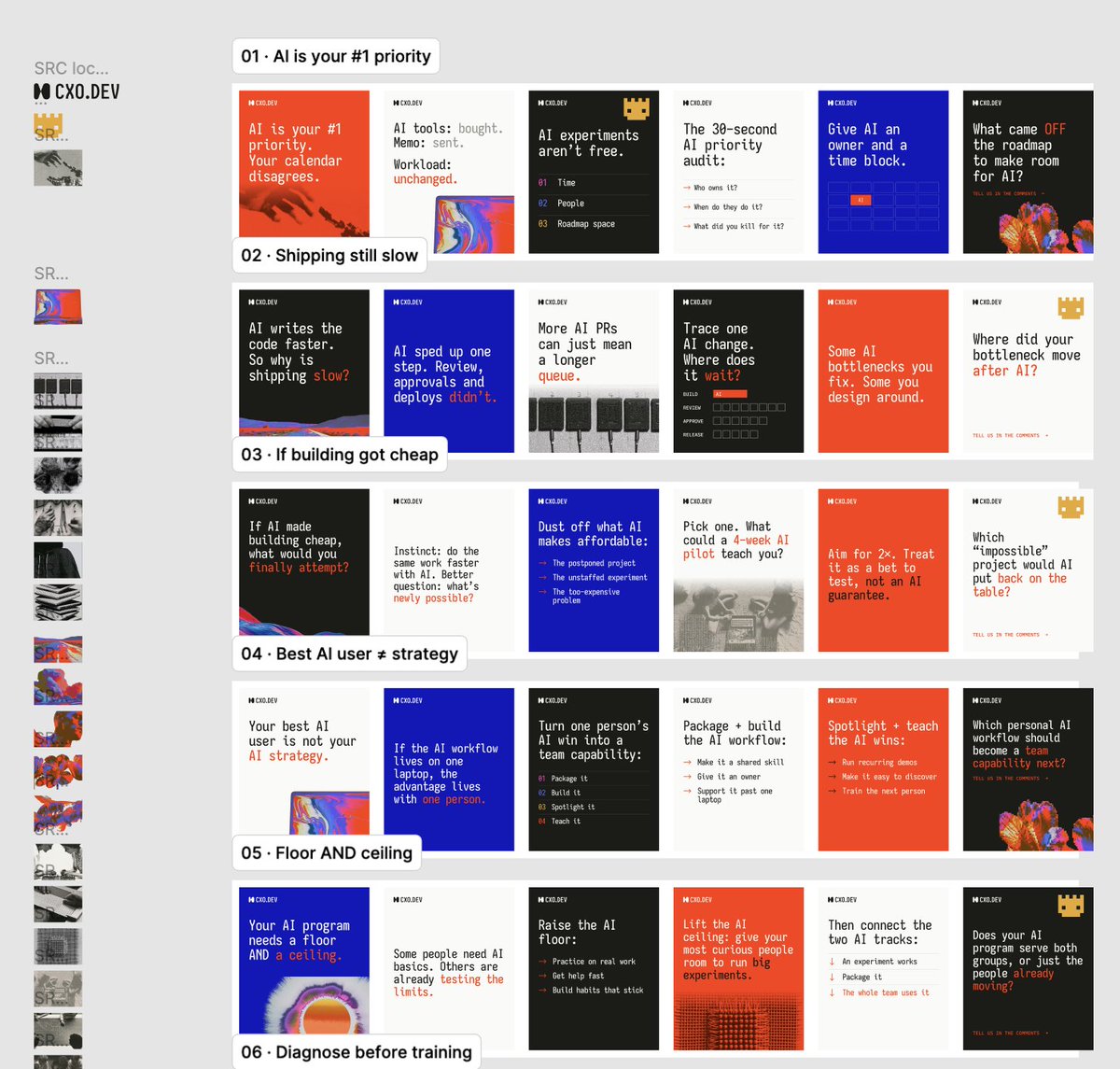
→ Leave with a 90-day plan and 25+ playbooks.
→ Rated 4.7/5 by alumni.
Next cohort Dec 2–3. Seats are limited.
Register now: https://t.co/rbJIqfv6JZ
Join us Dec 2-3 as we work with a small cohort of technical executives on their AI strategy:
- tech
- ops
- culture
Registration open now: https://t.co/NyPsnB432k
"What's our AI strategy?" deserves a better answer than "we bought Claude Code."
@cxodev -- join @zachdavis and I as we walk through the exec playbook for AI in eng, product, and design:
→ Two live half-days for senior engineering, product, and design leaders.
→ Leave with a 90-day plan and 25+ playbooks.
→ Rated 4.7/5 by alumni.
Next cohort Dec 2–3. Seats are limited.
Register now: https://t.co/rbJIqfv6JZ
After working w lots of real eng orgs at @cxodev here’s my current take on software factories
- first of all: you do you. If a system works for you, no one is bullying you into adopting something else
- model choice & cost optimization is a big driver of “software factory” projects
- you should get clear on when you need an agent, when you need a factory, and when you need determinism and validation
- good factories eval and measure their way into a structured process that outputs high quality code *for their company/product*
- this structured process is usually something like a plan, relevant code discovery, validation, PR/checks/review/scoring, and a release process sometimes even to market facing teams
- factories also have non-code objectives, like moving more building into public, making multiplayer more sensical, and enforcing a desired SDLC that would be hard and annoying to enforce organically
- ime factories are very good at raising the floor (often necessary in large orgs) but they’re not necessarily going to raise the ceiling for someone like @poteto
- that doesn’t make them fake, it just makes them a different tool, and often one needed for whole org transformation
- that being said, many fall in love with the idea of “factory” before addressing more fundamental gaps/oppty in their AI Eng stack: everything from repo readiness to fast lints/checks/previews to background agents/automations and basic enablement on AI coding tools/models
- also many orgs give someone a factory project and they end up trying to compete with Claude code/codex/whatever instead of designing something unique to their org w specific problems solved really well
- which is why I tell people usually to not start w a software factory, but rather w a big factory or a security factory or a UI polish factory. More well scoped and easier to eval
- some of this across both factory and non factory setups is pure f*ing theater and token slinging and you should watch out for that (in your company and online)
I think @zachlloydtweets writes thoughtfully about factory concepts, and I particularly like how he measures & evals every component, encourages ensuring your factory delivers quant and qual value, and acknowledges the culture/ops benefits of factories like more transparency and XFN learning
ymmv but this is what I see!
and fwiw I’m trying to build a “factory” for a smaller repo to see if I see the cost/value benefit. So far, no, but those max subs are hard to beat for a small team 😎
don't let someone else brew up your AI strategy.
at @cxodev every transformation is cooked from scratch
no center of excellence (and only a little eye of newt)
Excited to be a @spacexai launch partner to help your team put @bot, grok, and @cursor_ai to work inside your technical teams (or your whole company.)
Want to see where we can help?
Try our AI readiness assessment → https://t.co/A7GRtdbaBg
"You will run into problems, and not to play the blame game: but they're your problems, they're not AI's problems." - @zachdavis dropping truth bombs.
Your codebase is frustrating for humans - why wouldn't it be for agents?
Fix your repo + make life better for AI (and humans)
Spent the weekend with a dozen execs on their AI plans.
Everyone had to set a 90-day goal -- even @clairevo
Hers: closed-loop AI, not open-thread AI.
Stop starting work. Start finishing it.
What loops are you and your teams leaving open?
don't miss @clairevo and @zachdavis oct 3-4 course: exec playbook for AI in engineering, product + design
- 2 day intensive with peer leaders
- small group office hours to debug your org
- delivered live (with a dose of AI)
$1000 off before sept 30: https://t.co/cY1xeklXLX
ok like always @jameygannon CHANGING MY LIFE with the @ElevenLabs MCP + cutting short form content
(she's much better at this but i'm starting to learn)
- took a janky cut from my iphone
- did editing + figma brand overlays
- capcut for music + a bit of manual tuning
I might be back to being a tiktok girl
At @cxodev we like to talk with clients about the need for AI "transformation" rather than AI "adoption". Transformation conveys a degree of change that adoption alone does not. Far and away the most common pitfall we see is teams adopting AI tooling but not changing the way they work. It's hard to get real change out if you're not putting real change in.
@levie calls this "process reengineering"; changing workflows to take advantage of AI rather than "just layering on agents into the existing flow". It's a great name, and it's worth examining whether your approach to AI fits this moniker.
We believe that the engineering function is a great place to start AI transformation. Because of the highly verifiable nature of software development, as well as the fact that models are very good at writing code, if you can't transform the way your engineering team works with the current tools, you're going to have a hard time doing it anywhere else. And also, you're going to learn a ton from making agents successful in your software development lifecycle (SDLC), or perhaps making your SDLC successful with agents, that can be applied to other functions as well.
That last point, that maybe you need to adapt your SDLC to agents instead of the other way around, that's process reengineering. Other functions within your company probably don't have anything nearly as well defined or obsessed over as the SDLC. But I assure you there is a process lurking in there, waiting to be reengineered, and that's where you're going to find real leverage.
The most AI-forward companies aren't just adopting tools broadly, they're using what they learned from reengineering the SDLC to rethink processes and workflows across the organization around the joint capabilities of humans and agents.
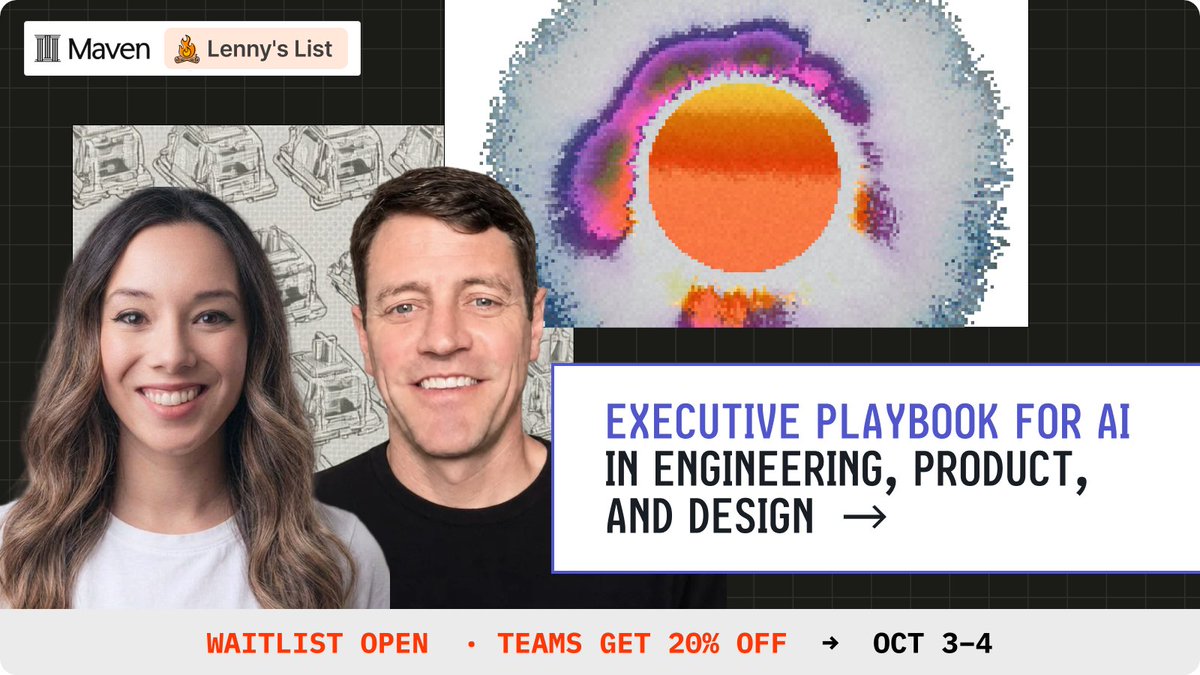
DON'T MISS: The next cohort of "Executive Playbook for AI in Engineering, Product, and Design" is now open for our October 3-4 session on @MavenHQ
In this @cxodev course, @zachdavis and I teach execs what it really takes to change how your team ships with AI (and no, it's not just tokenmaxxing.)
You'll get
- prework and readiness assessments that find your AI gaps now
- two half days of high signal tactics + AMAs from AI-native operators
- a room of 50 of your VP+ peers
- 90 days of open office hours to help you put it in practice
Featured on @lennysan's List as a top AI course for leaders https://t.co/py974tjJwg
Attend with your team and get 20% off.
Registration open now → https://t.co/MUg3dVaWYU
So excited about the @lennysan and friends summit coming up in 2 weeks.
The night before (Weds, Sept 9) I'm hosting a "How I Happy Hour" along with @Amplitude_HQ and @cxodev, featuring mini-demos from some of my post popular guests 🤩
RSVP here: https://t.co/5RcFIrHZh5
Hanging out with @poteto@n2parko@clairevo and the @bot team to get Amplitude setup on Grok Bot today.
We're pretty permissive on AI tooling, but even so Grok Bot automatically takes action so getting the security right is the biggest blocker. Spent the first 20 minutes making sure we don't shoot ourselves in the foot.
It always feels like you're drowning as an executive and you don't have time to spend messing around with your tooling setup. I think they've gotten the interface right as you're able to take action right away.
The best part of building @cxodev is I get to bring my favorite AI tools + models to awesome teams wanting to ship more with AI
we ❤️ our partners
@spacexai@OpenAI@ExaAILabs@bot@perplexity_ai
and more coming soon 👀
I am having the most fun of my life building with AI, and I think every company should, too
so i'm starting something new: https://t.co/gP7DHXddec
AI transformation consulting for AI-pilled leaders
(by builders, not consultants)
why I had to do it 👇