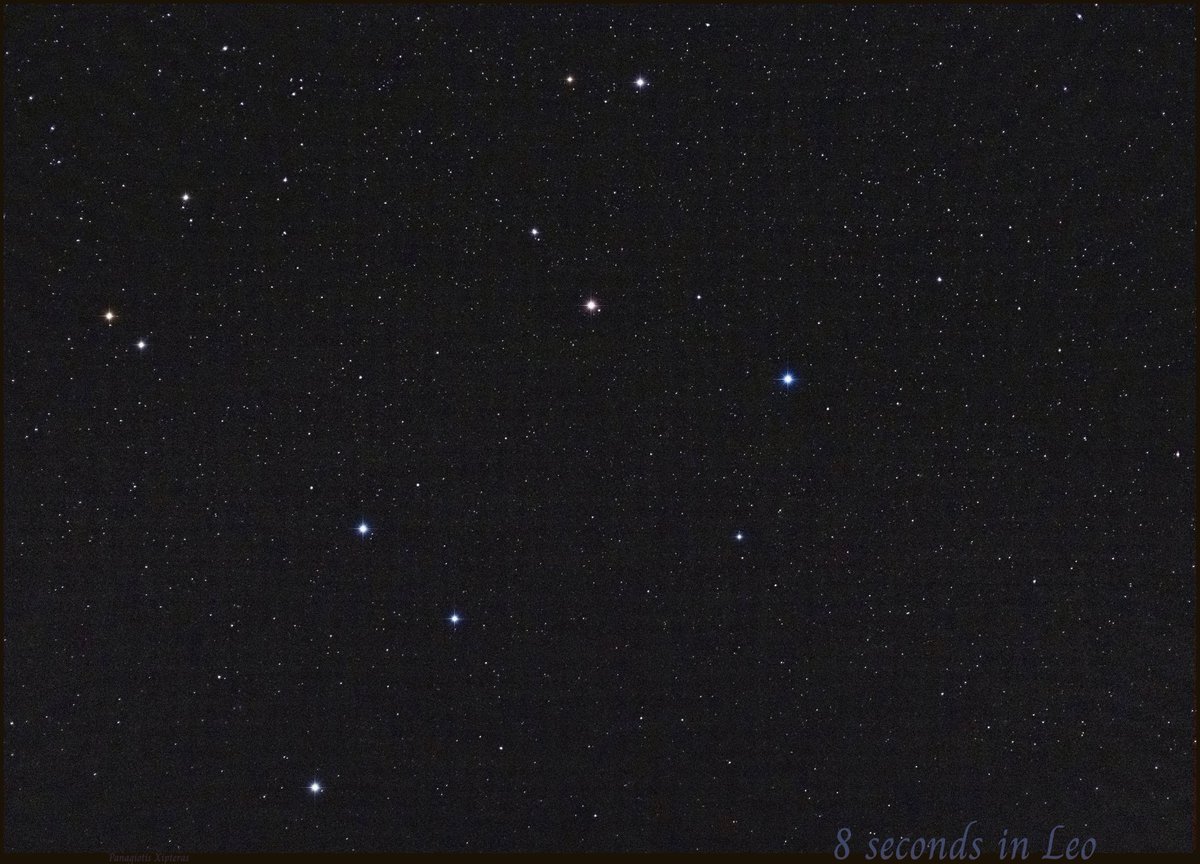
🦁 Leo, one of the constellations of the zodiac, is easily recognized by its characteristic shape, which looks like a crouching lion.
⭐️ Leo is interesting because of the many bright stars and interesting deep sky objects it hosts. The brightest star in Leo is Regulus (α Leonis), a blue-white main sequence star about 79 light-years from Earth with an apparent magnitude of 1.35, making it one of the brightest stars in the night sky. Other notable stars include Denebola (β Leonis), a blue-white star about 36 light-years away, and Algieba (γ Leonis), a binary system consisting of two giant stars. ✨✨
❓ Leo's sickle asterism, which is like a backward question mark, is formed by these and several other stars, creating a pattern often associated with the lion's mane.
🔭👀 For us #stargazing friends, Leo is an attractive target. Spring nights provide the best viewing opportunities as Leo climbs high in the sky. However, the impatient among us can get started as early as January after midnight, assuming a new moon and clear, unpolluted skies. Binoculars (eg. 7x42) are always a good investment.😉
🌌 Leo also contains several prominent galaxies, not shown in my snapshot below, most notably the Leo Triplet galaxies - M65, M66, and NGC 3628 - which are popular targets for us amateur astronomy enthusiasts, and of course the well-known M95 and M96, both of which are barred spirals.
🙏 Thank you for joining me for one more night on my journey through space. Clear skies and enjoy the #stars. /px
--
Snapshot taken by @xipteras 8s at f/2, photo tripod.
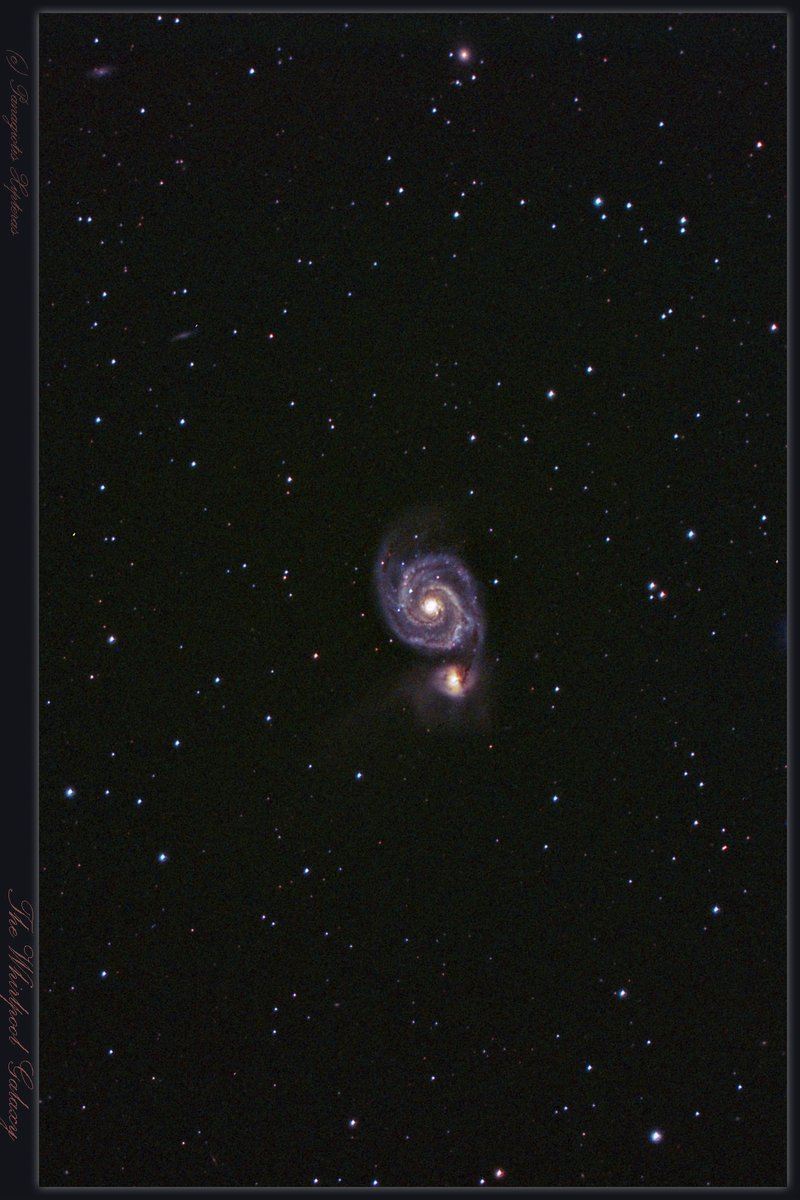
The Whirlpool Galaxy (M51), located in the constellation Canes Venatici, is a barred spiral galaxy around 23 million light-years from Earth. With an apparent magnitude of +8.4, its physical span is about 11 arcminutes by 7 arcminutes in the night sky. This galaxy is particularly noted for its pronounced and well-defined spiral arms, rich in star-forming regions and dust lanes, making it a more dynamic and interactive cousin to the elegant Bode's Galaxy (M81). At its center is a supermassive black hole around which the galaxy's arms revolve, shaped by gravitational interactions with its smaller companion galaxy, NGC 5195, adding to its unique structure and beauty, see my image below.
🔭 Springtime offers the best window for observing the Whirlpool Galaxy, especially after midnight when it's at its highest point. However, the impatient among us can get started as early as midnight in January, provided there is a new moon and a clear, unpolluted sky.
We, amateurs with our telescopes of at least 8 inches aperture can begin to grasp #stargazing its grandeur, but larger telescopes, 14" or more, will reveal finer details of its spiral arms and glowing star clusters. Powerful setups will anyway help in capturing the galaxy's intricate spiral structure, its interaction with NGC 5195, and the hotbeds of star formation along its arms.
The last time I observed this galaxy was with our 30" Dobson telescope of my astronomy club in the place where I live, in southern Germany, two hours drive from the Alps. That brutal light hunter revealed to me the bridge between M51 and its companion. I was speechless, and NO, it is not the same to see the bridge in the stacked photo of the live view of a robotic telescope or in a photo. No way, guys. It was the real, ancient light from there that I saw.
#Astrophotography fans wishing to capture M51's magnificence should use a long-exposure technique with a high-quality CCD camera, on a motorized equatorial mount, to track its movement across the sky. Also a low-noise DSLR with a fat 600mm f/4 tele lens can work wonders.
🦣 When the light we see today from M51 began its interstellar journey, the Earth was undergoing profound changes in the Miocene epoch. During this epoch, dramatic climatic shifts favored the spread of grasslands, a critical factor in the evolution of mammalian species, including early hominids. This era was significant for the evolutionary trajectory of primates that would eventually lead to the emergence of Homo sapiens. As M51's light traveled across the cosmos, our ancestors developed vital survival skills that laid the groundwork for the rise of human civilization.
🌍🌿 At that time, Earth underwent a global cooling trend, a transition from the warmer climates of earlier epochs. New ecosystems flourished during this period, with the expansion of grasslands driving the evolution of large mammals, including the ancestors of horses, elephants, and even primates. The movement of tectonic plates continued to reshape the Earth's surface, leading to further uplift of mountain ranges such as the Himalayas (!) and the Andes. The Miocene was a time of ecological and geographic transformation, setting the stage for the rich biodiversity and complex ecosystems we see on the planet today.
🙏 Dear all, it is always a pleasure for me to write about space. If you like my stories, please leave a like or retweet my post, it helps a lot, since this tweet is hours of work. All images attached are real, taken by me, freezing out in the cold next to my telescope. My texts are a strong mixture of my own experiences in the last 21 years, research in web and books and AI texts with special self-made, complex prompts. Guys, I think, it is time to ride this horse called AI, there is no other way in future, IMO. Either we ride it, or it rides us.
Clear skies and enjoy the night sky #stars ✨✨
/px
--
🎶 Now playing ‘John Askew Live From VII London 2023’ on #SoundCloud https://t.co/YUhTwS5ncD
--
Image taken by me @xipteras with my Takahashi TOA-130NFB telescope, @QHYCCD 8L camera, on my Takahashi NJP-JPZ mount.
I always notice excellent tweets from accounts that I deeply admire and that I would like to retweet. However, they almost never retweet, as if it were a sin to share information about our wonderful hobby.
Yes, I know it takes extra effort to find and retweet good tweets BUT:
Retweets are a blessing to our community.
None of us are THE truth owners or the best astrophotographers in the world. Also an appeal to all of you: Please retweet your colleagues, gladly including me. We do not ask for money. We are 100% amateurs who only want to motivate you to capture and document our beautiful surroundings 🌿☀️✨ and wonderful moments. 🙂
That is why we are here.
thx 🙏 /px
--
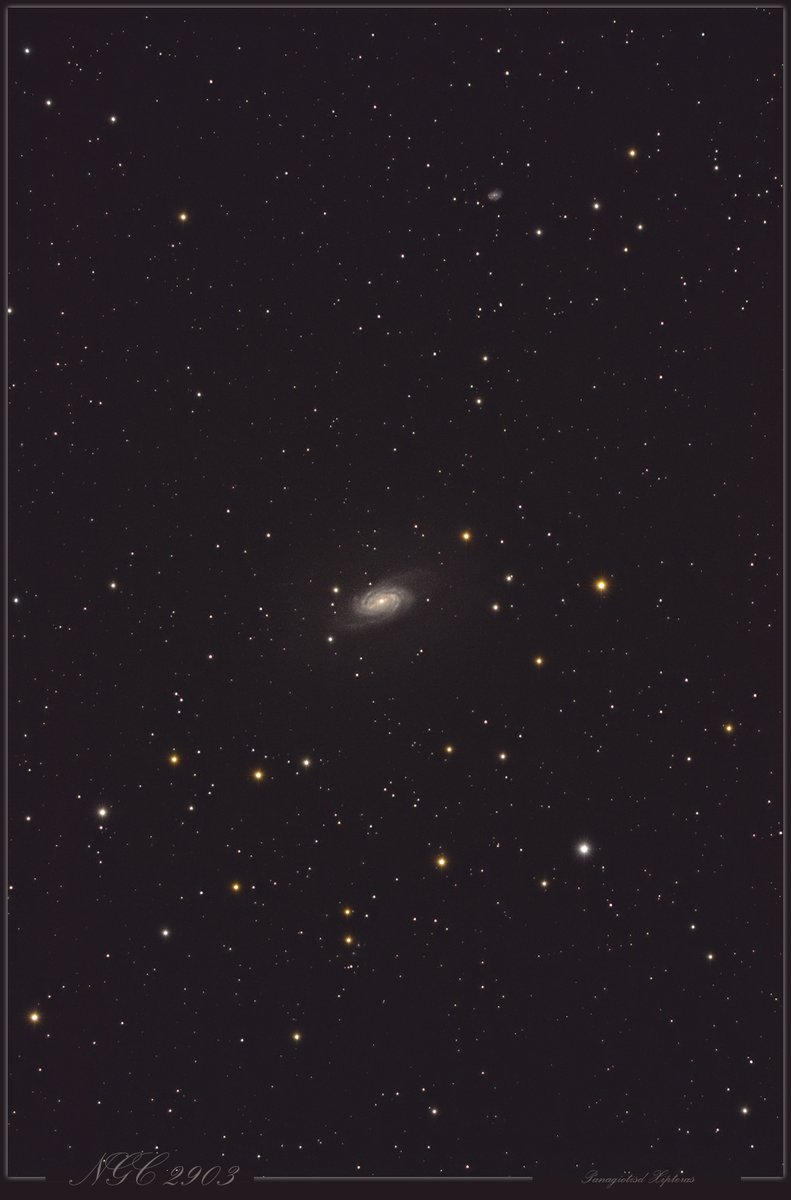
BTW, this is a galaxy, the NGC2903. More on this target, in my documented tweet soon. Enjoy the #stars