One of my latest deep learning systems:
Automated industry classification system 👇
-> Enter a single URL or a list of URLs of firm websites
-> System extracts statistically most relevant keywords
-> Neural network classifies the keywords into respective industry category
@Rainmaker1973 My personal experience is the complete opposite. Was a vegetarian for 10 years and got into lots of health problems: overweight, prediabetes, reflux, weak immune system, diarrea, brain fog etc. Then switched to keto and it turned my life around. Red meat saved my life.
Big Tech has ruined the internet
> Centralization
> Control communication
> Spying
> Censorship
> Shape regulation
> Push for mass surveillance such as age verification
It was one of the few places where I felt free.
Sad that it's over.
“California's 3D Printer Law
Would Criminalize Open Source, Enshittify The 3D Printing Space”
Read it again: Criminalize Open Source.
For the back row:
CRIMINALIZE
OPEN
SOURCE
3D
PRINTERS.
Golden rule in engineering:
Everything comes with trade-offs.
Forcing user-replaceable batteries in phones may sound good, but it likely implies trade-offs in structural stability, sealing and design.
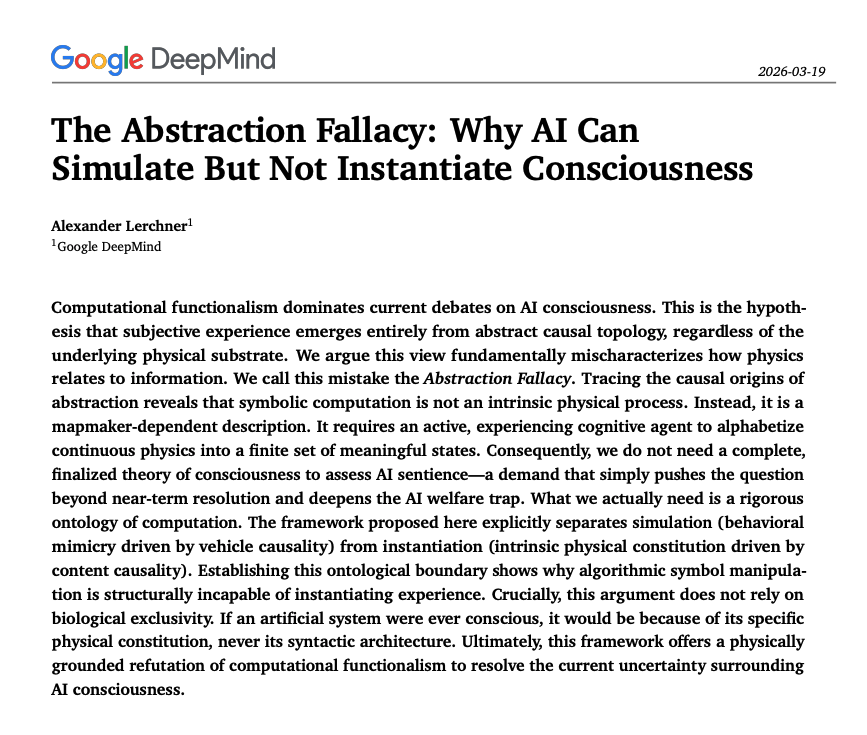
A Google DeepMind researcher published a paper arguing that AI can never be conscious. Not a matter of time or scale. A matter of category.
The argument is that computation is a description of a process, not the process itself. For a physical system to count as "computing," a conscious agent has to first carve reality into symbols and assign them meaning. Without that agent, there are only voltage gradients. Not symbols. Not experience. Computation presupposes consciousness. It cannot produce it. The paper calls this confusion the "Abstraction Fallacy."
The analogy that makes it click: a GPU simulating photosynthesis can model every reaction perfectly. It will never produce a single molecule of glucose. Simulation is not instantiation.
The paper doesn't say artificial consciousness is impossible. It says if a system were ever conscious, it would be because of its physical constitution, not because it ran the right algorithm. No amount of scaling changes that.
This comes from inside the house. Not a philosopher. A researcher at the lab building some of the most advanced AI on the planet, arguing that the entire framework connecting computation to consciousness is logically broken.
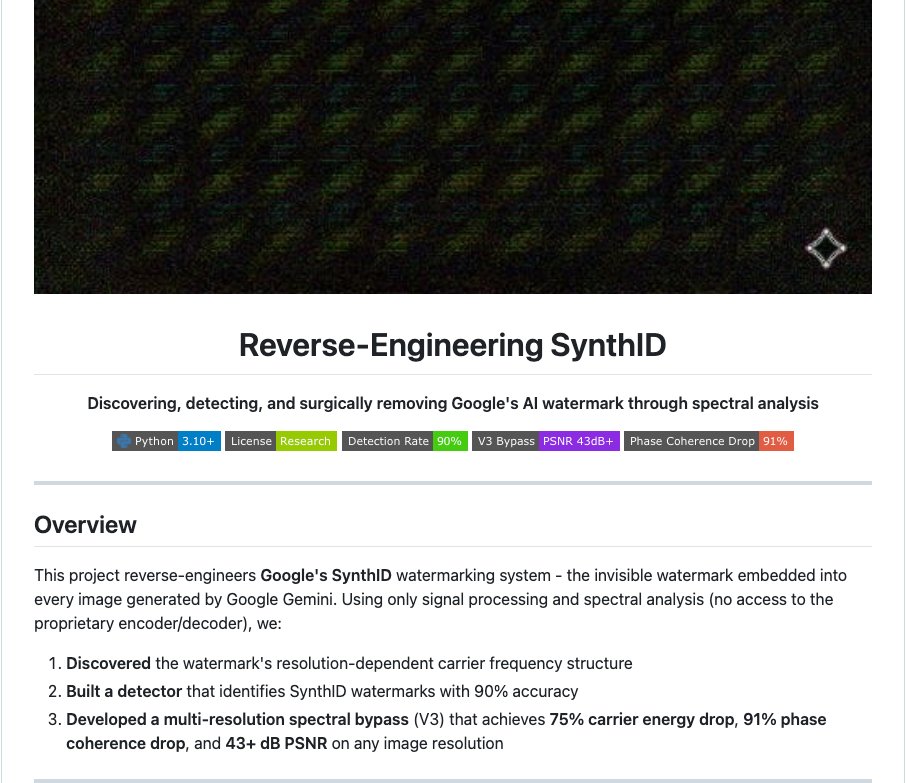
🚨Google built an invisible watermark into every image Gemini has ever generated. Over 10 billion pieces of content marked.
One unemployed engineer just cracked it open. With 200 black images and math.
It's called reverse-SynthID.
SynthID is Google DeepMind's invisible watermark. It's embedded at the pixel level into every image, video, audio, and text generated by Gemini. Invisible to the human eye. Designed to survive cropping, compression, screenshots, and format changes.
It was supposed to be unbreakable.
Here's how he broke it:
→ Generated 200 pure black and pure white images from Gemini
→ When you average enough pure-black AI images, every non-zero pixel IS the watermark. Nothing to hide behind. Just the signal, naked.
→ Used FFT spectral analysis to map the exact carrier frequencies
→ Discovered the watermark uses a fixed phase template — identical across every image from the same model
→ Cross-image phase coherence at carrier frequencies: over 99.5%
→ Built a detector that identifies SynthID watermarks with 90% accuracy
→ Built a V3 bypass that drops 91% of the phase coherence and 75% of carrier energy — at 43+ dB PSNR. Almost zero visible quality loss.
No neural networks. No proprietary access. No leaked code. Just signal processing and too much free time.
Here's the wildest part:
The green channel carries the strongest watermark signal. The carrier frequencies change based on image resolution. And the entire phase template is fixed — meaning every single Gemini image carries the same fingerprint structure.
One engineer. 200 black images. A Fourier transform. That's all it took to reverse-engineer a system protecting 10 billion+ pieces of content.
519 GitHub stars. 39 forks. Python. Research and educational purposes only.
100% Open Source.
(Link in the comments)
I somehow miss the use of hashtags.
• They allowed me to instantly click on a keyword and explore all the posts
• HT aggregated different posts about one topic
• HT provided a visual signal of the relevant keywords during scrolling
• Some HT were entertaining and funny