GP, Backing buidlers at @PlutosCap w @FryCookVC || Core @ETHPanda_org @Eth_Auckland @web3privacy, prev @wiepteam
Ex-litigation. Cypherpunk. Views are my own.
When exploring a business-oriented version of @rotkiapp I asked many crypto orgs.
The common answer was we already use @cryptio_co and local data is not a requirement.
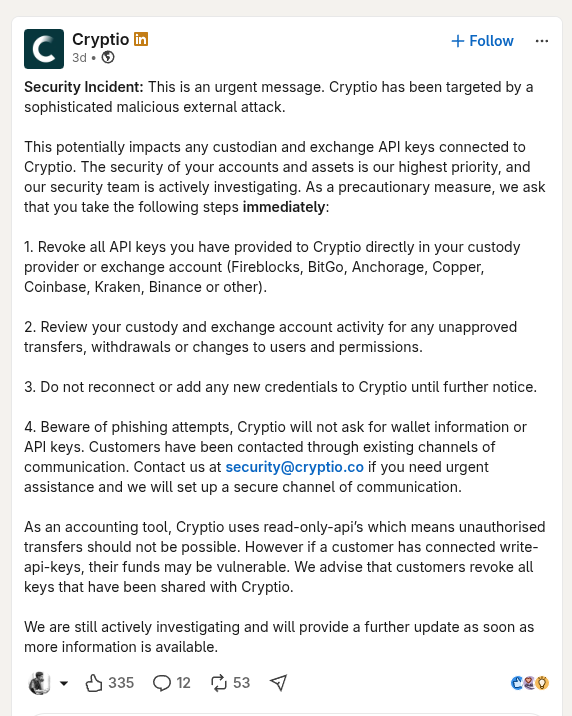
Well, seems like 3 days ago cryptio had a VERY serious security incident potentially compromising user API keys and credentials.
Their X and website mention nothing. Only LinkedIn has an announcement with no more information since then.
Should businesses really have to entrust their entire financial history and exchange credentials to a third party just to do their accounting?
Perhaps keeping financial data local should be a requirement after all.
I'd love to hear from businesses interested in a local first alternative approach
Absolutely fucking disgusting
AI is going to make it easier and cheaper to find all the personal data you’ve ever left behind.
All the more reason to reduce your attack surface before its indexed forever.
https://t.co/FbuzqE0O4W
It’s rly cool how ~the whole twitter world is having to grapple with understanding Lean / what formal verification is all about rn
6 months ago that was pretty niche,
now it’s like on CNN or some shit
things gonna keep being confusing in the public discourse for a while imho
"Previously, privacy gave you worse products... people and businesses had to go out of their way to gain privacy."
"You had to make sacrifices, but that ends now."
@yrschrade chatting with @robbieklages & @andyyy from the @therollupco.
Good FOs recognize how much broader their access to dealflow gets when investing in the right funds. A few checks here and there and you have unlocked niche sourcing around the world and you can still deploy your own capital directly if you want.
FOs that see the world as black and white tend to lose out in the long run.
everyone wants the EF to talk about products, every week people say "Ethereum foundation should talk more about products..."
and then suddenly "...but not like this!" lmao.
people quoting this and just yapping about @zama from a privacy perspective is kinda easy mode?
The thread lays out what FHE is and how it could add to privacy onchain. Then it moves to Zama and how Zama has confidential applications.
privacy ≠ confidential.
It be much more productive to engage in a technical discussion about why FHE is or isn't better than MPC or zk tech, or whether the numbers claimed and tech are actually feasible for becoming an improved HTTPS equivalent layer for Ethereum. Or maybe attack and question the lattice based approach or the fact that the protocol still requires an MPC protocol to function (KMS is 13-party MPC).
@arik_g (who I assume wrote the thread) literally mentions that privacy comes in different approaches and this approach is aimed at tradfi, that zama uses confidential not private vaults and swaps, and is aimed at institutions.
FHE ≠ Zama. Zama is just a lab implementing and researching FHE. Lol.
relayers are backbone of funding new, private accounts, but they charge you a fee
so I built a public good, that charges no fee (only gas+buffer) and routes over @torproject
first supported privacy project is @0xprivacypools, with more to follow soon
privacy is normal
Given all the recent system outages and hacks, it's high time for the President to announce a Cybersecurity Initiative to harden our digital infrastructure.
Using formal verification, safe languages, and better runtimes, we can build secure systems. We have the technology.
Imagine a new Manhattan Project that will ensure that our data stays private, our systems just work, and we need pay no ransom (of any kind, financial or political) to any threat actor. It'll be well worth the spend.
A new security standard is headed to orbit.
@SpaceComputerIO , the Singapore-based in-orbit digital security startup, will fly its Space Fabric secure-compute payload aboard a D-Orbit ION mission next year. The mission aims to test the company’s ability to add a security layer into a satcom network.
Payload's @Douglas__Gorman spoke with SpaceComputer officials about what the missions mean for the future of in-orbit security.
I've been saying this for ages: cryptography and formal verification reduce attack vectors.
MPC allows enterprises to access confidential compute on sensitive data without exposing it, and ZK verifies without revealing the data. We need cryptographic primitives to ensure that data is handled securely (not in its naked form) and mathematical guarantees that the system behaves in a way it should.
every VC on monday:
“we’re raising a highly concentrated, thesis-driven fund focused exclusively on cybersecurity.
the recent Outlook outage and FAA disruption have only reinforced our long-standing thesis: cyber is entering a generational inflection point, driven by AI-native threats, legacy infrastructure, and an unprecedented urgency to modernize mission-critical systems.
our edge is simple: deep domain expertise, proprietary deal flow, and strong conviction built over the last [48 hours].”
@Cyph3rVae the difference between an emerging manager that larps about multiples and promises future returns vs an emerging manager that actually spent years studying their niche. The former collects fees, the latter exits.