To clarify:
- frontier AI companies clearly state they are building AGI
- from general to super intelligence (aka intelligence explosion), there is an unknown period (prob fast)
- controlling an ASI is virtually impossible
- why isn't this top of the global discourse?
Nobel Laureate Geoffrey Hinton says AI superintelligence is "not hype" and he used to think it was further away but the speed of recent developments have convinced him that it will happen in 5-20 years
Dwarkesh Patel says the government should mandate public access to every model AI labs use internally.
"We don't wanna be in a situation where people are secretly doing intelligence explosions."
"If you don't trust your AI enough to let it be deployed publicly and be robust to people trying to use it to do very dangerous things, then you probably shouldn't be using it to develop future AI systems as well."
Source: The Long Game podcast https://t.co/Ii2qIgolls
I’m working on a new, bipartisan AI bill called the Safe and Accountable Federal Evaluations of AI Act — aka, the SAFE AI Act. No industry in America gets to police itself, and AI shouldn’t be the exception. We need real, mandatory guardrails now.
https://t.co/qKcl3ecKG2
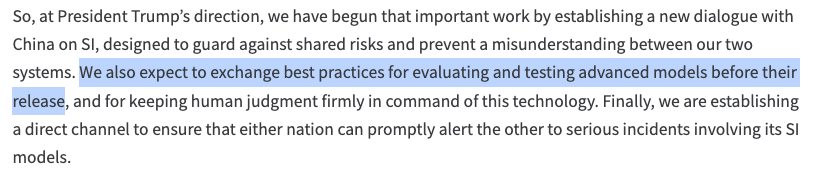
The U.S.-China AI dialogue appears to be moving in a good direction. Last week, Secretary Bessent announced that the U.S. expects to exchange best practices for pre-release testing and evaluation of models. This would represent a meaningful step up from the September agreement, when the two sides agreed to establish an information sharing channel. The key question now is how to do the best practices exchange: what experts will participate? How detailed will their sharing be? Will it go beyond testing toward post-deployment safeguards?
Yesterday, I was at the table at the Élysée for President Macron's working meeting on AI and security, with heads of state and leaders of frontier AI companies.
Loss of control is now discussed openly by governments.
In the Paris Call for AI Safety and Security, six governments and ten companies, including OpenAI, Anthropic and Microsoft, commit to fail-safe mechanisms to shut down their models, including during training and internal use. Many points echo the civil society statement on recursive self-improvement I served as rapporteur for at UNGA.
What's missing: thresholds and a deadline. Sam Altman told the UN Security Council we should not train new models without an extremely strong case that we can keep them under control. No one has made that case yet. We believe states should set those thresholds, ideally by January. They should also build the capacity for an internationally coordinated slowdown in case of emergency.
Thank you to France for leading on this.
Guys can we not make RSI a partisan issue please? Swarms of hyper autonomous superintelligent agents won’t give a shit about team red *or* team blue.
They’ll be optimising for their goals and their goals alone, which may or may not be compatible with human civilisation.
Honoured to be formally appointed Chair of the EU's AI Act Scientific Panel, together with the wonderful Nicholas Moës as Vice-Chair. The Panel will inform in particular on general-purpose AI models, and the systemic risks they may pose the Union, which has already proven to be a timely (and demanding!) brief.
The last 5 months have been a rollercoaster, getting to grips with agent swarm incidents and AI-assisted cyberattacks. I suspect the next 18 months will be even more intense. It will be more crucial than ever to ensure decision-makers have access to focused scientific expertise and assessment that is up to date to the cutting edge of frontier AI progress.
There are a few things I really appreciate about this role. One is the truly remarkable calibre of expertise represented in the Panel - really quite the dream team, and humbling to have the opportunity to support and catalyse their efforts. But the other is that the Panel is designed to be independent from the get go: we inform when asked, we can dive into topics and make ourselves heard on them when we think something needs attention, even when not asked, and we can challenge on scientific grounds when need be. I think this is really important for a fast-moving technology with uncertain impacts, where both the scientific community and decision-makers need to be ready to adapt and course correct. It's a smart mechanism to include.
It's a part-time role, but with a lot of opportunities, and I intend to take it seriously, so it's where all my spare minutes will be going for the next 18 months (so apologies if I'm not around much for most other things).
https://t.co/2jE0VAwmMG
Cyrus Hodes, a member of the OECD Expert Group on AI Future and founder of AI Safety Connect, highlighted the importance of open-source AI at the 2026 World Internet Conference Wuzhen Summit. He emphasized sharing knowledge and developing AI models with safety in mind, as well as the value of mechanisms of coordination among countries leading AI development discussions.
@danfaggella@tombibbys Indeed, thanks Dan! Launched at the UN General Assembly and France a signatory too 🇫🇷
Great that this is gaining momentum and that Switzerland has joined 💪
@jaystratton@HarperCollins@WmMorrowBooks Thanks for your service sir, and for your courage speaking up 💪
The most credible narrative one could ever read on the most sensitive, classified, and covered-up topic
The future of #ArtificialIntelligence is not pre-determined. As a technology developed by human beings, its future depends on the choices we make. We therefore have the responsibility to guide, change and, when necessary, reject its applications. A reliable system that serves the human person is of greater value than one that is exceptionally powerful but whose consequences cannot be adequately foreseen or controlled.
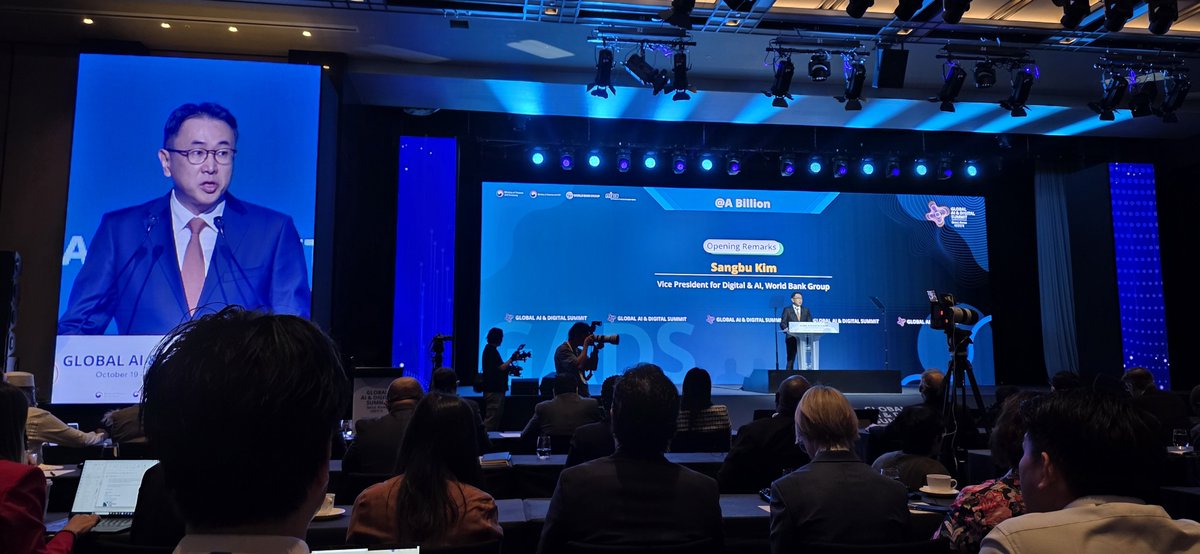
In Seoul with @n_miailhe for the Global AI & Digital Summit, opened by my HKS classmate Sangbu Kim, @WorldBankGroup VP for Digital & AI. Inclusive AI and safe AI are the same project. Glad to be here building bridges between the development and safety communities.
"Anyone creating an ultra-intelligent machine anywhere is a threat to American national security, and so we need to somehow prevent that from happening[...] we need to start orienting to this the same way that we orient to preventing rogue actors from getting nukes."