I’m a dermatologist. I’m supposed to say there is no amount of safe sun exposure.
But I won’t, because that’s a lie.
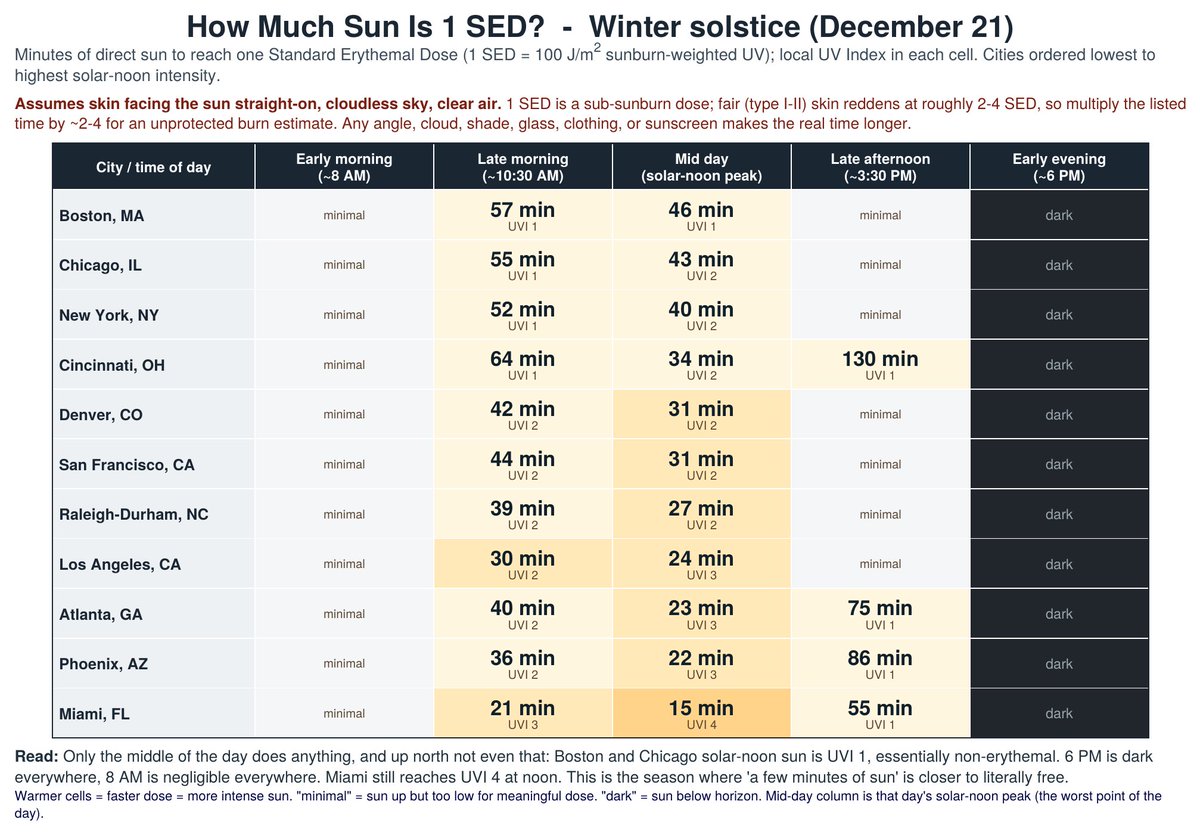
The attached shows how much sun is safe in different cities at different times of year.
What do I mean by ‘safe’?
I mean this: UV causes DNA damage and skin cancer.
But, shockingly, your body repairs that damage. As long as the damage doesn’t outpace repair and start accumulating it shouldn't increase your risk of skin cancer.
Data just came out that tells us how much UV you can get without damage accumulating.
They took the people most susceptible to DNA damage from UV and exposed them to UV, then did skin biopsies to measure the damage, then more skin biopsies to measure the repair, and repeated it daily for 4 days.
At 1.6 ‘Standard Erythemal Dose’ (SED) there was no accumulation of damage.
So, the attached charts show how much sun it takes to get 1 SED in different cities at different times of the year at different times of day.
And there are extra safety margins built in. It assumes a perfectly clear day with zero air pollution and that the sun is hitting your skin perpendicularly. Unless you’re laying flat, most sun is hitting you at an angle, which isn’t nearly as intense.
But a bigger question you might be asking is ‘Why would a dermatologist be telling you to get sun in the first place?’
Because getting sun reduces your risk of death.
Mostly by reducing your risk of heart attacks and strokes. That is very well proven.
But it’s also very likely that sun exposure reduces your risk of autoimmune disease, dementia, cancer and depression. It’s just not as well proven as the protection against heart attacks and strokes.
And before you reply and say ‘just take vitamin D!’, know that it has been ROBUSTLY proven that vitamin D has little (if any) benefit for preventing any of the above. Vitamin D is mostly useful as a marker of if you’re getting enough sun.
What do I do myself and what do I tell my patients?
Get as much unprotected sun exposure as you can without getting a burn.
That’s my GUESS as to what has the best risk/benefit ratio. Dying of skin cancer is actually really rare, especially when compared to the risk of heart attacks, strokes, autoimmune disease, dementia and other cancers.
But I’ll admit it’s not for sure best to get as much sun as possible, since sun does increase the risk of skin cancer and it might be the case the benefits plateau at a low level.
So, if you’re really worried about skin cancer stick to the charts.
The best science I can find says that amount won’t cause skin cancer.
The takeaway?
Sun is good for you, just don’t get a burn.
That moment when, for a brief second in time, your unconsciousness permeates into your psyche and you realize the infathomability of life and all its existential consequences #OhTeri
The mind doth not ponder on the thought of how you are constantly, at an infinitely small interval, proving older thoughts to be wrong in order to avoid the fragmentation of self into infinite pieces along time, because that would disavow its own meaningful existence.
@full_kelly_@robinhanson The profundity in this project is its absurdity. It makes you question the value of human time, and what qualifies the basis of something being "worth" it from a nihilistic sense. The absurd universe where typing every number from 1-1 mil is equivalent to any other activity.
@SerkinxX@SSavson This retard posted straight placebo nonsense as proof of some magical intuition of knowing what someone is deficient in off of observation. Peak "Mitochondrial" health expert postings.
@Believedsky@RealOdysseas Live to an old age where you are miserable staying indoors all day. Good plan. At least you will look young when you are old though!
@none_your_bis@johntrified because skin doesnt have equivalent of HPA axis. far too inconsequential to dedicate as many resources to skin moisture (which is fine being always on, constitutive) than to hormones paramount for reproduction that must walk on a thin-rope (inducible system).
@anthonystaj@TeddyFREN1488 "Notwithstanding their key roles in therapy and as biological probes, 7% of approved drugs are purported to have no known primary target, and up to 18% lack a well-defined mechanism of action." PMID: 22711801
This is a high status signal
We are so back.
General rule: When a behaviour is massively beneficial for you as an individual, Les Misérables begin to sing the chorus of shame to guilt you into worsening your life like them.
Unless you are important enough to be the news, do not watch it. Zero benefits.
Never allow people to shame you into not exercising your privilege. Unless you're directly there & being impacted, working yourself up over news cycles is a boomer psyop.
I-ran from demoralising news about the middle east, I said bibi to mind scattering propaganda.