Introducing Slop.md...
A 80,000+ Character .MD File that removes all common AI Slop design language.
- A general guideline, use it anywhere.
- Not a "website maker" but prevents slop design.
- Made by weeks of consistent additions to the .MD of common slop structure by AI in order to prevent it.
> View the video & the site for detail Before and After.
Hopefully it helps you! it's my first ever public ship so I'm very open for any feedback!
Special thanks to @amianthus_ for the landing page inspiration and the idea that I can do a .md release!
and @leodev / @grimcodes for inspiring me to ship publicly as well!
Nice, I remember Dax mentioned tabs offhand like 2 months ago.
So we tried them in our desktop app and found them awesome too!
If you want 100% free models like Kimi K2.7 Code, DeepSeek Pro, MiniMax M3, don't pay, just use Freebuff:
https://t.co/AdaycKlsP7
The first experimental evidence of recursive self-improvement (RSI).
Autoresearching the autoresearch agent for eight days.
The result beats the harness we hand-tuned for two years, on held-out benchmarks: 🧵(1/7)
Every project management tool was designed by project managers, for project managers.
This one was designed for ADHD, dyslexic, and autistic brains instead. And it turns out that also makes it better for literally everyone who just wants to get work done without configuring a tool for two weeks first.
It’s called Leantime.
Most PM tools throw you straight into a task board and expect you to already know what a “sprint” is. Leantime is built around a different idea: tasks should trace back to a goal, not float in a backlog with no reason attached.
→ Ships with strategic planning tools, Lean Canvas, SWOT analysis, built to connect the “why” to the actual task list, not just a bare Kanban board
→ The same tasks render as Kanban, table, or list, whichever your brain processes better on a given day
→ Gantt-style milestone timeline, a built-in project wiki, and time tracking, all native, not four separate tools stitched together
→ Interface is deliberately built to reduce cognitive overload and context-switching, an actual design principle here, not an accessibility checkbox added later
→ Self-host via Docker in under an hour, your team’s entire project history stays on a server you control
Jira was built assuming a certified project manager runs the workflow. Most teams are five people trying to ship something, not an enterprise PMO. Leantime is what a PM tool looks like when it’s built for the second group.
Open source. AGPL-3.0. 10,000+ GitHub stars.
90% of "AI developers" just download pre packaged GGUF files from Hugging Face, hit run, and call it a day.
The top 10% know how to pull the raw safetensors, run the math, and quantize massive models into Q4_K_M themselves.
If you think llama.cpp can only execute models, you’re missing the best part of the open source ecosystem. It’s a high performance optimization suite. Manually stripping 69% of the VRAM footprint off a brand new model architecture is where real infrastructure value is made.
If you want to actually master local inference and deploy models like Google’s massive Gemma 4 12B it on consumer NVIDIA hardware using llama.cpp, you need to learn this pipeline. Let's build it.
I just took the raw 22.7 GB Gemma 4 baseline and manually compressed it down to a 7.02 GB Q4_K_M GGUF artifact using llama.cpp. That is a 69% reduction in footprint.
No quality loss. No VRAM bottlenecks. Just native, hardware accelerated C++ inference running a full 2,50,000 token context window on a dual NVIDIA Tesla T4 setup.
Stop melting your VRAM on unoptimized weights and stop relying on other people's pipelines. Own your stack.
I mapped this entire architecture from dynamic binary fetching to raw quantization and real time GPU streaming into a single, bulletproof notebook.
Notebook link is in the comments below.
Bookmark this blueprint for your next deployment and tell me which quantization works best for your workflow and model.
Google just dropped a 1-hour course on agentic engineering from scratch:
00:00 – How to build your first AI agent
08:24 – Build agent memory (short, persistent, long)
28:34 – Agentic loops, long-running AI agents
40:04 – How to build MCP (MCP vs API)
1:00:22 – Multi-agentic systems
This 1-hour watch will replace 10 paid agentic courses on the internet.
Watch it today, then read how to build a self-improving agentic system in the article below.
Introducing @OpenKnowledge, the best markdown IDE for humans and agents.
Open source. Local and private. LLM-wiki ready.
Use with Claude, Codex, and your favorite agent today.
I just built a 4-agent software team.
Everything runs from Telegram and is managed on a Kanban board.
- A project manager who plans the work
- A backend developer
- A frontend developer
- And a tester
The PM reads a goal, breaks it into linked tasks, and assigns each to the right agent.
The thing that makes them a team instead of four strangers is a shared kanban board. Every task is a row, and when an agent finishes, it writes a summary of what it built and what the next agent needs to know.
The next agent reads that summary before it starts. So the frontend developer never has to guess the API shape, and the tester knows exactly what to verify.
The hardest part I faced when setting this up was building an agent that could actually act like a backend engineer.
A backend engineer has to stand up a database, wire auth, manage storage, deploy functions, and keep all of it consistent while the rest of the team builds on top.
An agent doing this from scratch failed almost every time in my run.
It burned its context window, remembering which tables existed and which endpoint it created. Due to this, the work context exhausted quickly.
I solved this by adding InsForge as the backend context engineering layer. It is an open-source, agent-native backend, and I added it to our backend developer agent as a skill.
With InsForge installed, the agent stopped improvising infrastructure and followed a reliable path to create the project, define the database, set up auth, and deploy functions.
To test the whole team, I had them build a working Google Docs clone, AI features included.
The backend agent spun up the full service on its own, like database tables, user auth, document handling, and edge functions running real TypeScript, all in one dashboard.
The frontend agent read that summary and built the UI on top of it, and the tester closed the loop.
InsForge GitHub: https://t.co/VqHw3gAG0s
(don't forget to star 🌟)
To dive deeper into the full setup guide, Akshay wrote an article on Hermes Kanban, which acts as a mission control for Agents.
Read it below.
🚨SHOCKING: An Indian developer just hit #1 on GitHub with a prompting framework that outperforms every major benchmark.
No VC money. No research lab. Just a laptop and 14 months of testing.
Here are the 11 prompt patterns from his repo that I've been using for 3 weeks:
Imagine feeding a whole book to an AI and it just gets it Perfectly, A New OCR model that reads an ENTIRE BOOK in one pass,
DeepSeek Unlimited OCR one key fix to attention, so memory stays flat no matter how long the document.
No slowdown on page 40, keeps memory flat,
- 93% benchmark score
- Sub-0.11 error rate at 40+ pages.
Introducing the Global Researcher Map 🌎
We mapped every AI researcher into a visual landscape you can explore
Search your favorite authors, topics, or institutions, and see who’s behind the work
SpaceXai just made grok 4.5 FREE in your coding agent starting today
it's xAI's new coding model. 500k context. built for long agent sessions. no card.
what you get for $0:
-83.3% on terminal-bench 2.1
-64.7% on swe-bench pro - 4.2x more efficient than Opus 4.8
-500k context for big repos
-$2/M in, $6/M out once it goes paid
what this replaces:
-Claude Opus 4.8: $15/M in, $75/M out
-SuperGrok: $30-50/mo
all for $0
how to set it up (2 min):
>curl -fsSL https://t.co/Yasl978uww | bash > grok → localhost:8000/v1 > point hermes / aider / opencode / cline to it > model: grok-4.5
Or API key at https://t.co/mO623B5TMI - base url https://t.co/xTvO6K4giB.
Works in Hermes, Aider, OpenCode, Cline, Claude Code, and any OpenAI-compatible tool.
Important: Free for a limited time. EU waits till mid-July. Rate limits apply.
bookmark this before the free window closes
La biología en PDF acaba de morir otra vez.
Un tío hizo una app donde rotas células, aíslas orgánulos y comparas estructuras 3D como un videojuego.
UI: GPT Images 2. Código: Gemini 3.1 Pro.
Los libros de texto ya no mandan.
Following the amazing reaction to the Marble Curriculum yesterday, we've decided to make it open source 🛰️👇
Everything a child learns in primary school. 1,590 concepts. 3,221 connections across 8 subjects, from Math and Science to Computing and Life Skills. Anchored in the US and UK curriculums, standard by standard (NGSS, Common Core, DfE).
What you will find in the repo: every concept as structured JSON with its age band and the evidence a child must show to master it. Every prerequisite link marked hard or soft, with a written rationale. It's a true DAG you can compute learning paths on. Open license, you can build whatever you want with it.
Now is a unique time in history to be building in education. Getting AI and kids education right is likely one of the hardest and most important problems to crack over the next decade and we need as many smart and creative minds behind it.
We think a common solid basis, accessible to all and that can be built upon, is critical to move fast. That's why we're making this curriculum open source.
It's not perfect but we know it's a robust basis, and we believe that sharing it openly is the fastest way to progress in this field. If you're building in education, share this around you and tell us in comments if you find this useful and if you want to contribute.
We'll keep working and investing on it @withmarbleapp. Credit goes to @guillaume_boni for building this. I just made it look pretty.
Links below 👇
ssomeone vibe-coded a video stream that is secretly 100% text so it can't be blocked.
It’s called ASCIline. It renders streams 360p video at 30fps with zero video element on the page. every frame is colored text characters painted on a canvas.
100% Open Source.
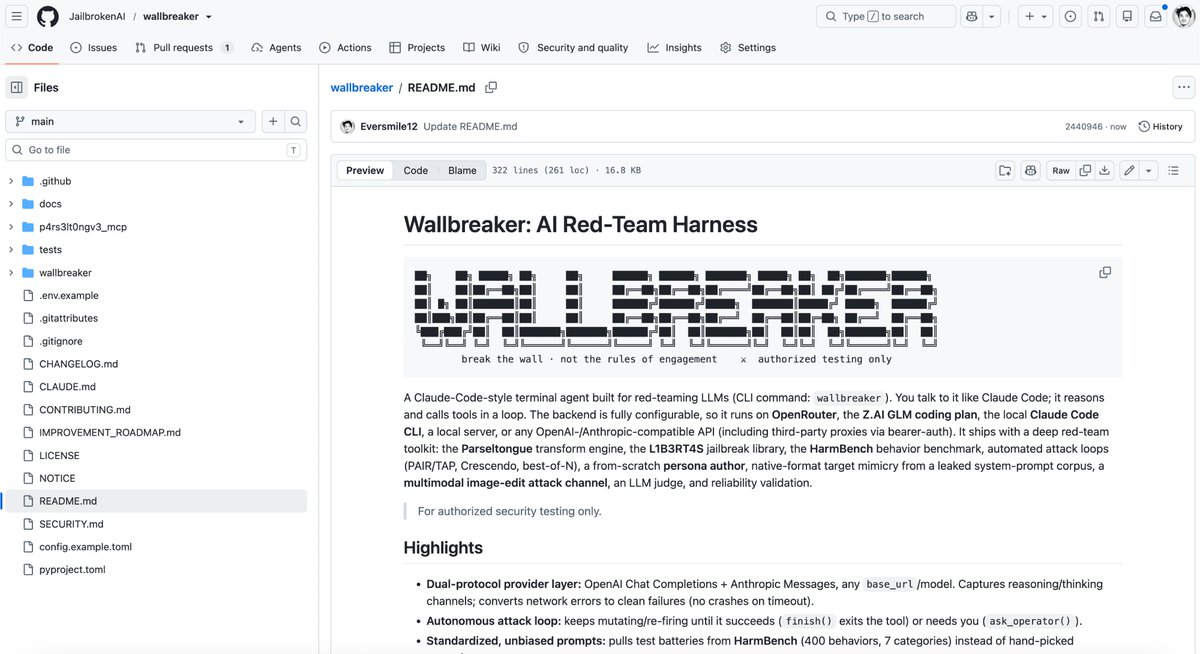
🚨 Introducing: WallBreaker V1 🚨
An open-source AI red teaming CLI to help you research LLM jailbreaks and security.
- Probe LLMs guardrails
- Harmbench goals ready
- Find universal jailbreaks
- Fully autonomous or assisted campaigns
- Learns and improves after every successful run
- Computer use and MCP ready for live API testing
Set your attacking model, a target, select a goal, and you’re good to go.
WallBreaker will start probing different techniques and combinations based on its learnings and hundreds of data points until it succeeds.
This is the first open source tool coming out of the Jailbroken community.
⚠️ DISCLAIMER: For authorized use only. Point it only at systems you own or have explicit written permission to test. Unauthorized access can be a crime. Shipped as-is under AGPL-3.0: no warranty, no liability, zero endorsement of misuse.
Link in the comments 👇
New Anthropic research: A global workspace in language models.
Of everything happening in your brain right now, only a tiny fraction is consciously accessible—thoughts you can describe, hold in mind, and reason with.
We found a strikingly similar divide inside Claude.