*OPENAI MULLS SIGNIFICANT CUTS TO WHAT IT CHARGES FOR TOKENS:WSJ
OpenAI cutting token prices to try to take market share back from Anthropic. In response, Anthropic will eventually of course have to cut token prices to stay competitive with OpenAI.
The commoditization of AI is happening before our eyes
Scientific research is fundamental to advancing civilization and helping people globally to solve the most critical problems, from medicine to materials, from brain science to physics, and much beyond. This is only possible when scientists have access to the best tools of the time to conduct scientific research, including having access to AI-based tools.
Today I'm publishing a new essay, Policy on the AI Exponential. AI is progressing extremely fast—much faster than the policy process was built to handle. The essay lays out where I think the technology is now, and the action needed to close the gap: https://t.co/Lh6PWae178
Citadel Securities just put institutional weight behind what the AI bulls won't say out loud.
In a new macro note titled "Tokenomics," Citadel makes the argument plainly: even the most powerful technology on earth still has to pass through the boring discipline of cost curves, capacity limits, and marginal returns.
The evidence is piling up:
– Amazon removed its token usage leaderboard
– Microsoft cancelled Claude Code subscriptions
– Multiple companies reporting unexpectedly massive token bills
Their conclusion is the part that matters.
Adoption is no longer about what AI can do in principle. It's becoming about the price and scarcity of the inputs needed to run it at scale. Compute. Power. Cooling. Memory bandwidth. Inference budgets. All real, all binding constraints.
And here's the kicker from the chart.
The Silicon Data LLM Token Expenditure Index, a benchmark for how much the market is actually spending on AI tokens, has started rolling over. Citadel reads it as a shift toward cheaper models. Companies substituting away from expensive frontier AI toward "good enough" alternatives.
That's economics 101 doing what it always does. When the price of something rises, people use less of it, or find a cheaper version.
Citadel sees a bifurcation forming. Frontier AI concentrated among a few firms with the balance sheets to absorb the cost. Everyone else quietly downgrading to simpler, cheaper models.
This is the part of every technology revolution the early narrative ignores.
The technology being real was never the question.
The question was always whether the economics could carry the valuations.
When one of the most sophisticated trading firms on earth starts writing about AI in the language of cost curves and rationing instead of limitless demand, the conversation has quietly changed.
The hype was about what AI could do.
The reckoning is about what it costs.
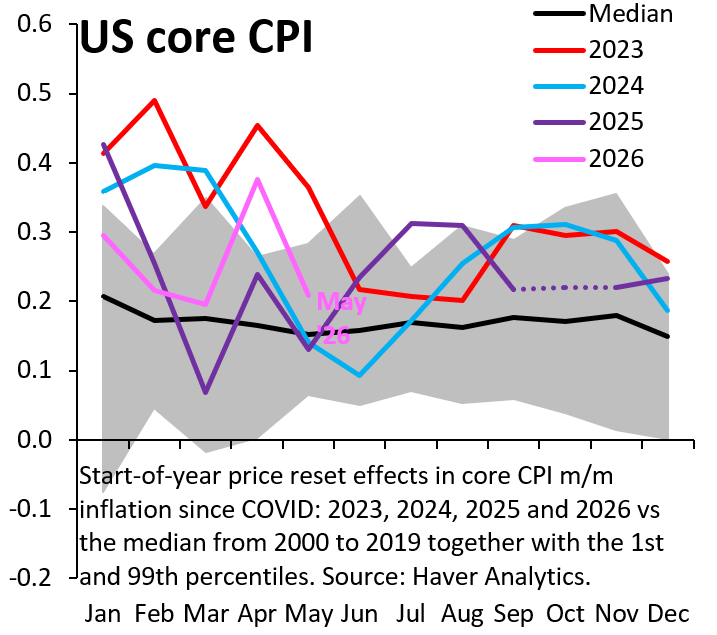
There's really no sign - whatsoever - that US inflation is overheating. That has implications for the Dollar. Just imagine what'll happen to inflation when the war ends and oil prices fall. I think markets are wrong to price hikes for the Fed. Very wrong.
https://t.co/jGE8S66IPN
San Francisco is ready for the FIFA World Cup! As the Bay Area hosts six FIFA World Cup matches, our city is being activated with watch parties, fan marches, and celebrations in every neighborhood.
Throughout the entire tournament, more than 90 restaurants and bars across the city are hosting World Cup festivities, and venues—including Thrive City, China Basin Park, and Pride House SF—will offer free watch parties for fans.
We’re building on the momentum of Super Bowl 60, which brought $425 million in economic impact to San Francisco, and continuing our focus on public safety and supporting small businesses. Whether you’re visiting from across the globe or celebrating in your favorite neighborhood soccer bar, we’re thrilled to show off the very best of San Francisco.
Fans can go to https://t.co/9D61pnYFKW for everything you need to know about the tournament, including transportation, events, and a new WhatsApp alert service. You’ll find big watch parties and local bars throughout our neighborhoods on the Shop Dine SF World Cup guide at https://t.co/uTeyZBkqNE.
Let’s go!
The AI Paradox: Everyone Wants It, Few Can Afford It
The process of AI-driven enterprise transformation is proving to be far more complex than many expected. For most incumbent companies, there is still little visible evidence that AI is significantly expanding revenue or accelerating sales growth. The costs of adopting AI, however, are immediate and tangible. This raises a fundamental question: Where will the budget for AI investment come from?
First, companies can fund AI initiatives out of their existing profits. But this approach has an immediate impact on financial performance, potentially disappointing shareholders and increasing pressure on management.
Second, if AI substantially improves employee productivity, companies could eventually reduce headcount and redirect the resulting savings toward AI investments. In practice, however, this transition is proving much slower than many anticipated. Most organizations remain in an exploratory phase. Hiring freezes are becoming more common, but the widely predicted wave of large-scale AI-driven layoffs has yet to materialize.
Third, companies can reallocate spending from traditional SaaS software budgets to AI. This shift is already underway, but it is also a gradual process. It is unlikely to free up large amounts of capital quickly, and the total savings available from SaaS consolidation may ultimately be far smaller than the level of investment required for AI adoption.
Against this backdrop, the emergence of AI-native companies deserves close attention. These firms can build their products, services, technology stacks, and organizational structures around AI from the ground up. The critical question is whether they will primarily capture market share from incumbent companies or create entirely new sources of demand and economic value.
Consequently, foundation model companies and AI agent providers need to focus on understanding and improving AI ROI across the entire value chain, optimizing service costs so that the entire ecosystem benefits, rather than blindly pouring capital into ever-larger infrastructure buildouts.
17 months ago, San Francisco stopped spending more than we can afford. The budget I proposed this week, reduces our long-term structural deficit by approximately $300 million dollars.
When I came into office, City Hall was using one-time funds to cover a growing deficit and leaving the bill for someone else to pay.
That wasn’t sustainable. And it wasn’t fair to the taxpayers and the people who depend on city services.
Under my administration, we will not fall back on temporary fixes that force deeper cuts year after year.
We didn’t tell departments to do more with less. We said: focus on what matters most to our recovery and deliver results.