Excited to share that our paper has been officially published in the @RevEconStudies: https://t.co/S5XPZSC1Z3!
A huge thank you to my outstanding co-authors @AndreasIMueller, Josef Zweimüller, Andreas Kettemann and @econ_uzh. Collaborating with you all has been a pleasure!
It was an honor to organize a workshop celebrating Josef’s career with @rlalive and to host brilliant researchers in the region that adopted me a few years ago 🇨🇭. Big thanks to all the participants!
Today at Monte Verità: “Firms and Workers in Switzerland and Similar Economies” -
a special workshop dedicated to our project leader Josef Zweimüller!
Colleagues and friends gather to celebrate Josef’s contributions and to exchange new ideas on labor, firms, and society.
It was a great pleasure to present our paper “The Ins and Outs of Vacancies” (with Damian Osterwalder and Josef Zweimüller) at the NBER Summer Institute. One of our key findings: replacement vacancies—those posted to refill jobs after workers quit—fluctuate strongly over the business cycle. This has important implications for how we interpret vacancy data and understand labor market dynamics.
Thanks to the organizers and participants for the engaging discussion! As always when you have all the best people in the same room, you get invaluable feedback for your research.
#NBER #JobVacancies #BusinessCycle #LaborMarket #QuitRate
Link to paper: https://t.co/lRmNSyDiho
What drives fluctuations in the job vacancy rate?
It was a real pleasure to present my joint work with Damian Osterwalder and Josef Zweimüller today at Copenhagen Business School. In our paper, “The Ins and Outs of Vacancies”, we use exceptionally detailed vacancy data from Austria to shed light on the dynamics behind changes in the job vacancy rate. We find that vacancy rates decline when both inflows (newly posted vacancies) and outflows (filled positions) fall—roughly in equal measure. A key driver of the declining inflows are replacement vacancies—those posted to backfill positions left by workers who quit to join other firms. When fewer workers quit, fewer replacement vacancies are posted, setting off a domino effect: fewer vacancies today lead to even fewer vacancies tomorrow.
Link to paper: https://t.co/aOFIq1L4fW
Thanks to @dbm27199695 for the invitation to CBS!
Excited to see my job market paper with Simona Sartor featured in the German news! 🔥
Read the article here (in German): https://t.co/uQRRJkps6n
Find a thread about the paper below. ⬇️
🎉 Congratulations to Damian Osterwalder who has successfully defended his PhD Thesis: "Understanding the Dynamics of Labor Markets: Unemployment, Vacancies, and Wage Formation".
Damian's thesis addresses three key questions related to job search: how to optimally insure unemployed workers in the context of repeated unemployment, how vacancy stocks fluctuate over the business cycle, and how starting wages influence the duration of vacancies.
Damian has recently joined the @SNB_BNS (Statistics Division).👏
We wish all the best for the future! 😀
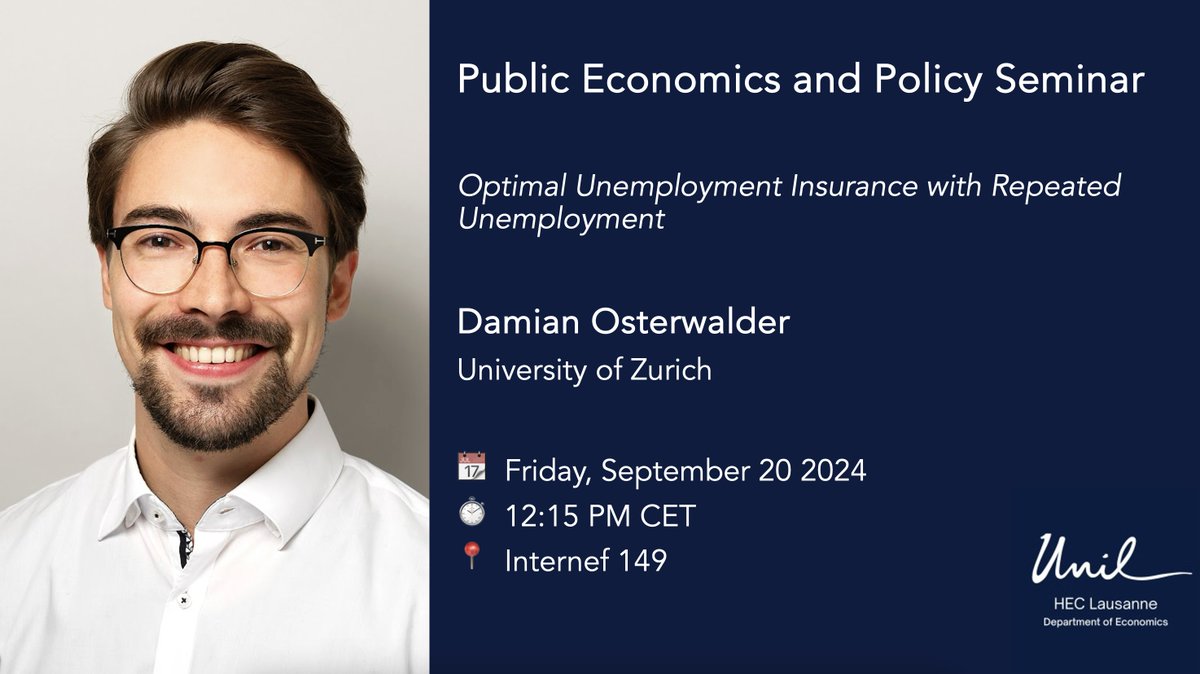
📢We're thrilled to welcome @da_oster from @econ_uzh tomorrow for a public economics and policy seminar. He'll present: "Optimal Unemployment Insurance with Repeated Unemployment". Don't miss this insightful discussion!🌟 #EconomicsSeminar
👉 Details: https://t.co/SNpRkcxRh5
Excited to share that our paper has been officially published in the @RevEconStudies: https://t.co/S5XPZSC1Z3!
A huge thank you to my outstanding co-authors @AndreasIMueller, Josef Zweimüller, Andreas Kettemann and @econ_uzh. Collaborating with you all has been a pleasure!
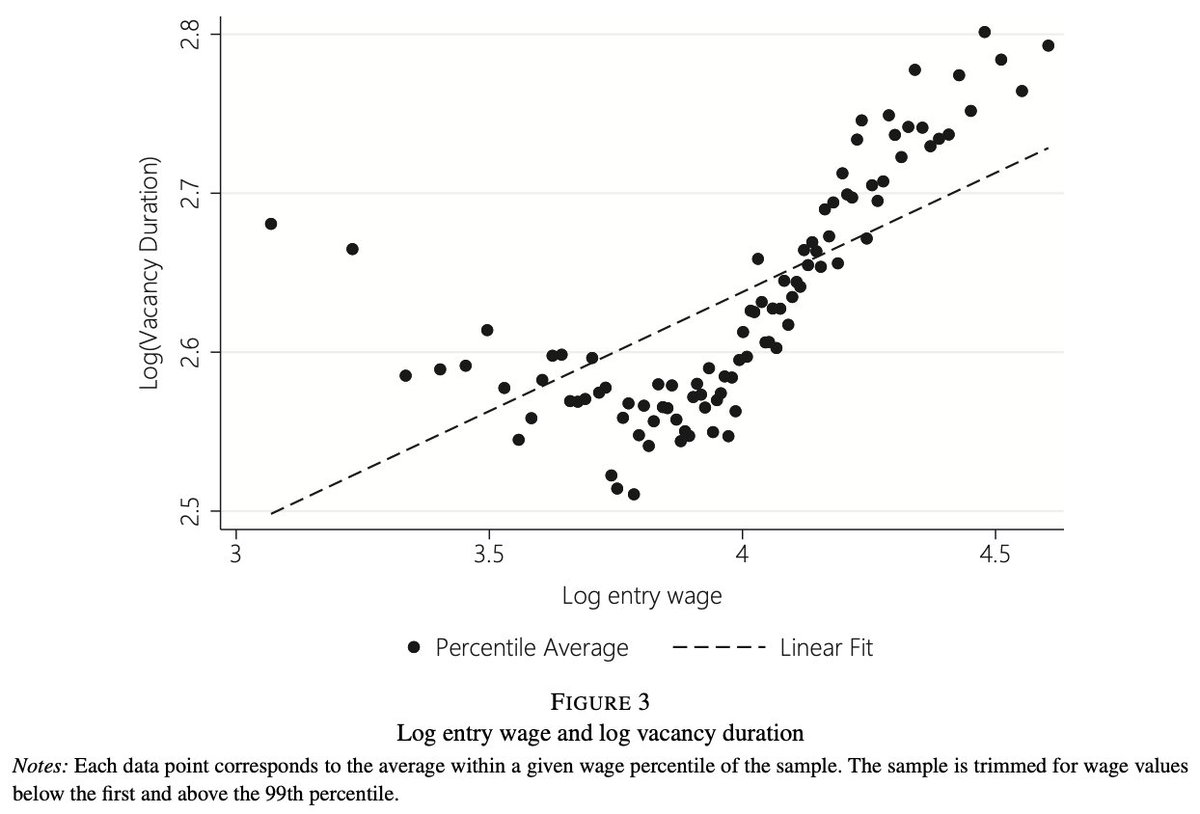
#FactOfTheDay How are vacancy durations related to entry wages of workers filling a position?
Empirical results from linked vacancy-employer-employee data show that starting wages and vacancy durations are positively correlated in the raw data, but the correlation turns negative when controlling sufficiently for worker-level heterogeneity.
This negative association is particularly strong with the establishment component of the starting wage.
Read more in "Vacancy Duration and Entry Wages: Evidence from Linked Vacancy-Employer-Employee Data", by @AndreasIMueller, @da_oster, Project Leader Josef Zweimüller and Andreas Kettemann, forthcoming in @RevEconStudies: https://t.co/tNwE6terfK
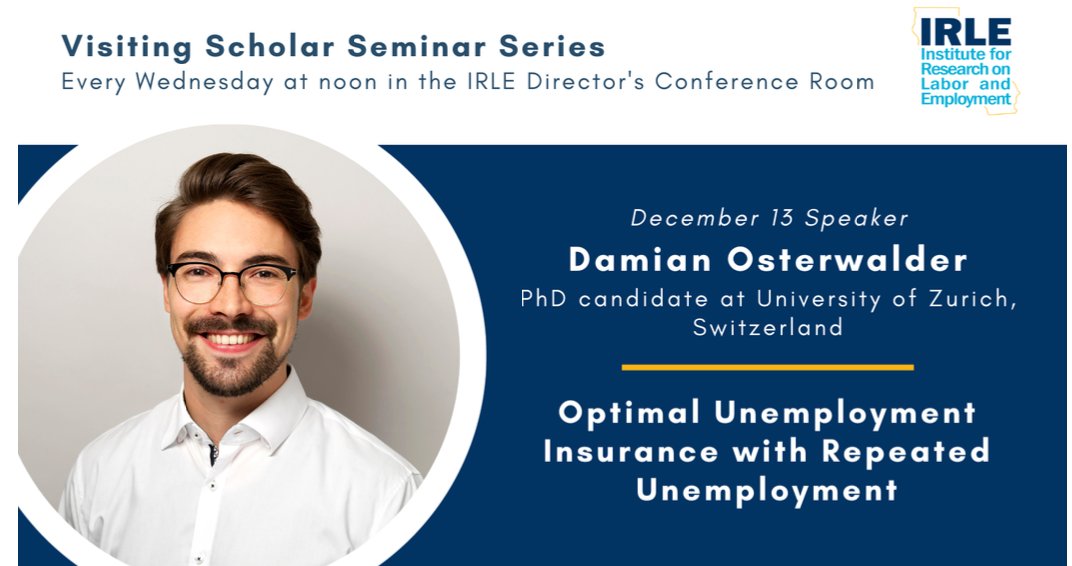
Join us every Wednesday at noon for our Visiting Scholar Seminar Series with pizza.
Hear this week from @da_oster as he discusses "Optimal Unemployment Insurance with Repeated Unemployment." 🍕📈