The CIA OGA (the Office of Global Access) article was deleted, but the "Good Trouble Show" posted a backup.
https://t.co/XNOKP3onex
https://t.co/wTZJTHU7fY
Beijing thought it could hold the entire global tech industry hostage by locking down rare earth minerals, but Western innovators just broke the CCP’s chokehold. A Wall Street Journal report highlights a massive wave of optimism as industries successfully eliminate their reliance on Chinese critical minerals. For decades, Beijing controlled up to 90% of global rare earth processing, using that monopoly as political leverage. However, its recent aggressive export restrictions backfired completely, triggering an unprecedented boom in non-Chinese processing and substitution technologies that cannot be undone.
Leading this technological rebellion is Minnesota-based startup Niron Magnetics, which has engineered the world’s first high-performance, rare-earth-free permanent magnets using iron nitride. By utilizing iron and nitrogen, which are abundant, cheap, and entirely domestic raw materials, Niron completely bypasses the dirty refining loops controlled by China. This breakthrough has attracted massive backing from automotive giants like GM Ventures, Stellantis, and Volvo, alongside defense partnerships to build military hardware. Demand is already outstripping supply, forcing Niron to expand from a pilot facility to a massive 190,000-square-foot production plant to fulfill its contracts.
At the same time, startups like Conifer are transforming electric motors by swapping out rare earths for standard, abundant ferrite magnets. Conifer’s proprietary design slashes motor size and weight by up to 50% while boosting vehicle range and operating efficiency by up to 30%. These clean motors seamlessly drop into everything from delivery vehicles and robotics to data center cooling systems. By trying to weaponize its mineral monopoly, the CCP has accidentally forced the West to build a resilient, localized supply chain that leaves authoritarian chokeholds in the past.
#RareEarths #SupplyChain #NationalSecurity #CleanTech #ChinaDecoupling #Innovation #Geopolitics #NironMagnetics
https://t.co/7oWP1U6Jek
I got to spend all day today with Jensen in Taiwan: talking with thousands of engineers and eating street food at a night market. Jensen is received as a rockstar in Taiwan, like it's Beatles in the 60's. It's mind-blowing and fun to watch. But most importantly, through all the interactions and all my conversations with him, he remained the same humble, kind, thoughtful, funny guy he always was, even as a kid who went to these same night markets many years ago.
Btw, we tried a crazy amount of different street food. It's legit some of the most delicious food I've ever had. I can't wait to share video of it, including a ton of our conversations and hangout. When I can pause for a moment from all the travel to edit the video, I'll post it.
Can't wait to continue talking to Jensen and engineers at Computex this week, and exploring more of Taiwan, and of course roaming the night markets for some more delicious street food.
Days like these, even more than usual, I feel like the luckiest kid in the world.
Love you all! ❤️
My husband Abraham was diagnosed with a very rare sacral chordoma. The surgery to remove bone and surrounding tissue lasted almost seven hours and was successful. He had a rough night and is in a lot of pain but is finally home resting. Now recovery begins. We’re so grateful for the outpouring of prayers and kind messages from all of you. Our hearts are full. ❤️
Taking old cars and turning them into electric vehicles is not a new idea. Tinkerers and car enthusiasts have been doing this for decades. Tesla, in fact, can trace its origins back to AC Propulsion, the Southern California-based company whose work on the Lotus Elise inspired the Tesla Roadster.
No one, however, turns classic cars into electric gems like Marc Davis and Moment Motor. From their Austin workshop, Moment creates absolute art.
Full video - https://t.co/eKbNcpKNuM
A framework I wish more Founders and VCs used when discussing US Manufacturing:
Automation Value = Labor Intensity × Labor Eliminated
Everyone gets excited about robots and automation.
Almost nobody asks:
“How much of revenue is labor?”
If labor is 60% of revenue and AI removes 80% of it:
• EBITDA: 10% → 58%
• EV: $80 → $928
Here’s the math:
Assume $100 of revenue.
• Starting EBITDA = 10% margin = $10 EBITDA
• Starting EV = 8× EBITDA = $80
Labor is 60% of revenue ($60). Removing 80% of that labor saves $48.
• New EBITDA = $10 + $48 = $58
• New EV = 16× EBITDA × $58 = $928
If labor is 15% of revenue:
The impact is dramatically smaller.
The biggest AI manufacturing opportunities may not be the most technologically impressive.
They may simply be the businesses with the most labor to remove.
*Assumes both EBITDA expansion and multiple expansion (8× → 16× EV/EBITDA).
Stick Your Tongue Out: The Silent Release
Dr. Elena Vasquez had seen thousands of patients at Mount Sinai, but Marcus was different.
A 42 year old software engineer, he arrived with shoulders permanently hunched, eyes shadowed by perpetual exhaustion, and cortisol levels deep in the clinical anxiety range.
Therapy and medication adjustments brought little change. His body was locked in a silent civil war.
One afternoon, after reviewing his latest scans, Elena made an unusual request.
“Stick out your tongue,” she said. “As far as you can. Hold it for forty seconds.”
Marcus blinked. “Is this a test?”
“Consider it an experiment,” she replied, her voice calm but certain.
He complied, feeling ridiculous at first. The muscle strained, unfamiliar and awkward. His jaw trembled. His neck, usually rigid from years at a desk, began to burn with a deep, releasing ache. Forty seconds felt eternal.
“Do this twice a day,” Elena instructed. “Morning and evening. That’s all.”
Marcus left skeptical. But he tried it anyway.
The first few days brought nothing but mild soreness. Then, on day six, he noticed something strange during his morning routine: his shoulders dropped an inch without effort. The constant low hum of background tension, the one he had lived with so long he forgot it existed, had quieted.
By day twelve, his wife commented that he seemed lighter. Less reactive to traffic, to deadlines, to the thousand small irritations that once wound him tight. When he returned for bloodwork two weeks later, the numbers confirmed what he already felt: his cortisol had plummeted from dangerously high to the middle of the normal range. No medication changes. No new therapy. Just the daily tongue extension.
Elena was not surprised. She had studied the hidden architecture of chronic stress for years.
The neck carries an enormous burden, often 60 to 80 percent of the body’s accumulated tension. That tension does not stay polite. It compresses the vagus nerve, the body’s master regulator of calm.
It restricts the gentle flow of cerebrospinal fluid that bathes the brain. It keeps the entire nervous system whispering danger even when the world is quiet.
The tongue, surprisingly, is the key. It connects directly to the hyoid bone, that floating anchor for the deep muscles of the throat and neck.
When you extend the tongue fully, you create a gentle but powerful traction through the fascial chains, those webs of connective tissue running from jaw to chest. Like loosening a knot that has been pulling on everything downstream.
One simple movement. Forty seconds. Twice a day.
Marcus became her quiet advocate. He taught the technique to his overworked colleagues, his stressed sister, even his skeptical father. Some felt nothing. Others, like him, experienced a profound unwinding.
Years later, when people asked Elena about her most elegant intervention, she would smile and say:
“The brain is rarely the villain. More often, it is simply what is wrapped around it, layer after layer of unnoticed armor. Sometimes the most powerful medicine is learning how to take it off.”
And in those moments, she would remember Marcus: the man who learned to release what he did not even know he was holding.
For related research on vagus nerve stimulation and stress reduction mechanisms, see: https://t.co/kxOsZBU3bQ
The shortage today isn’t good ideas, it’s good founders.
There’s multi/billion dollar industries that haven’t seen a drop of investment in fifty years.
Zero competition. Just waiting.
I’m willing to testify under oath that I saw at least two partially hidden cameras.
I assume that’s why a network of IC accounts constantly accuse me of being unreliable/fraud/grifter/charlatan/etc
Like when I was the *ONLY* one who told you about the American Flag table cloth:
🚨 BREAKING: Joshua Kushner's @ThriveCapital is putting $1 billion into buying local accounting firms and rebuilding them around AI.
The acquisition arm is a company called Current.
The pitch to a decades-old CPA firm: sell us a majority stake, keep a meaningful piece for yourselves, and we'll re-engineer the back office with AI.
The ownership model is the part worth a look:
→ Traditional PE buys to sell inside a fixed window
→ Thrive plans to hold for the long run, the way Berkshire Hathaway does
→ Local partners keep real, meaningful stakes
Patient capital, pointed at a fragmented, unglamorous industry.
The proof point so far is Larson Gross – one accountant, one office in Bellingham, WA in 1949, grown into a regional firm with five offices and 200 employees.
In 2025 its partners sold control to Current.
@Forbes reports the in-house models are hitting up to 98% accuracy on data entry.
Worth being precise, though – data entry is the high-volume floor of accounting, not the judgment work clients actually pay for.
The skepticism is fair, too.
AI roll-ups have been hyped for years and mostly underdelivered. The gap between the pitch and the operating reality is still wide.
The bet underneath all of this: that permanent capital plus AI can run a professional-services firm better than the people who spent decades building it.
If it works in accounting, the same template is waiting for law, insurance, and consulting.
A billion-dollar wager on the back office of American business.
Excited to share how Anthropic's data team has automated 95% of business analytics queries with Claude. Blog post covers how we approach evals, ablations, and online validation!
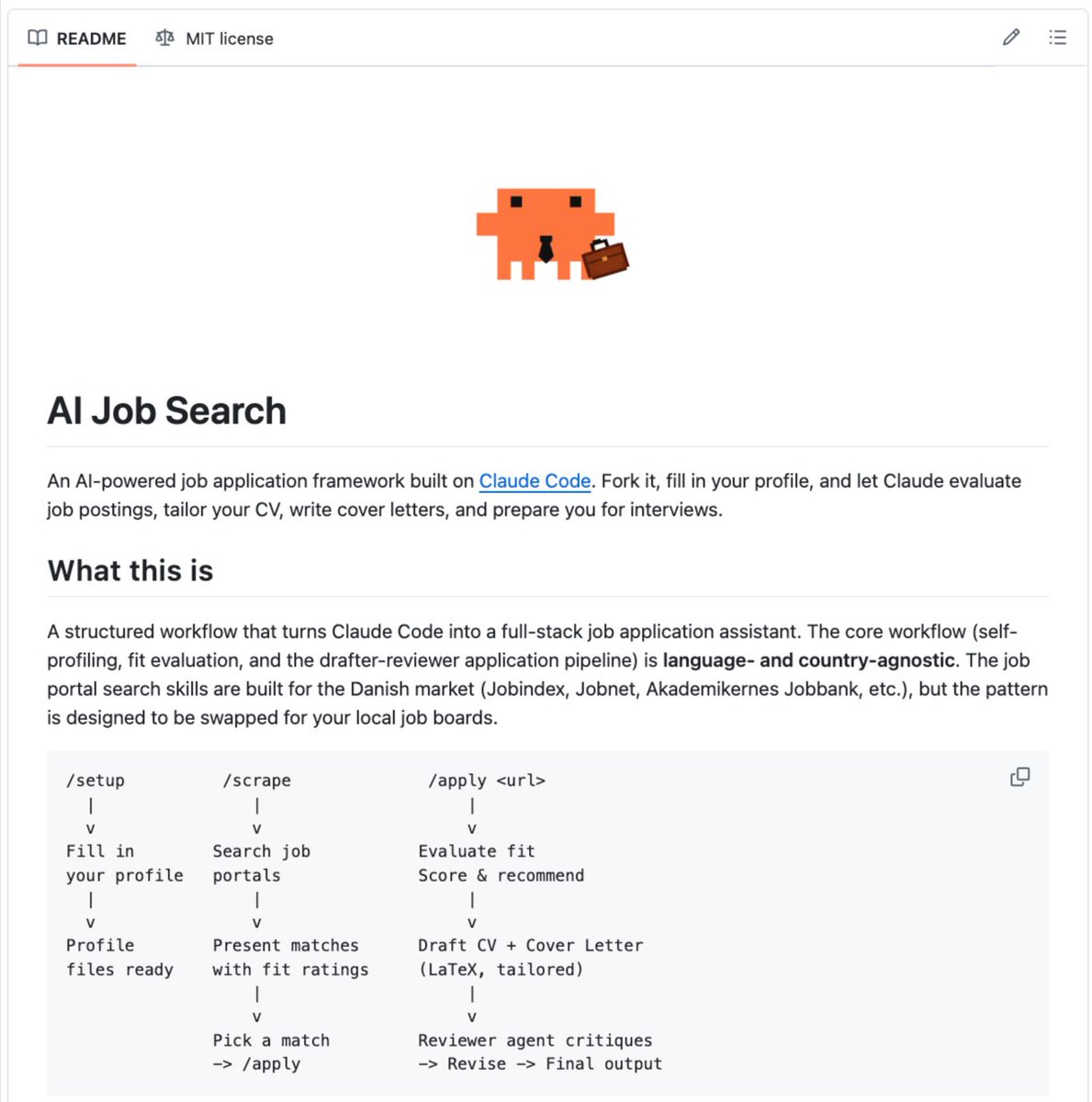
A scientist in Denmark figured out how to make Claude prepare his job applications. He open-sourced the whole thing.
His name is Mads Lorentzen. He is a PhD geophysicist. He built it on top of Claude Code and released it under MIT license.
Here is what it does. You fork the repo, fill in your background once, and it runs a five-step pipeline for every job you want to apply to.
Step 1. It reads the job posting and scores how well you fit.
Step 2. It drafts a tailored CV in LaTeX, picking only the experience that matches.
Step 3. It writes a cover letter framed around what you would bring to the role.
Step 4. A second AI agent reviews the first agent's work, points out weaknesses, and the first agent revises.
Step 5. It compiles both into clean PDFs you can send.
The whole thing is a folder of markdown files. The candidate profile, the writing style rules, the CV templates, the interview prep notes. Every step is plain text you can read and change.
The job portal search is built for Danish boards. The application workflow itself works for any country.
489 stars. 270 forks. A fork-to-star ratio that high means people are using it, not only bookmarking.
Mads is not a startup founder. He built this because he needed it for himself, then shared it.
This is the future of job hunting. Not a service you pay for. A workflow you own.
(Link in the comments)