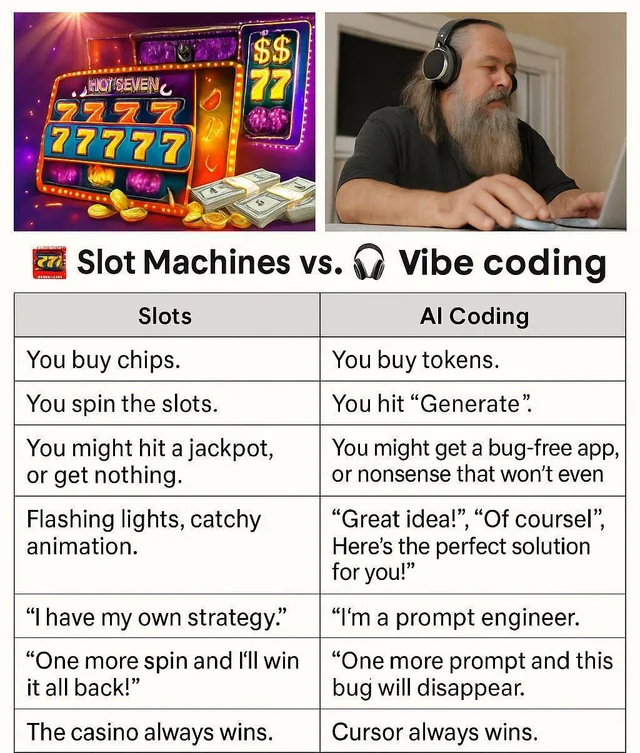
i swear vibe coding is a real addiction now
bro i know people who code 12-16 hours a day just building random things.
anyone else like this or just few?
One idea to safeguard a company's confidential information from being harvested by LLM providers is to periodically inject fake data. An internal team could create misleading information and distribute it among employees, effectively confusing potential espionage attempts.
What is MCP & why it's a big (huge) deal:
(model context protocol)
TLDR: MCP makes it possible for AI Tools to use external tools. E.g. Chatbot/IDE/AI-Agent can use Gmail/GoogleDrive/WeatherApp etc.
Detailed explanation for both, tech & non tech people (+demos):
1) AI Tools (chatbots, wrappers, agents, code generator, etc) wanna talk to external systems.
In pre-MCP world, one would have to write code to connect AI tool to the external system via API. Which meant every connection had to be pre-coded.
It also meant that every AI tool had to hard code its connection to every other tool. So if there are 1000 AI tools and 1000 external tools, then 1000000 hard-coded connections via API.
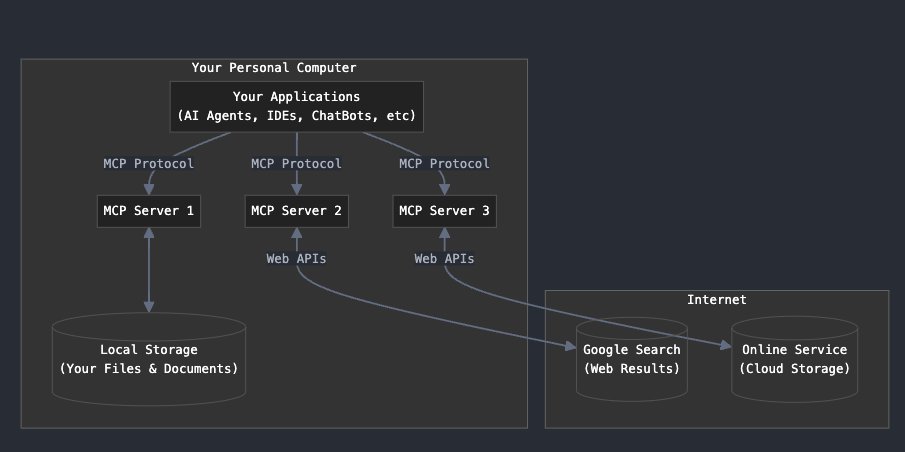
2) MCP is a standard protocol. This means that every AI tool has to implement this once, and then it can connect to thousands of external tools via this protocol.
3) The same goes for external tools. They all have to create an MCP server just once, and all AI tools that support MCP can connect to them.
4) It's a huge deal. Imagine 10k AI tools and 10k external tools now all have to implement MCP just once each. So it's 20k implementations. Versus 10k*10k=100M implementations.
5) This whole thing can also run on the cloud or on local computer.
See demos:
AI Agents 101: 𝗔𝗜 𝗔𝗴𝗲𝗻𝘁 𝗠𝗲𝗺𝗼𝗿𝘆.
In general, the memory for an agent is something that we provide via context in the prompt passed to LLM that helps the agent to better plan and react given past interactions or data not immediately available.
It is useful to group the memory into four types:
𝟭. Episodic - This type of memory contains past interactions and actions performed by the agent. After an action is taken, the application controlling the agent would store the action in some kind of persistent storage so that it can be retrieved later if needed. A good example would be using a vector Database to store semantic meaning of the interactions.
𝟮. Semantic - Any external information that is available to the agent and any knowledge the agent should have about itself. You can think of this as a context similar to one used in RAG applications. It can be internal knowledge only available to the agent or a grounding context to isolate part of the internet scale data for more accurate answers.
𝟯. Procedural - This is systemic information like the structure of the System Prompt, available tools, guardrails etc. It will usually be stored in Git, Prompt and Tool Registries.
𝟰. Occasionally, the agent application would pull information from long-term memory and store it locally if it is needed for the task at hand.
𝟱. All of the information pulled together from the long-term or stored in local memory is called short-term or working memory. Compiling all of it into a prompt will produce the prompt to be passed to the LLM and it will provide further actions to be taken by the system.
We usually label 1. - 3. as Long-Term memory and 5. as Short-Term memory.
A visual explanation of potential implementation details 👇
And that is it! The rest is all about how you architect the topology of your Agentic Systems.
What do you think about memory in AI Agents?
#LLM #AI #MachineLearning
Where are all the fun consumer AI apps?!?
There’s a shortage of AI apps that exist in the categories of consumer that have dominated in the past decade: Social apps, marketplaces, messaging/communication, video, etc. Yes, there are a lot of prosumer products and a lot of creator tools, but that’s not the same thing.
There’s a bunch of reasons for this:
- cost. To put AI front and center into your product experience means that you are generating a lot of API calls as users interact. We are just on the cusp of AI being cheap enough that you could have a low value audience that is either ad-supported or premium, and the economics work. The good news is that this is radically improving and one day we’ll have small on device models and make us a trivial problem. But for now it’s an issue.
- catch 22 on product design. LLMs our best for generating new novel conversations with users. Image and video generation models are amazing when they create media. It turns out it’s not so easy to find consumer product categories where conversation or generating media fits within the pre-existing usage and design. Yes there are a lot of chat apps but generally people want to chat with other people and LLM conversations are not quite good enough to replace that. What you want is to potentially augment existing conversations, but is that actually enough of a value prop? So far no. Same with creating new forms of media. Instagram users post photos while on vacation overseas for clout, and using AI generated content subverts this entire status game. It’s like knowingly using a knock off handbag.
- growth channels remain stagnant. In prior technological tranformstions like mobile, or the Internet one of the big advantages was that there were new distribution channels to tap into for your new product that was created for the new paradigm. Startups could be quick to build mobile apps, which could then happen to mobile apps and the App Store. Contrast that to today where AI provides functionality that exists within existing UX and thus existing growth channels. These channels are saturated, and new startups still have to go to market in stagnant channels where incumbents are putting a lot of dollars.
- the transition from infra to apps. For the past two years building, AI functionality into your product has not been easy. You have needed to build your own infrastructure and potentially employ your own AI research team in order to build the user experience you want. The trend for this has been improving dramatically, and now you can build entire new product categories without knowing what model is underneath. Your team can be plain old application engineers as opposed to AI researchers. This is going to unlock a ton of new experimentation as a result, and I’m not even referencing the big strides that code gen tools and vibe coding are soon to create!
- incumbents are moving fast. In disruption theory, the argument is that incumbent will move slowly and not recognize the technological shift. We saw that in mobile, of course, because in the first few years, it wasn’t clear that the iPhone was going to be the thing, and it took time to redesign and re-create functionality from web/desktop to mobile. This is why we saw products like AIM and ICQ get displaced by products like WhatsApp and Signal. The crazy thing of course with AI is that a lot of the largest consumer facing companies in the world, like Meta and Google, are actually embracing the new paradigm and trying a ton of different ideas. That’s leading to a situation where it seems more likely the best AI WhatsApp will just be WhatsApp.
Ultimately, I think we are about to see an explosion of consumer products because of the cost and ease of building AI into new ideas. I’m very excited about this. However, this time seems to be different than the Web-to-mobile transition because of some of the issues above. Nevertheless I’m very excited.
google’s core problem is that it was built to organize a web that no longer exists. the open web has been replaced by walled gardens, discord servers, newsletters, private forums, & algorithmic feeds that are never exposed to search. worse, the visible parts of the web that google still indexes have been overrun by seo-optimized sludge, ai-generated spam, & paywalls.
their dna is fundamentally extractive. they never built a creator ecosystem because their whole game was to scrape, index, & serve ads against other people’s content.
the entire ecosystem slowly but surely shifted drastically—with llm’s anyone can organize anything so the mission breaks down.
I added stock prices to our AI financial agent
Agent now shows you:
• stock price
• market cap
• volume
• historical prices (chart)
No signup required to use the agent.
All of the code is open source.
"Verticalized agents" is a bit of a meme among startups right now—but rightly so: Over the last year, we indexed too far into AI being a Swiss army knife—jack of all trades and master of none.
You simply cannot go wrong building something obsessively focused around a problem. And this is not simply because you will deliver value more precisely—but because the world is still behind in realizing what AI can do and your marketing message needs to spoonfed them: "DM and pitch creators on TikTok", "create HTML animations with speech", etc.
AI or not, my rule of thumb has always been that Version 1.0 of any product should be so verticalized that:
1) when a target user lands on the page, their only reaction is "Well, shit. This was made for me. I better sign up."
2) when you tell your friends & family what you're working on, it is so narrowly focused that you feel embarrassed
One big question in AI is do you have AI Agents conform to today’s workflows, or bet on enough changing that you reinvent the workflow from the ground up. This is a major architectural and UX decision for every AI company and it will determine the winners and losers.
Vous pensez qu’une IA se contente de « répondre à nos questions » ? 🤓 Détrompez-vous : tout commence par le prompt engineering, l’art de formuler la consigne parfaite pour guider un grand modèle de langage (LLM). Sans bon prompt, pas de réponse optimale.
Enfin, les méta-prompts (souvent en “system”) définissent un cadre global : rôle de l’agent, style, interdictions. Ils renforcent la cohérence, mais peuvent être détournés (prompt injection). Conclusion : bien manier ces techniques fait toute la différence.