📰Happy to share our new paper in Studies in Educational Evaluation: 'A critical evaluation of alignment optimization' Explores psychometric challenges & the promise of alignment for global ed research. Co-authored w/ @n_eryilmaz_93 & @dacarras
https://t.co/liUdTjZS4S
#EdResearch
I’m thrilled to share our new publication on Gender attitudes in Latin America 🥹❤️ this study is in my heart. With my super stars co-authors @dacarras#siugminlay@treviner Here: https://t.co/3QRhANsz62
¿Se pueden andamiar los conocimientos previos de los alumnos para promover evaluaciones estandarizadas más justas? En este artículo de Assessing Writing lo discutimos:
https://t.co/eAKngNq6WF
Fue elegido por los editores para tener acceso abierto hasta marzo. Pase y lea :)
🌎Reserva fecha y hora: viernes 10 mayo a 11 hrs Chile será el webinar: “Las ventajas de los estudios regionales: el caso del #ERCE”, donde presentará estudio investigador @MideUC sobre aporte investigación #LLECE para #LAC. Inscríbete📝https://t.co/ouiipodKth
Te invitamos a participar en este webinar acerca de las ventajes que presentan los estudios regionales en el ámbito de la educación escolar🌎 Viernes 10 de mayo - 11.00 horas (Santiago de Chile, UTC-4), vía YouTube. Inscríbete aquí 👉 https://t.co/xyngc4m22J
🌎Entérate, ¿Cómo aportan las evaluaciones internacionales?
Te invitamos a participar en el Webinar "Las ventajas de los estudios regionales en gran escala: el caso de ERCE.
🗓️10 de mayo
⏰11h00
👩💻Inscríbete👉 https://t.co/UXS1Fchmyh
¡Avanzamos hacia ERCE 2025!
[LLAMADO A CONCURSO]
Los interesados deben enviar su CV, carta de presentación y ejemplos de trabajos o proyectos relevantes a Francisca Rodríguez, dir. ejec. de MOVI 📪 [email protected] antes del 29/03/24🗓️Indicar en el asunto👉🏻“Postulación ayudante de investigación MOVI”
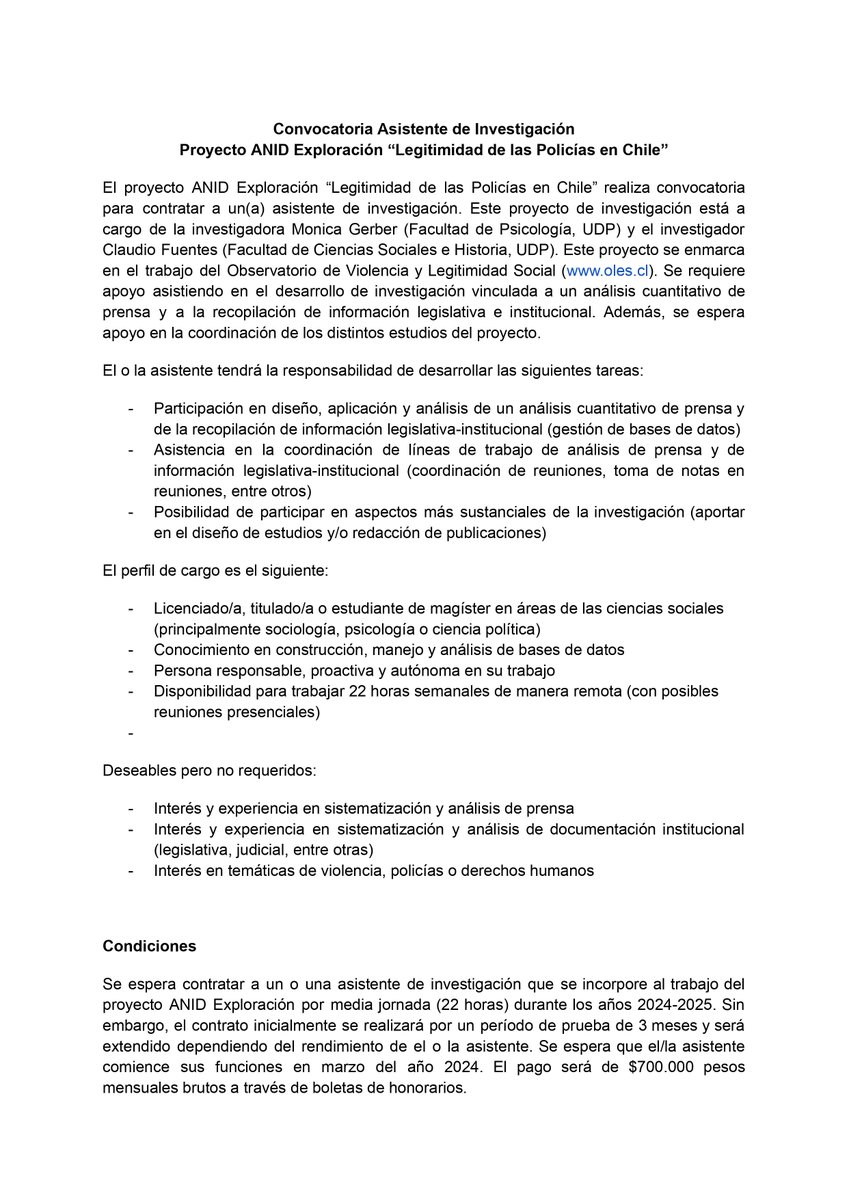
Busco asistente de investigación jornada completa para trabajar conmigo en proyectos Fondecyt y Anillos en temas de género, reproducción y crisis climática. Por favor difundir @UDPsociologia@Odesigualdades https://t.co/m89zfDkA4a
@stephenjwild And a tutorial: Svetina, D., et al (2019). Multiple-Group Invariance with Categorical Outcomes Using Updated Guidelines: An Illustration Using Mplus and the lavaan/semTools Packages. https://t.co/EhZCXFXyGu
@stephenjwild Measurement invariance in the social sciences: Historical development, methodological challenges, state of the art, and future perspectives. https://t.co/LKhabBaGOX
🔊THE 2nd CALL FOR APPLICATIONS FOR THE ONISILOS COFUND FELLOWSHIPS IS NOW OPEN!
ℹ️Applications and Guide for Applicants: https://t.co/SmHGnZvlG4
❗️Deadline for applications: 25/01/2024
#MSCA#cofund#ucy#fellowship#ONISILOS#research
📍CONFERENCIA MOVI📍
Este jueves 30 a las 9:30 h. se realizará la conferencia: “Estrategias globales para impulsar la movilidad social en Chile”.
Lugar: Sala colorada, centro extensión UC, Alameda #340
Link de inscripción: https://t.co/eQyTxUzxLN
@CentrosAnid @min_ciencia
@stephenjwild I very much like the author take on the overview of how latent variables (i.e., random terms), can be specified as continuos or categorical.
@stephenjwild For fundamentals, and history of, I really like this one:
Torres Irribarra, D. (2021). A Pragmatic Perspective of Measurement. Springer International Publishing. https://t.co/6BOu5oVUUm
@stephenjwild This one of the few references I found, where the partial credit model is clearly explained and describe (keep an eye on the idea of "delta dot").
@stephenjwild For IRT models, I deem Wu book, as a main reference.
Wu, M., Tam, H. P., & Jen, T.-H. (2016). Educational Measurement for Applied Researchers. Springer Singapore. https://t.co/LMA9w1KPx9
I am admitting Ph.D. students-- if you're interested in Education and mixture modeling, join us this Friday for our departmental informational session. Information below


![Nucleo_MOVI's tweet photo. [LLAMADO A CONCURSO]
Los interesados deben enviar su CV, carta de presentación y ejemplos de trabajos o proyectos relevantes a Francisca Rodríguez, dir. ejec. de MOVI 📪 frodrig1@uc.cl antes del 29/03/24🗓️Indicar en el asunto👉🏻“Postulación ayudante de investigación MOVI” https://t.co/sFF7Vx0XjJ](https://pbs.twimg.com/media/GIfrQ2KXcAA_vwK.jpg)





![Nucleo_MOVI's tweet photo. [LLAMADO A CONCURSO]
Los interesados deben enviar su CV, carta de presentación y ejemplos de trabajos o proyectos relevantes a Francisca Rodríguez, dir. ejec. de MOVI 📪 frodrig1@uc.cl antes del 29/03/24🗓️Indicar en el asunto👉🏻“Postulación ayudante de investigación MOVI” https://t.co/sFF7Vx0XjJ](https://pbs.twimg.com/media/GIfrQ2OXUAADogW.jpg)