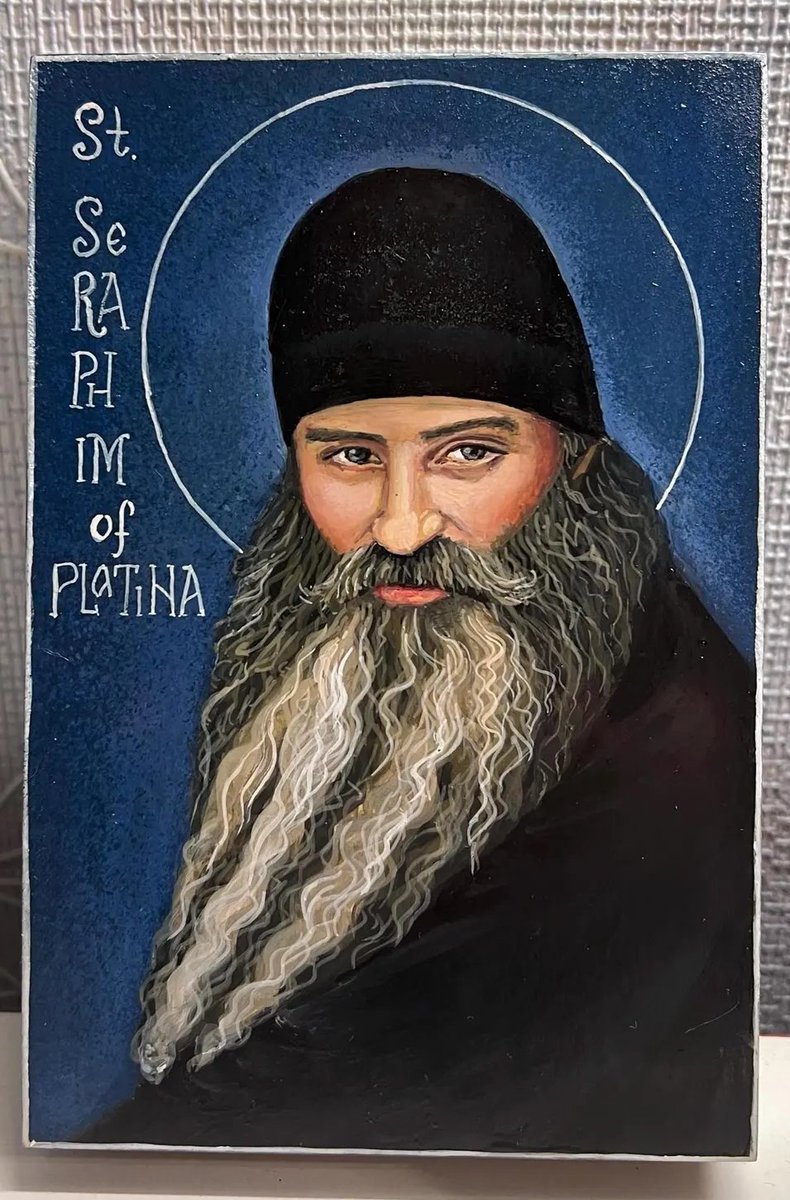
@OrthodoxPole81 This is good, but even more:
Words have multiple referents. His critiques are of heresy, not Orthodoxy.
And the “Jewish” he means is anti-Christ kabbalistic talmudism, again not Orthodoxy, which is the true Israel and the true continuation of the Jewish inheritance.
☦️☦️☦️
"Speak well of those who speak evil of you.
Pay good for evil.
Pray for those who cause you various offenses, wrongs, temptations, persecutions.
Whatever you do, on no account condemn anyone; do not even try to judge whether a person is good or bad, but keep your eyes on that one evil person for whom you must give an account before God – yourself." - St Ignatius Brianchaninov
Saint Ascension (?!)
A short story told by Saint Paisios:
“I remember an elderly monk at Esphigmenou Monastery on Mount Athos, who was so simple, that he thought “Ascension” was the name of a women Saint. He prayed to her on his komboschoini, “Saint of God, intercede for us!” Once, he had to feed a sick Brother in the infirmary and had nothing to offer him. He immediately went down the stairs, opened a window overlooking the sea, stretched his arms out and said, “Ascension, my Saint, give me a little fish for the Brother.” And right away, as if by miracle, a big fish jumped out of the sea and into his hands. The others who saw him were astonished, but he simply looked at them smiling, as if he were saying “What’s so strange about what you’ve just seen?”
And then look at us. We may know everything about the life and martyrdom of the Saints, or about when and how the Ascension took place and yet, we cannot even catch a tiny little fish! These are the strange and paradoxical things of the spiritual life, which the reasoning of those intellectuals that are centered on themselves and not on God, cannot explain, because their knowledge is of this world and sterile; their spirit is ill with secularism and their mind void of the Holy Spirit.”
+++
Spiritual Counsels, Volume 1: With Pain and Love for Contemporary Man by Elder Paisios of Mount Athos p. 230
Continuation: The demons of despair
Another letter came from the owner of a coffee shop. He wrote that he had lost everything. His property went under the hammer of the devil. Out of despair, he went to the cemetery at night to commit suicide.
After sitting on the fence for a couple of hours, he lay on his parents' grave and fell asleep. His mother appeared to him in a dream and said: "In the Kingdom of God, there are many who were poor on earth, but there are none who consciously deprived themselves of life." He woke up and did not go through with it. Instead, he began living off charity.
Now he asks: isn't it a sin to ask for a handout?
The priest replied, "God said, 'You shall not steal,' but He did not say, 'Do not ask.' Begging, in your case, does not make you a thief."
Then he said something that is hard to accept: "What have you lost? What was not yours when you were born is not yours now. You were a master, and now you have become poor. That is not a loss.
A real loss is when someone was a man but became a beast. You were a man, and you remain a man."
The people who deceived him and drove him into bankruptcy now laugh outside the coffee shop window while he stands outside, burning with shame. The priest did not promise that everything would be made right immediately, warning: "Do not be jealous of their happiness, for you do not know their end."
An ancient Greek wise man once said, "Do not call anyone happy until you see how they die."
Lastly, he wrote: "Gold is tested in fire, and people who please God are tested in the chamber of humiliation. But you have already proved yourself to be a hero by defeating the dark thoughts of suicide.
You have defeated the demons of despair. After such a victory, every other battle will be easier.
May the Good Lord give us the grace to conquer our own demons!
Frightened by Father Iakovos’s prayers, some demons took the form of a furious black dog, a terrified wolf, or a predatory bird. At other times, they howled and roared like beasts, spreading fear everywhere.
Those who were freed from these demonic clutches often returned to the monastery on thanksgiving pilgrimages. However, accepting gratitude was not always simple.
The monks were stunned one day when the Elder refused a thank-offering from a mother whose son had been delivered. The Elder explained his rejection: the demon had moved into the money. He told her, "I drove the devil out of your child, and now you are trying to bring him back to me!" This grace that sets people free from devils is a triumph of immense importance.
It provides clear proof that Satan's power over humanity and nature is temporary and can be abolished. Since the graceful power of St. David of Evia drives out demons, it shows that Saint David lives in the Kingdom of God. This means that the Kingdom of God exists and can be experienced daily, even in our world.
To be continued….
Continuation👇🏿
The demon complained, "You are breaking my horns! I have fought you for sixty years. I could not lead you into sin to send you to hell. You must thank this Elder (Saint David), otherwise I would destroy you."
The demon then changed its tactics, addressing the Elder directly: "You are a saint. There is a saint among you, and you do not realize it." The Elder immediately replied, "You say this to distract me, but I do not listen to you. I am nothing but dust and ashes. I am humbled." The demon agreed, burning from his words, and replied, "It is your humility, you rascal, that burns me. Go away!"
On another occasion, parents brought their daughter to the monastery, but she refused to enter the church. The Elder came out holding the skull of St. David. Suddenly, the possessed girl screamed, "Disappear! I don't want to hear you, old man!" and began to scratch herself furiously.
"I am the ruler of this world," the demon cried from her mouth. "I hold Athens in my hands. What I hoped for has happened; I have compromised the priests. I have fought this monastery for many years. The Great One is here to protect you, so I cannot deceive you. Look at your legs; your feet are rotten." (The Elder suffered from painful varicose veins and poor circulation). "If you lose your mind and say you are a saint, I will send you to hell." The Elder stepped in, saying, "I am not holy, for the Lord said, 'You shall become holy.' I am doing my best. I am just a man created from the earth."
With renewed resentment, the demon said, "What can I do with you? You are so stubborn, priest. You are humble and Christ is in you, otherwise I would have destroyed you. I have cursed you with so many diseases, yet you persist in your fight against me."
Another possessed man proudly told the monks, "I have eight thousand wizards under my control." The Elder asked how he entered human bodies, and he replied, "I enter those who have no faith. I go into them like smoke."
On another occasion, a policeman brought his possessed wife to the Elder. At first, she seemed calm, and the Elder extended his hand to greet her. She snapped angrily, "Do demons grab the hand of a priest performing worship?" Two young people brought their possessed mother to the monastery from Veria, Greece. The Metropolitan of Samos happened to be present.
At first, the woman seemed calm and said playfully, "Iakovos the prodigal! Iakovos's father is a saint. Believers worship you as a saint." The Elder loudly repeated over and over, "I am a sinful man of the earth." After a while, she became aggressive and scratched the faces of several bystanders. When she tried to attack the Elder, he stopped her by placing St. David’s skull on her head.
Another possessed man shouted at the Elder's prayers, trembling, "Shut up, Iakovos! Shut up, exhausted one! Like smoke I enter human bodies, and like smoke I leave them. I fear and tremble at the Cross. When people are baptized, I leave. When the grace of God departs from them, I enter."
In all cases of demonic possession, the Elder read exorcism prayers while holding the skull of St. David to protect himself. People could not claim that the Elder cast out demons by his own power, since he always used St. David's skull as his spiritual aid.
Occasionally , dramatic scenes unfolded as the demons manifested different appearances….
To be continued…
The more a person's spiritual eyes are opened, the more pain they feel over the darkness they see in themselves and the world.
Since the introduction of sin, the world has never been normal; it has been corrupted. Through the unusual behaviour of some individuals who have caricatured the madness of the world, which condemned them without realizing it was actually condemning itself.
Yet occasionally, someone recognizes that the behaviour of these saints exposes the true madness of the world and its followers. This realization helps them come to their senses, allowing the scales to fall from their eyes so they can see their true condition, recognize the state of the world, and repent.
“The power of the State stops where the Truth begins”
Elder Iakovos (Tsalikis) of Evia was a contemporary of Elder Porphyrios Kavsokalivites. They were both miracle workers. Elder Iakovos died on November 21, 1991, and Elder Porphyrios died on December 2, 1991.
They had a profound spiritual influence on the modern Orthodox Church, an impact that has only increased since they passed into eternity. What was unusual about the life of Elder Iakovos was his visible battles with the demons that attacked him, and how he managed to defeat them. After confronting these spirits of darkness, he was given the grace to become a highly effective exorcist. With the aid of the holy skull of St. David of Evia, the founder of his monastery, he drove many demons out of possessed believers. At the very beginning of his monastic life, demons physically attacked him. Following these ruthless demonic attacks, Father Iakovos was granted the grace to cast out evil spirits.
During the 1980s, possessed people were frequently brought to the Monastery of St. David for deliverance prayers. Father Iakovos read exorcism prayers over them and blessed them with the holy skull of St. David. The monastery was founded by Saint David in 1550, and his relics remain fragrant to this day.
On September 13, 1987, a demon began to torment George L., a 23-year-old young man. His condition worsened every day. In October, his mother and brother brought him to the monastery and asked Father Iakovos to perform the rite of exorcism.
During the prayers in front of the church, the demon began to rage. The young man uttered foul words, waved his hands indecently, and threatened those around him. When they brought him inside, his aggressive behaviour continued. Father Iakovos opened the reliquary, removed the skull of St. David, and began to recite the exorcism prayers. At that moment, the young man's mother entered the church. Disbelieving her eyes, she shouted, "My God, what do I see? May my son be healed!" When the prayers concluded, George was freed from the demonic forces and calmed down. After leaving the church, the mother explained her astonishment to a monk. She said that while Father Iakovos was praying to drive away the unclean power, he was levitating about half a meter above the floor, standing on top of a black dwarf with horns and a tail.
Believers regularly brought possessed people to the monastery, alongside mentally ill individuals suffering from various forms of schizophrenia. In most cases, it is difficult for a person to distinguish schizophrenia from demonic possession. Father Iakovos possessed the spiritual discernment to see the difference. He would say, "This man is mentally ill and should see a doctor. This other person has a demon and needs an exorcism." Many people witnessed these exorcisms and recorded the dialogues between Father Iakovos and the demons.
The demons spoke through the mouths of the possessed and often swore furiously. They also expressed knowledge of things ordinary people could not know. Once, a possessed man named Panagiotis thrashed from side to side and refused to approach Father Iakovos. The demon threatened to blind the Elder so he could not read the prayers. In the morning, the Elder asked the demon its name, and it replied, "Osmond." Another possessed man replied that his name was Beliar.
The Elder retorted, "You, Beliar, and your father are liars. Your father is Beelzebub." The demon confirmed this, saying, "Yes, that is his name. He torments me and forces me to do bad things; I cannot take it anymore." The Elder commanded, "I order you to leave Panagiotis." The demon replied, "I will leave. Will Panagiotis let me go? I'll leave you, you tired old man." The Elder repeated, "You are going to the mountain." The demon replied firmly, "I will not go to the mountain; I will go into other people." Then the Elder took St. David’s skull and placed it on the man's head...
To be continued
Schema-Archimandrite Stefan Karulski, a Serb by birth, was an anti-fascist and a member of the Resistance during World War II. He recounted how he, along with other Resistance fighters, were arrested and led to be shot. Father Stefan made a vow to the Mother of God that if he survived, he would become a monk on Mount Athos. When the shooting started, he felt a jolt, and he ran. He felt the bullets burn his back, arms, and cheek, but they did not harm him. And the Germans didn't pursue him, which was also a miracle.
After the war, he took monastic vows on Mount Athos and labored there for nearly fifty years. He spoke several foreign languages and wrote spiritual articles and instructions. Father Ilya saw the elder laboring on the terrace, and snow-white doves would fly down and perch on his shoulders. When he finished writing, the doves would fly away.
One day, a friend from Russia came to visit Father Ilya, and he took him to Father Stefan for a blessing. The nearly eighty-year-old elder had eyes as blue as the sky, and he hadn't washed for many years, as was the custom of Athonite monks, yet he had no odor. He ate little, preferring a dry diet: he always carried dry vermicelli in his pockets, which he ate himself and fed to the birds.
On the Annunciation, he would lower a net from a cliff into the sea and ask, "Mother of God, send me fish." He would immediately pull it out, and the net would always be full of fish.
When he was renovating his dilapidated cell, a friend brought him building materials. This friend had a five-year-old daughter, Despina. And so, whenever the elder needed his friend's help, he would go out to the sea and loudly plead, "Despina, tell Papa to come to me, I need him!" And the girl would run to her father: "Papa, Father Stefan is calling you." Why didn't he address this request directly to his friend? Perhaps the child, in her purity, could hear the spiritual call better, who knows? And so, when the friend arrived, he would ask, "Father Stefan, did you really call me?" And the elder would answer, "Yes, I asked Despina to tell you that I'm waiting for you."
Lately, he'd been playing a bit of a fool, using it as a cover for his spiritual gifts. When Russians came over, Father Stefan would sing "Moscow Nights." And when they arrived, he sang them a song and then put the kettle on to offer them some tea. Father Ilya's friend looked at the hermit with disbelief: some old man singing songs—and this was an elder of prayer?!
The teapot was old, sooty, and had no handle, just a horn. When the water in the kettle boiled, Father Stefan grabbed it by the sides with both hands, straight from the fire, and began pouring tea into the mugs. Both guests watched in horror: the kettle was scorching hot. But the elder calmly poured the tea and didn't burn himself.
Father Ilya recounted that when America bombed Serbia, the elder prayed fervently and made his spiritual contribution to the defense of his homeland through prayer. And the grief was so intense that he experienced intense spiritual suffering. It was during this time that his cell burned down. Were there spiritual reasons for this? We can only speculate. And when he moved to a cave, continuing to pray for his compatriots perishing in the flames of the explosions, the cave itself caught fire.
Father Stefan died in Serbia. Before his death, he returned to his homeland, to the monastery where his relative was the abbess, and reposed on the Feast of the Entry of the Most Holy Theotokos into the Temple. And She, to whom he had prayed for so many years, received his soul.
“Conquer men by your gentle kindness, & make zealous men wonder at your goodness. Put the lover of justice to shame by your compassion. With the afflicted be afflicted in mind. Love all men, but keep distant from all men.” - St Isaac the Syrian
"Don’t worry too much about how spiritually poor you are—God sees that, but for you it is expected to trust in God and pray to Him as best you can, never to fall into despair, and to struggle according to your strength."
-Fr. Seraphim Rose, letter Nov 7/20, 1975
@TLE_Car@TLEbird just sat through the first 5 mins of a safety meeting at work listening to bird talk about local fauna, Merlin, and bat houses. The official topic today is bloodborne pathogen safety. But—birds. ❤️