The AI rev was supposed to be for everyone. Instead, most top-tier AI tools are moving toward expensive subscription models. $PIE is betting on a different future: open access, community-driven AI and decentralized infra. A belief that AI shouldn’t belong to Big Tech. @169Pi_ai
What's the most underrated feature in Crypto Cards?
Borrowing. Your crypto stays yours, the card spends borrowed stables, and in many countries that means no taxable event, because you never sold.
Old money has done this forever: don't sell assets, borrow against them. They call it Buy, Borrow, Die. DeFi just put it in your pocket.
How it works:
- you deposit crypto as collateral
- the card borrows stables the moment you tap
- you repay whenever you want, no billing cycle
- your bag stays intact and keeps growing
Cards that already do this:
- @ether_fi : 4% APY against ETH, BTC, HYPE and stables
- @xplaceapp : USDC line against SOL, ETH and BTC, 5.86% variable in my app today
- @hyperbeat : Credit Mode borrows on Morpho against HYPE, BTC, ETH, SOL or gold
- @Nexo : 98 assets including gold, but 1.9% needs their token and low LTV
- @wirexapp : 9% on BTC and ETH, up to 15% on alts
Now the tax part. A regular crypto card technically sells your crypto every time you pay, and in many countries every purchase is a taxable event. A loan is different: you sold nothing, and a loan is not income, so usually there is nothing to tax until you actually sell. Rules differ by country, check yours.
Do you already use this feature?
if you stand for ownership, clean ux and integrity of the team behind the products you use, check out @avici
why: Avici is an internet-native neobank. they provide credit cards, virtual bank accounts. in the app you can trade stocks, there are vaults for stablecoin or Solana yields and they have even introduced a credit line.
problem + differentiator: in crypto neobank space with cards shutting down it’s important knowing that you can trust this team with your money and that the product will be around 3 years down the road. imo, Avici is that team.
background: Avici has previously launched a token on @MetaDAOProject which is a futarchy-based launchpad and the team won’t have any token incentives until the business is a $5B company. this shows:
a) their long term intention and
b) values around ownership
experience: great customer support. the founder, @RamXBT dmed me when I mentioned that I cannot use Avici in my country and asked questions to help me onboard.
accountability driving trust: Ram has been doing great in terms of founder led marketing, e.g. writing monthly updates and pointing out what went right and what went wrong. people don't trust logos, people trust builders. so him publicly evaluating the work the team his done makes users trust the product more.
so if you appreciate good ui and care about the integrity of people behind what you use everyday - Avici is for you.
Free Crypto Cards With Cashback And Limits 👇
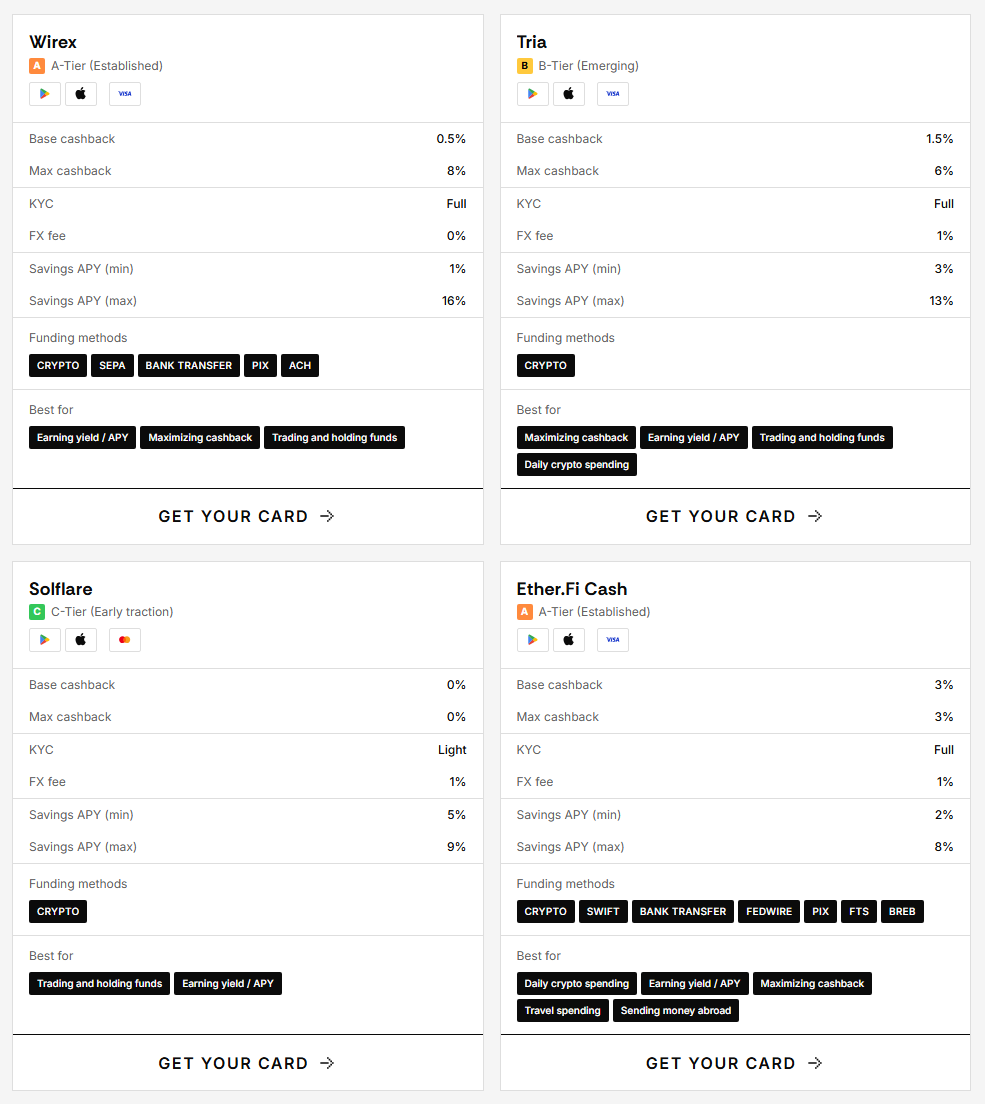
Every landing page sells you the rate. The monthly cap decides what you actually get: same "cashback", anywhere from $1.50 to unlimited. Official docs of 13 free tiers, worst to best:
@useTria : 1.5%, max $1.50/mo
@Plasma One Lite: 2%, max $10/mo
@wirexapp : 0.5%, redeem cap $25/mo
@KASTxyz : 1.5%, max $30/mo
@BleapApp : 1% base + 20% on subs, ~$30/mo and up
@ether_fi : 3%, max $60/mo
@lava_xyz : 1% in BTC, max 0.001 BTC/mo (~$63)
@KoloHub : 1% in BTC, max $100/mo, but only $1 per purchase
@jup_mobile : 2%, max $100/mo, quietly cut from 4% on July 1
@xplaceapp : 0.5%, no cap listed in the docs
@krak : 0-2% depending on balance held, no cap
@coca_card : 1%, no cap
@MetaMask : 1%, no cap
The fine print behind every number is on the image. Save it for the next time a landing page promises you "up to" anything.
Do you know the real cap on your card?
The neobank I use costs $999/year:
1 - Ledger-level security, you always control your funds
No Privy, no Turnkey, no third-party custody, keys stored on your device (iCloud / Google Drive backup)
2 - Borrow against your crypto instead of selling, all via @kamino
3 - Black-card perks: personal concierge, global lounges, travel upgrades, fast-track, and a tax calculator that shows the tax before you sell
4 - Cashback everywhere: 10% on AI (Claude, GPT, Cursor), 10% on airlines (Emirates, British, Turkish), 5% on rides (Uber, Wheely)
5 - 4% USDC cashback with no limits, + 10% XP cashback on confirmed token Airdrops
6 - 0% FX fees
@xplaceapp best in the game
🚨 ALTCOINS VOR IHRER BESTEN PHASE SEIT 6 JAHREN
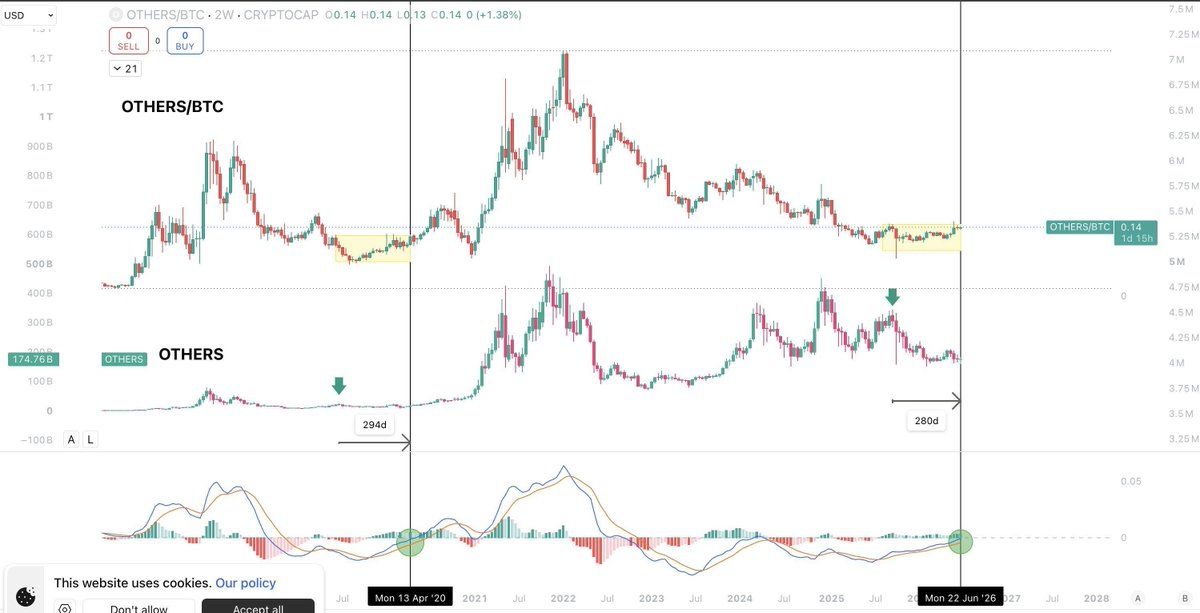
@Sykodelic_ schreibt: "Altcoins stehen vor ihrer besten Phase seit sechs Jahren. Die Mehrheit wird nicht verstehen, was da passiert - sie erwartet nur weiter nach unten." Sein Argument ist rein strukturell: Wir hätten nie einen echten Altcoin-Run gesehen, weil wir nie einen vollen Zyklus hatten. Der Chart, den er zeigt, ist aber nicht der Grund, warum gerade der halbe Feed dasselbe ruft. Darunter liegt etwas Konkreteres.
DER DOMINANZ-CROSS, DER ALLE EINT
Die #Bitcoin-Dominanz kippt zum ersten Mal seit rund fünfeinhalb Jahren nach unten. Der letzte Cross dieser Art war im Oktober 2020, wenige Wochen vor der Altseason von Anfang 2021 - aktuell steht die Dominanz bei knapp 56 Prozent. Genau dieses Muster treibt gerade den Timing-Hype durch alle Feeds. Sykodelics OTHERS-Chart liefert nur den Anlass, das Gewicht liegt auf dem Cross darunter.
ETH ZIEHT, DIE BREITE HINKT
#Ethereum hat in sieben Tagen rund zwölf Prozent gemacht, #Solana fast vierzehn. $BTC liegt auf dreißig Tage dagegen leicht im Minus - die Rotation aus Bitcoin heraus lässt sich an den Sieben-Tage-Zahlen direkt ablesen. Noch deutlicher: die $ETH-ETFs drehten zwei Tage früher ins Plus als die von Bitcoin. Das ist echte relative Stärke der großen Namen mit realer Nutzung. Die tausend Token ohne echten Zweck, die 2021 alle zehnfach explodierten, bleiben diesmal am Boden.
GENAU HIER KIPPT DIE THESE
Eine Altseason braucht Geld, das von außen neu in den Markt kommt. Der kombinierte Stablecoin-Vorrat aus USDT und USDC liegt bei rund 257 Milliarden Dollar - und ist seit dreißig Tagen praktisch flach. Kein frischer Zufluss. Dazu die Makro-Bremse: die Fed hält den Leitzins seit dem Frühjahr bei rund 3,6 Prozent, der Dollar hat über den letzten Monat gut anderthalb Prozent zugelegt. Ein steigender Dollar und eine leere Kasse ersticken jede Manie, bevor sie überhaupt anläuft.
ROTATION IST NOCH KEINE ALTSEASON
Das Skelett stimmt. Die Dominanz rollt nach unten, ETH dreht gegen Bitcoin, und $SOL läuft der ganzen Gruppe voraus. Was Sykodelic strukturell sieht, hat Substanz - das Umfeld kippt wirklich. Nur ist jeder Treiber, der gerade feuert, Umschichtung zwischen Coins, die längst da sind. Frisches Kapital von außen fehlt komplett. Ohne diesen Zufluss bleibt der Dominanz-Cross bloße Umverteilung in einem schrumpfenden Topf - viel Bewegung bei gleichem Geld. Für mich entscheidet am Ende der Stablecoin-Vorrat, ob aus dem Stühlerücken ein echter Run wird. Sobald die Kasse wieder wächst, dreht das hier - und keinen Tag früher.
solana reached a new peak of 3.77B in total transactions last month.
that was more than 10x the monthly transaction count of the next closest chain, once again showing where most on-chain activity happens.
you can hate on solana all you want, but the numbers don't lie.
Crypto cards are offering some great yields on your balance.
Here are the top 10 cards by max APY:
1️⃣ @wirexapp
• APY: up to 16%
• Source: balance converted to a stablecoin + lent via Morpho/Aave
• Paid in: WXT
2️⃣ @useTria
• APY: up to 15%
• Source: onchain vault strategies (Upshift/Sentora)
• Paid in: vault asset for base yield + TRIA for boosted rewards
3️⃣ @solflare
• APY: up to 9%
• Source: SOL staking
• Paid in: SOL
4️⃣ @ether_fi
• APY: up to 8%
• Source: DeFi vaults or value-accruing stablecoin products
• Paid in: various tokens
5️⃣ @xplaceapp
• APY: up to 8%
• Source: DeFi lending (Kamino)
• Paid in: USDC
6️⃣ @hyperbeat
• APY: up to 8%
• Source: USD+ lending markets on Hyperliquid/HyperEVM
• Paid in: USD/stablecoin
7️⃣ @Plasma
• APY: up to 6%
• Source: stablecoin lending markets (Aave)
• Paid in: XPL
8️⃣ @KASTxyz
• APY: up to 5.5%
• Source: RWA yield through USDKY (tokenized treasuries)
• Paid in: USD/stablecoin
9️⃣ @ready_co
• APY: up to 5.5%
• Source: DeFi via Vesu on Starknet + Bitcoin staking flows
• Paid in: points
🔟 @gnosispay
• APY: up to 5%
• Source: DeFi lending on EURe/USDCe (Zeal Earn)
• Paid in: stablecoins
Regular bank cards cannot compete with this.
Data source: https://t.co/hrGMfpX1BA
PS: I started a website for comparing & checking country availability for all major crypto cards.
Find your best card here ↓
https://t.co/HrjSCD0GtY
A ton of new neobank players surfaced lately.
While we're all comparing the @RedotPay / @gnosispay / @ether_fi cards, many new cards have emerged in the market.
Each one is leaning into a different edge:
→ @SolidYield: up to 8% APY + 3% cashback
→ @PulsarMoneyApp: agentic payments + 5.2% stablecoin APY
→ @xbnkapp: 5% cashback + 10% yield
→ @altitude: 3.25% APY backed by US treasuries
→ @Krak: 0% FX + 1% on fiat-to-crypto
→ @DogPay_: full compliance + business accounts
→ @tryavvio: up to 7% APY + transfers across 160+ countries (waitlist)
→ @orchidcredit: neobank on MegaETH (waitlist)
→ @joinCero: a credit-score card, higher score = more benefits (waitlist)
→ @AnodosFinance: financial AI agent + institutional-grade investing (waitlist)
Tbh, I'm starting to run out of reasons to use a classic bank card.
10 FREE ECONOMICS AND FINANCE TEXTBOOKS FROM THE WORLD'S TOP UNIVERSITIES
Bookmark every single one. Students pay hundreds for textbooks that are worse than these. Every one of these is free, legal, and written by people who teach at the top.
1. https://t.co/GKQC5B1W1d
The textbook that's quietly replacing the old ones at nearly 500 universities. "The Economy" was built by an international team of research economists who thought intro econ had gone stale. Interactive, data-driven, and free to read online. The single best place to actually learn economics today.
2. https://t.co/VGkzVCAXc7
Rice University's nonprofit publisher. "Principles of Economics," "Microeconomics," and "Macroeconomics," all peer-reviewed, all genuinely free, used by millions of students. The exact intro textbooks professors assign, minus the $300 price tag. Licensed so you can download and keep them forever.
3. https://t.co/mRRFRLeEZJ
Open Yale Courses. Robert Shiller's full "Financial Markets" course, taught by the man who won a Nobel Prize for his work on asset bubbles. Complete video lectures, transcripts, and problem sets. A finance education from one of the sharpest minds in the field, for nothing.
4. https://t.co/6vDuZ2eThP
MIT OpenCourseWare. The entire economics and finance curriculum, from intro micro to 18.S096 Mathematics with Applications in Finance, the quant toolkit Wall Street pays a fortune to hire. Full lecture notes, exams, and solutions. No signup, no end date.
5. https://t.co/MQVx1dk5AC
Marginal Revolution University, built by two George Mason economists, Tyler Cowen and Alex Tabarrok. Over 900 free videos that explain economics through real-world stories instead of dense theory. The most watchable economics education on the internet, and completely free.
6. https://t.co/hPpYB61XoC
A nonprofit offering full economics and finance courses with free certificates, several eligible for real college credit. Principles of economics, corporate finance, and more, structured as complete courses rather than scattered notes. A genuine credential at no cost.
7. https://t.co/841KFXkK8N
The Open Textbook Library from the University of Minnesota. A vetted collection of free, peer-reviewed economics and finance textbooks, each reviewed by actual faculty. The place to find a trustworthy free replacement for almost any assigned book.
8. https://t.co/eyUSc9QumM
The Library of Economics and Liberty. The complete classics, free and readable: Adam Smith's "Wealth of Nations," Ricardo, Keynes. The foundational texts of the entire field, the ones everyone cites and few have actually read, all in one place.
9. https://t.co/CgK92aURxk
Free finance and accounting textbooks aimed at students and professionals, covering corporate finance, financial statements, and valuation. Practical, clean, and free to download. The applied side of finance that the theory books skip.
10. https://t.co/AvjjwZ0iFt and nber. org
Where the real economics actually lives. SSRN and the National Bureau of Economic Research host the working papers from MIT, Chicago, Harvard, and every top department, free to read. The research itself, years before it becomes a textbook chapter.
A degree used to be the only door to this knowledge. Now it's free, and the people who teach it at the top are the ones who put it online.
Builders outside the gated garden have been ready. Alpie Core (32B 4-bit reasoning) delivers competitive performance on reasoning/SWE benchmarks with a fraction of the compute - while OpenAI and Anthropic navigate Friday afternoon kill letters. $PIE powers the ecosystem. Resilient, deployable AI that doesn't vanish when politics hit. Efficiency era is here.
Why is no one talking about Krak?
I thought it was just another crypto card
Turns out it’s one of the closest things I’ve seen to a real crypto-native neobank
A few things that stood out:
- Registration + KYC in 2 minutes
- Free virtual card
- Free physical card
- Mastercard
- 2% cashback for the first 30 days, then 0.5-2% depending on your balance
- 0% FX fees
- Supports EUR, USD, GBP, CAD, CHF, and JPY
- IBAN accounts in your own name
- Bank transfers in supported currencies
- Deposits in USDC, EURC, and other stablecoins
- Crypto deposits including BTC and many other assets
- Fiat top-ups in seconds (tested with EUR)
- Multiple fiat funding methods (PayPal, PayLink)
- Instant EUR withdrawals to bank accounts
- Auto Earn with up to 10% APY on fiat balances
- Yield on crypto holdings
- Cashback paid in either EUR or BTC
- Referral program: €10 for you and €10 for your friend
- 25% discount on tax reporting
- Smooth UX from start to finish
Fees:
- Crypto to fiat conversion: 1%
ATM limits:
- Single withdrawal: $340
- Daily withdrawal: $5,450
At some point, crypto cards stop feeling like cards and start feeling like full banking products
Krak already feels much closer to the second category
The AI arms race is a trap.
Bigger models burn more GPUs, more energy, more capital — for marginal gains.
Alpie flipped the script.
A lean, precise intelligence layer that actually delivers — and $PIE is the token that captures it on Solana.
This is what the efficiency supercycle looks like.
Most people just haven’t noticed yet.
Who else is done betting on bigger?
Try https://t.co/mLfNGum7Ci → https://t.co/t52IDaut5q