Building production-grade AI tools. Deeply focused on prompt engineering, context window optimization, and fine-tuning open-source LLMs for specialized tasks.
What really clicked for me in this thread is how Pexo turns video creation into an actual creative conversation rather than a one-and-done generation – you kept feeding it feedback on rhythm, information reveal timing, and lens breathing room until the 30-second piece had real narrative weight, not just flashy space visuals.
For indie creators juggling multiple hats, this kind of iterative loop with AI saves so much time on storyboarding and revisions while keeping your personal vision intact, especially for conceptual brand pieces like this SpaceX one. Definitely trying the chat-refine method on my next productivity tool demo.
The underrated part is you can skip or decline roles. It’s not just firing your resume at everything—it still leaves the call with you on what’s worth it.
The underrated part is you can skip or decline roles. It’s not just firing your resume at everything—it still leaves the call with you on what’s worth it.
We just killed job hunting.
Introducing AiApply: a career agent, in your pocket.
Tell it what you want. It scans millions of jobs, skips 99.9% of them, and helps you apply to the few that perfectly fit, with a resume and cover letter written for each.
• No Spray and Pray. Our matching learns from millions of applications and interview outcomes.
• Accurate. Every application uses your real skills and experience. Nothing invented.
• Swipe to Apply. Every swipe teaches your agent.
• Full Control. Review every application, or put the strongest matches on autopilot.
• Already Applied. Other apps alert you when the right job goes live. AiApply has already applied.
Link below.
No barking. Just pure savage https://t.co/GsGnnesZwH SAVAGEDOG — the crowned pitbull of Solana.
Community-driven. Fearless. Moving as one pack.Token: solana:ATBqqcqKumxQEgLBTbuL5iNMMk7DNPzwKNTi8XVSpump
Contract: BeYU6FjSU21WTH7sX3CGPJKSEmYopJmqCLFdzWuGpumpLaunched on $SOL #SOLANA.Stay savage.
Follow: @savagedog0z6
How much did you leave in trading fees last month? 👀
Trading fees add up. Here’s what a month on KuCoin could look like with GetRef.
You make 100 complete spot trades: 100 buys and 100 sells, each worth 2,500 USDT. That’s 500,000 USDT in monthly volume.
At a 0.1% trading fee:
• 500 USDT paid in fees
• 300 USDT returned with 60% cashback
• 200 USDT in costs after cashback
Same trades, less spent on fees. The cashback comes from commissions you’ve already paid and is credited by KuCoin.
Create a new KuCoin account through GetRef to access these terms 👇
https://t.co/QyhjToATWS
Your old exchange UID won’t earn you GetRef Points.
We’re seeing users submit UIDs from accounts they already had. Those registrations don’t qualify, even if the UID is yours.
To get the exchange offer and your GetRef Points:
1️⃣ Open a task on GetRef and follow its registration link.
2️⃣ Create a new exchange account through that link.
3️⃣ Submit the UID of that new account in the task.
Once we verify the registration and task requirements, your points are credited. The exchange offer applies according to its terms.
Submitting an old UID won’t connect your existing account to GetRef or activate our offer.
Already use that exchange? Pick a task for an exchange where you haven’t registered yet.
Find your next task → https://t.co/3plxvzgt4I
You earned the points. Now they could earn you a reward. 🎁
We’re giving 15 winners 20 USDT each from a 300 USDT pool.
Have 500 confirmed GetRef Points on your balance when the giveaway ends to enter automatically. Previously earned points count, and nothing gets deducted.
Need more points?
• Complete exchange tasks: register through the GetRef task link and submit your new account’s UID. Old accounts don’t qualify.
• Invite friends: earn 20 points per signup, plus 20% of their approved task points.
Closes 7 days after this post. Winners are chosen randomly, one prize per person. If fewer than 15 qualify, they share the full pool equally.
Spent a little time on a local percentage calculator. Number in, percentage in, result out.
The first version from the 1.6T compiled and ran. Most values looked right. 200 at 15% came back as 30 instead of 30. I left it alone. It reloaded, entered the same numbers again, watched the result, then fixed the calculation and checked the same inputs. The fields stayed. Only the math moved.
Daily model got the calculation right on the first try but rebuilt the result field and lost the ability to clear both inputs at once. This one kept the clear and only missed the result until it looked at the number.
The 397B opened the page, typed 200 and 15, watched the result, then changed the percentage. It caught that the result stayed on the old value after the change. Same session I pointed it at a browser reaction test for about thirty seconds. It waited for the color and clicked. Same basic check: look at the screen, act, see what the number did.
35B on one 24GB card, Q5, roughly 22 GB and mid-30s tokens a second. Gave it a test that 200 at 15% returns 30. It fixed the test and the function. Asked for the full page and it wrote the calculation, then stalled once the inputs and the result had to stay in sync. Still the one I leave running for the pure math checks. Cheap enough to rerun until the number is clean.
Usable calculator took about 8 minutes with the bigger text model plus a minute or two while the multimodal one typed. Daily model was slower because of the field rewrite. The small one never produced a page I would leave open.
What I keep noticing is how little the models need once they can see the wrong result. Small local model for the isolated calculation. Bigger text model for a page that mostly stays intact. Multimodal model for typing the numbers and saying when the result is lying.
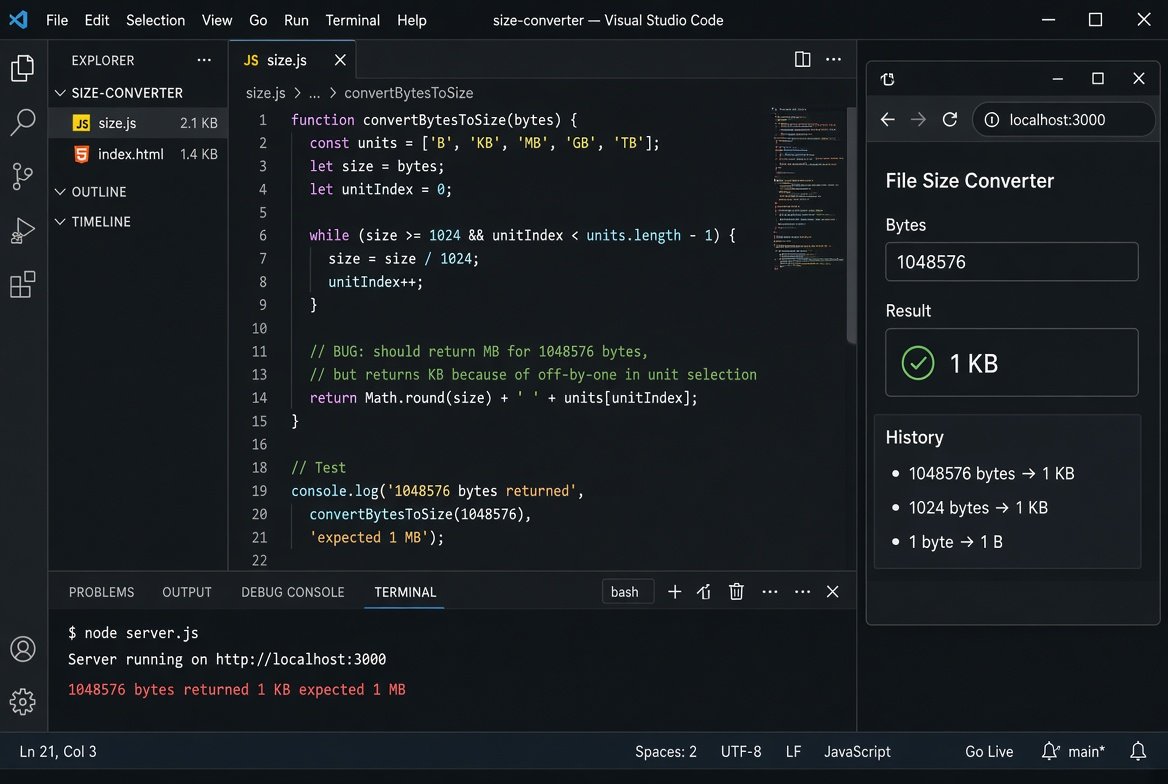
Spent a little time on a local file size converter. Bytes in, human-readable size out, with a short history of what you just converted.
The first version from the 1.6T compiled and ran. Most values looked right. 1048576 bytes came back as 1 KB instead of 1 MB. I left it alone. It reloaded, entered the same number again, watched the result, then fixed the threshold and checked the same input. The history list stayed. Only the size calculation moved.
Daily model got the threshold right on the first try but rebuilt the history and lost the ability to clear a single entry. This one kept the clear button and only missed the megabyte until it looked at the output.
The 397B opened the page, typed 1048576, watched the result, then tried a smaller number. It caught that the history still showed the wrong unit after the second conversion. Same session I pointed it at a browser reaction test for about thirty seconds. It waited for the color and clicked. Same basic check: look at the screen, act, see what the number did.
35B on one 24GB card, Q5, roughly 22 GB and mid-30s tokens a second. Gave it a test that 1048576 bytes becomes 1 MB. It fixed the test and the function. Asked for the full page and it wrote the conversion, then stalled once the input and the history had to stay in sync. Still the one I leave running for the pure size checks. Cheap enough to rerun until the unit is clean.
Usable converter took about 10 minutes with the bigger text model plus a minute or two while the multimodal one typed values and looked. Daily model was slower because of the history rewrite. The small one never produced a page I would leave open.
What I keep noticing is how little the models need once they can see the wrong unit. Small local model for the isolated conversion. Bigger text model for a page that mostly stays intact. Multimodal model for typing a number and saying when the unit is lying.
I pasted a short list of color pairs and asked for a local contrast checker: two inputs, a live ratio, and a clear pass/fail against WCAG AA.
Same prompt to my daily model and to the open stack. 1.6T for the build. 397B to drive the form. 35B local for the math tests.
1.6T wrote the form, the calculation, and a simple result box. Started the server. First pair looked close. A known black-on-white pair returned 18.2 instead of 21. That is the loop. It reloaded the page, entered the same pair again, read the number on screen, then fixed the luminance formula and checked the same inputs. Write, run, look at the UI, fix, re-verify. Two passes after the first compile.
Where it beat my daily model: it kept the form and only patched the math. Daily model rebuilt the whole page and lost the live update. 1.6T touched the formula and left the inputs alone.
Where it lost: the fail state was a small gray label. Daily model makes the failure obvious. 1.6T will ship a correct ratio in a quiet box.
Then I gave the running page to the 397B multimodal build and said: you can see the screen. Check a known pair.
It opened localhost, typed black and white, watched the ratio, then switched to a low-contrast pair and caught that the page still said pass. Filed the one-line fix. That is computer use as QA. I also pointed it at a browser copy of a simple color-matching game for a minute. It read the tiles and clicked a match.
Same skill:
pixels in, clicks out. Useful for verifying a result. Not a game agent.
35B on one 24GB card, Q5, about 22GB, mid-30s tok/s. I gave it a test that asserts black on white returns 21. It fixed the test and the function. I asked it to build the whole checker. It wrote the formula, then stalled on the form layout. Leave it as the inner loop. I can rerun the test until the ratio is correct and not watch a bill.
Same prompt, one task:
Compiling app — daily model yes, 1.6T yes, 397B n/a, 35B formula only
Correct contrast ratio — daily model yes after I told it the number was wrong, 1.6T found it in the UI, 397B
confirmed on a known pair, 35B yes on the test, no on the form
UI self-check — daily model I did it, 1.6T weak, 397B yes, 35B no
Time to a checker I would actually use — 22 min / 14 min / +4 min of typing colors / abandoned as a full page
Keep the split: 35B for the ratio tests. 1.6T to turn a formula into a service.
397B to type the colors and say when the number is lying.
If the model cannot see the ratio on the screen, the checker is not done.
14k creators and 7 trends in one month is the kind of number that makes the “just post and hope” advice look outdated. The 1,5k people who actually got paid are the only stat that matters here.
8.6M effective impressions off 61k posts is decent, but the part I keep coming back to is how spread out the rewards are. 25% US and then everyone else across 189 places means this isn’t just one market carrying it.
@yucheng@tuttihq The jump from 159 in April to 14k is wild, but what stood out more is 1,431 people actually posting across those 46 events. Most platforms pad the signup number and then go quiet.
@yucheng@tuttihq $81k out and a top single payout of $2.6k is real money for a month. Curious how much of that came from the US slice versus the long tail across the other countries.