1. To see the possibility of the specific interest rate target in the future.
https://t.co/xPHjLddu3R
2. To see the Summary of Economic Projections details of FOMC every 3 months.
https://t.co/30UnpCrZ0x
3. To see the actual inflation.
https://t.co/wrOrxvtV3g
Institutions are aggressively loading up on Ethereum, Tom Lee’s Bitmine is leading the massive dip buy!
➡️While retail sits on the sidelines, the big boys are stacking Ethereum like crazy. They’re seeing it as the ultimate buying opportunity. Smart money is all in on ETH’s future in AI, tokenization, staking, and DeFi dominance.
➡️Bitmine Immersion Technologies (chaired by Fundstrat’s Tom Lee) has gone full beast mode, scooping up over 250,000+ ETH in just the last 3 weeks; that’s hundreds of millions worth!
➡️Recent power moves include 126,971 ETH ($214M) in early June, their biggest weekly buy of 2026, followed by 76,881 ETH last week, and a fresh 20,000 ETH ($35.85M OTC with FalconX) just dropped.
➡️Current holdings now sit at a massive $5.62 million ETH, roughly 4.66% of total circulating supply, valued near $10 BILLION and closing in on their 5% target.
➡️Over 4.7 million ETH are locked via their MAVAN network, printing $230–280M+ in projected annual yields.
➡️Real passive income while they HODL long-term. This is part of a much bigger institutional wave; corporates and whales are aggressively accumulating ETH on every dip, showing insane conviction in Ethereum’s roadmap.
This is serious accumulation by players who move markets. The buy-the-dip energy is STRONG at the institutional level.
If I had to turn $100k -> $1M in 1 year.
It would be: $XLU OTM 2 year leaps
2026 is the first time in modern history markets have:
- falling interest rates
- AI inference + buildout
There's a potential ~40% for XLU (1000%+ OTM), from mapping.
Here's my macro thesis:
1. Rate Cuts
When the Fed cuts rates without a recession, utility debt becomes cheaper, and institutional rotates low-yielding cash to for utility dividends.
This causes immediate valuation multiple expansion:
1995: The S&P Utilities sector returned +31.3% in 1995 and another +12.1% in 1996 - ~47% cumulative return
2019 Mid-Cycle Cut: Result: XLU generated a +25.9% total return in that single year
Standard soft-landing rate-cut cycle naturally maps to a 25% to 30% baseline return. And we're entering a new rate cut cycle in 2026.
2. The Infrastructure Supercycle Capex
Infra CapEx gives the sector compounding earnings growth. Following the early 2000s, utilities entered a massive CapEx cycle to modernize aging grid infrastructure.
Because they were constantly spending and expanding their guaranteed rate base, XLU returned +23.5% in 2004, +16.3% in 2005, +20.8% in 2006, and +18.4% in 2007.
However this time:
The $800B+ AI buildout of 2026 makes the 2004 grid modernization look like pennies.
So you have Valuation Multiple Expansion (+15% to +20%), from rate cuts from #1. EPS growth (+18% to +20%) from #2 from capex spend historically. Just from a history lesson.
But 2026 is the most unique moment in history from AI usage.
Just from my own model projections as all former estimates are likely wrong from extreme AI ramp (eg. DOE/LBNL projections):
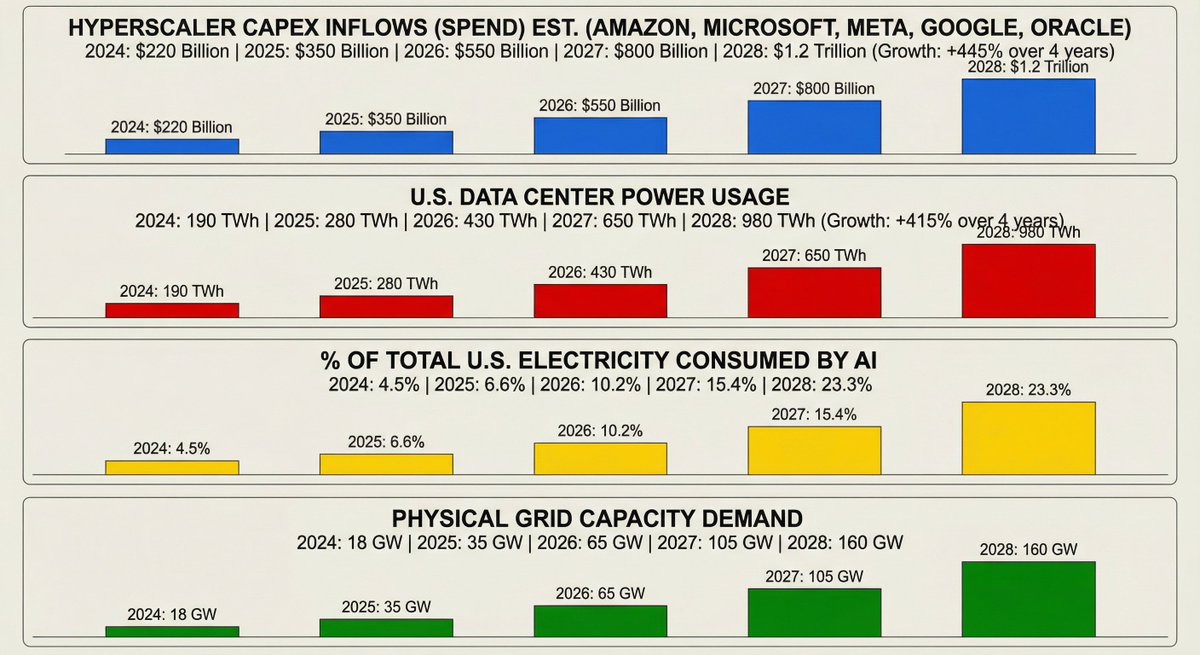
Hyperscaler CapEx Inflows (Spend) - (Amazon, Microsoft, Meta, Google, Oracle) into DCs est:
2024: $220 Billion
2025: $350 Billion
2026: $550 Billion
2027: $800 Billion
2028: $1.2 Trillion (Growth: +445% over 4 years)
U.S. Data Center Power Usage:
2024: 190 TWh
2025: 280 TWh
2026: 430 TWh
2027: 650 TWh
2028: 980 TWh (Growth: +415% over 4 years)
% of Total U.S. Electricity Consumed by AI:
2024: 4.5% of the U.S. grid
2025: 6.6%
2026: 8.2-10.2%
2027: 13.4-15.4%
2028: 21.3-23.3%
Lawrence Berkeley National Laboratory and the Department of Energy seem off by AI usage (they're projecting ~12% by 2028)
Physical Grid Capacity Demand:
2024: 18 GW
2025: 35 GW
2026: 65 GW
2027: 105 GW
2028: 160 GW
Basically you can just see 2026 into 2028 being the inflection point whereas 2024-2025 where slower years on the ramp up.
Then there's the "Desperation Premium" for independent companies. Because grid capacity is sold out, tech giants are paying massive premiums to utilities to cut the line. eg. PJM Interconnection (Virginia "Data Center Alley"), capacity prices spiked from $28.92 per MW-day in 2024 to an unfathomable $329.17 per MW-day for 2026/2027.
$VST or Constellation are a large weighting in the ETF as independent power producers.
Across the board, you can see the extreme ramp from 2026 (now) into 2028 compared to previous years, alongside extreme capex going into building the infrastructure.
2026 is the first time in modern market history that every single thing is firing at the same time for the boring grid/power sector with AI as the biggest tailwind.
And as Elon quotes it: "Billions of dollars of the most advanced hardware. Sitting dark. Not because the chips won't work. Because there's not enough electricity to run on them".
Again 2026 is an absolute historical anomaly due to AI and MMs have priced in historical IV (extremely flat ~14%-16%) for OTM calls.
We're seeing an explosion in AI inference (beyond previous measurements) as well as training (per OpenAI report today).
So the most boring sector on earth (power/grid), might just be the start of a major rally due to hyperscaler/gov spend into grid improvements -> extreme power consumption from AI inference/training -> rate cuts and others.
This is just my personal thesis, options come with risk and magnifies downside too. These are also my own projections, no certainty if they will exceed or be lower than them.
But basically:
2026 is an absolute historical anomaly.
New bottleneck in the US is power.
There's extreme demand from AI, extreme capex, rate cuts:
$XLU looks like the best trade for exposure.
Time will tell if this is right or not.
TOM LEE: DEFI WILL REPLACE BANKS.
He says the next financial giants will be crypto native.
JPMorgan is projected to make $60B this year with 300,000 employees.
Tether and Jane Street made nearly the same profit with around 3,300 employees combined.
🔹 Fewer people
🔹 Faster settlement
🔹 Higher efficiency
🔹 Blockchain-native finance
In 10 years, TOM LEE @fundstrat says half of the largest financial institutions could be native digital.
That is the crypto endgame.
$ETH $BMNR
The bull case for $ETH is actually very simple.
If Ethereum becomes the settlement layer for stablecoins, tokenized assets, payments, DeFi, HardFi, digital ownership, etc… -> then trillions of dollars in economic activity will depend on Ethereum.
And if trillions of dollars depend on Ethereum, securing the network becomes increasingly important.
$ETH is the asset that helps secure that economy.
More adoption.
More value onchain.
More $ETH staked.
More validators.
More economic security.
This is how we should value $ETH 🙏📖
“이더리움은 곧 다른 체인에게 밀릴 것이다.”
실제로 수십 개의 “이더리움 킬러”가 등장했다.
EOS.
Cardano.
Solana.
Avalanche.
그리고 매번 더 빠르고,
더 싸고,
더 좋은 기술이라고 주장했다.
⸻
그런데 ShapeShift 창업자 Erik Voorhees는 다른 관점으로 접근했다.
그는 ETH의 강점이 기술이 아니라고 말한다.
“네트워크 효과”다.
⸻
페이스북보다 기능 좋은 SNS는 많았다.
구글보다 기술적으로 뛰어난 검색엔진도 있었다.
그런데 사람들은 이미 친구와 사용자가 모여 있는 곳에 남았다.
기술보다 네트워크 효과가 강했기 때문이다.
⸻
Erik은 이더도 같은 단계에 도달했다고 본다.
사람들은 TPS를 본다.
그는 개발자를 본다.
사람들은 수수료를 본다.
그는 스테이블코인 거래량을 본다.
사람들은 새로운 L1을 본다.
그는 자본과 사용자가 어디에 모여 있는지를 본다.
그리고 지금 그 대부분은 여전히 이더리움 위에 있다.
⸻
그래서 그의 결론은 단순하다.
비트코인이 돈의 네트워크 효과를 구축했다면,
이더리움은 스마트컨트랙트의 네트워크 효과를 구축했다.
더 좋은 체인이 나온다고 해서
사람, 자본, 개발자가 한 번에 이동하지는 않는다.
⸻
그렇다면 Base는?
Erik은 Base가 이더를 이긴다고 보지 않는다.
오히려
이더가 구글이라면,
Base는 유튜브에 가깝다.
이더리움 위에서 가장 강력한 서비스가 될 수 있다는 것이다.
⸻
결국 Erik의 주장은 한 문장이다.
이더리움의 진짜 해자는 TPS가 아니다.
개발자, 자본, 스테이블코인이 만든 네트워크 효과다.
$ETH is giving everyone a GENERATIONAL entry here.
Under $1,700 is a GIFT.
Any lower is absolutely free.
If you are not buying now, you'll definitely regret it later.
Looks like the options thing is happening already!
See also: various people thinking through and building different versions of the idea in the thread: https://t.co/gFNEvCbHct
Though I do strongly urge that if any of these get on mainnet quickly, we formally verify it first. I hope @vyperlang and/or https://t.co/OMFlWRqJda folks ( @Fricoben) can help!
(Also, now is a good time to be thinking about robustness-optimized oracles)
https://t.co/j1dxLV4Pn4
Crypto bulls need to remember how $ETH actually moves.
It does not climb like a normal stock.
It sleeps.
It bleeds.
It makes everyone think the trade is dead.
Then it compresses months of returns into days.
Examples:
In Jan 2018, ETH went from about $756 to $1,289 in 8 days.
That is roughly +70% in a little over a week.
In Jan 2021, ETH started around $730 and was over $1,200 within the first week.
Then by November 2021, it was near $4,800.
That is more than a 6x move in one year.
That is why crypto bull cycles are so violent.
The chart can look broken for months, then suddenly the market realizes it was accumulation.
ETH is around $1.65K right now.
A move to:
$2,000 is only +21%
$3,000 is about +82%
$4,000 is about +142%
$5,000 is about +203%
$6,000 is about +264%
$10,000 is about +506%
That sounds crazy in traditional markets.
In crypto, that is literally what prior cycles have done.
The trigger is usually not one thing.
It is a stack:
ETH/BTC turns up
ETF flows return
Yields cool
Dollar weakens
Retail comes back
DeFi wakes up
Stablecoins grow
Tokenization becomes real
Treasury buyers keep accumulating
Then suddenly everyone who was waiting for “confirmation” is buying 40% higher.
That is the part people forget.
Crypto bottoms feel awful.
They do not feel safe.
They feel like the asset is broken.
Then the first real leg up happens before most people believe it.
That is where $BMNR gets interesting.
If ETH moves fast, BMNR’s NAV moves fast.
BMNR owns millions of ETH.
So when ETH reprices, the balance sheet reprices immediately.
If ETH goes from $1.65K to $3K, BMNR’s ETH stack becomes dramatically more valuable.
If ETH goes to $5K, the market may stop treating BMNR like a weird crypto stock and start treating it like the public Ethereum treasury vehicle.
That is the dream setup:
$ETH runs
BMNR NAV rises
mNAV expands
ETH per share becomes the scoreboard
The risk is obvious:
ETH loses $1,600, ETH/BTC keeps bleeding, macro stays ugly, and the whole move gets delayed.
But the hopium is also real:
When ETH finally runs, it does not wait for everyone to feel comfortable.
It moves first.
People believe later.
ETH investor Stanley Druckenmiller: “Our whole payment system will be stablecoins in 10-15 years”
BitMine (BMNR), the ETH treasury company chaired by Tom Lee, holds almost $10 billion of ETH. Legendary investor Stanley Druckenmiller is listed among key backers like Founders Fund, ARK's Cathie Wood, and Bill Miller. This aligns with his recent bullish comments on stablecoins and blockchain payments:
“Blockchain and the use of stablecoins — if you want to throw crypto and tokens into that — are incredibly useful in terms of productivity. I assume our whole payment system will be stablecoins in 10-15 years. Efficient. Quicker. Cheaper.”
🇦🇺 Australia: Liberal Party's Angus Taylor and Tony Abbott have both backed a preference deal with Pauline Hanson's One Nation, after the party topped a national poll for the first time.
Abbott: "It makes sense for parties of the right to preference each other just as parties of the left have always done."
Taylor: "We’ll work with whoever we can to get rid of a rotten Labor government."
This follows strong voter support for a conservative alliance in recent Sky News polling, amid One Nation’s surge to ~29-31% primary vote. Some moderate Liberals remain opposed.
Classic right-wing preference flow strategy in action.
Sources:
https://t.co/aVXlqovyhW
https://t.co/5aUlBhzUtX
https://t.co/kEYSP0SzvD