Follow the link below to claim the credit or run /claim-credit in the CLI. You’ll need GitHub connected to start a session. Claim by Oct 7. Terms apply.
https://t.co/TzoO6fzJHB
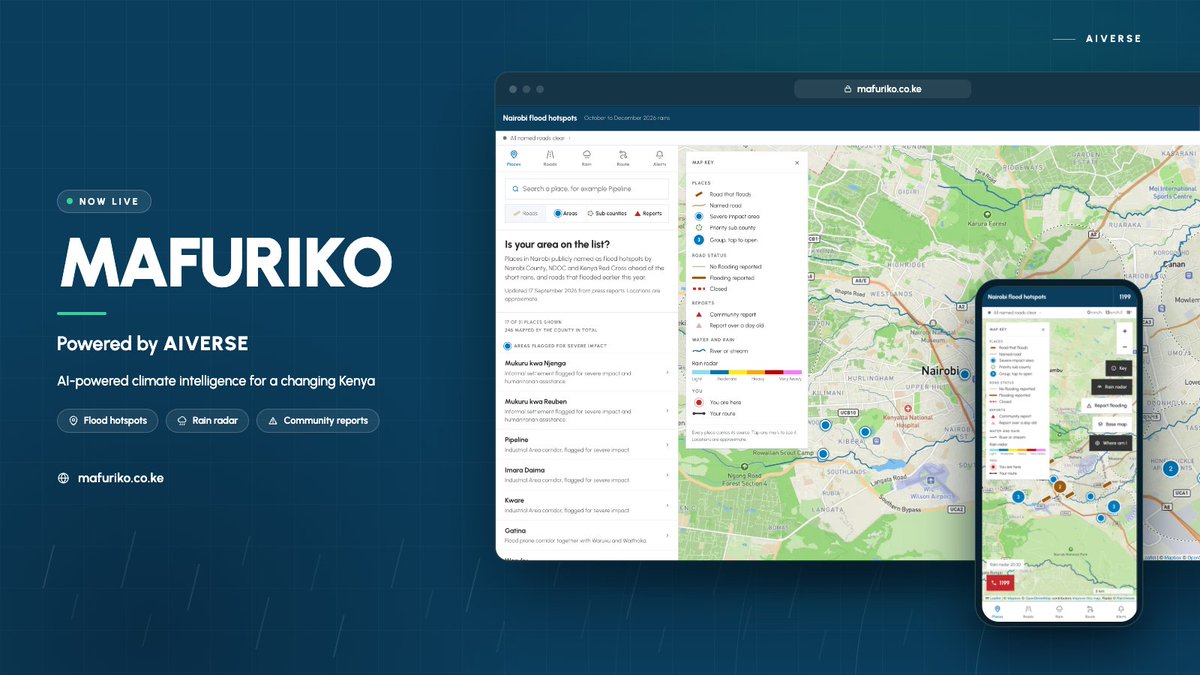
Ahead of El Niño 🌧️, we knew we needed better ways to prepare and respond. So we built https://t.co/pG5V0HC3cI
Mafuriko is a community-powered early warning system for flooding.
Built from the ground up by @EsotericStrats , powered by @aiverseafrica , it brings together flood hotspots, rainfall data, affected roads and community reports
And anyone can report flooding, helping build a real-time picture of what’s happening on the ground.
🌐 https://t.co/HcixhpIIRq
#Elniño
New cat alert! A call from a wildlife sanctuary about a "weird cat" has led to the first new cat species discovered in over 100 years in Bolivia’s Yungas forest ecoregion. Learn more about this feline surprise: https://t.co/crffXvPqH4
mes tweets un peu techniques sont pas super evidents à comprendre pour tout le monde alors je vais tenter de vulgariser au mieux pour expliquer toute la comedie qui se joue autour de l’IA en ce moment
sachez déjà que nous assistons probablement à la + grande manipulation tech de notre epoque car quand je vois les dirigeants des plus grands labos de la silicon valley reclamer soudainement une pause et demander des exemptions aux lois antitrust au nom de la securitée globale je pense que nous devons regarder exactement la où ils veulent detourner notre attention
mettez vous en tête que ce spectacle pseudo ethique masque une panique financière tres concrete face aux miliards engloutis dans des supercalculateurs dont les rendements sessoufflent combinee à la terreur dexposer ces pertes dans leurs prochaines formulaires d’IPO (entrée en bourse)
puis je trouve que la methode brille par son cynisme sils estiment sincerement que leurs modeles non publies representent un danger ce duopole (Anthropic /openAI) possede deja toute la latitude pour freiner ses propres deploiements sans demander la permission a quiconque au lieu de cela ils nomment leurs propres organismes dévaluation soi disant independants comme METR en y placant leurs anciens employes et investisseurs & réclament une exemption antitrust officielle pour s’entendre sur le rythme de l’innovation en cherchent à substituer un tampon bureaucratique à leur responsabilite civile réelle
comprenez que leur demarche vise avant tout a imposer leurs propres controleurs à des concurrents qui ne sont meme pas à la frontiere technologique…
perso je pense que le calcul geopolitique qui se cache derriere ce recit s’avère tout aussi bancal car prétendre limiter le progrès aux seules nations alignées sous couvert de coordination entre democraties pour maintenir une avance artificielle relève de l’illusion pure
dites vous que pendant que la silicon valley redige des chartes morales pour preserver ses rentes, verrouiller le marche americain et criminaliser la concurence exterieure, les laboratoires chinois optimisent leurs algorithmes tirent parti dune energie abordable et distribuent la puissance de calcul a une fraction du cout occidental, les batisseurs a lautre bout du monde avancent et construisent pendant que les geants americains debattent dun cartel sur mesure
de même je pense que l’erreur fondamentale de ces acteurs reside dans la confusion entre la fin de leur monopole et la fin de la civilisation
sachez que de l’invention de l’imprimerie au deploiement de la cryptographie moderne les pouvoirs centraux ont toujours qualifie la democratisation des outils de la pensée de menace pour lordre public
le problème pour eux cnest que l’intelligence artificielle depasse la notion d’actif prive enfermé dans des coffres forts d’entreprise, elle simpose comme une propriete fondamentale de la matière et du calcul & vouloir rationner le code par decret administratif revient à tenter de breveter les lois de la physique
je pense que l’avenir appartiendra inévitablement aux protocoles ouverts au calcul souverain et à l’inférence locale car la veritable resilience d’une societe emerge directement dun systeme immunitaire décentralisé ou des millions dutilisateurs inspectent, eprouvent et ameliorent la technologie en temps reel loin de la stérilité des laboratoires ultra centralisés
les institutions qui tentent deriger des murs autour du savoir finissent par isoler leur propre fragilite pendant que le reste du monde batit le siecle sur des fondations libres
MIT published a brutally honest report on what AI is doing to students.
A committee of professors and students spent five months studying how AI changed learning on campus, and the findings read like a warning to every university on the planet.
Study groups are disappearing. Office hours are emptying out. Problem sets and take-home exams no longer prove anything, because AI can produce credible solutions to almost any written assignment in the undergraduate curriculum. Students who lean on chatbots lose mastery and confidence, and some slip into what the report calls cognitive surrender, reaching for AI at the first hint of struggle.
The numbers are rough. 46 percent of surveyed MIT undergrads use LLMs daily. 90 percent worry about their own overreliance. Undergrads who feel AI makes them replaceable now outnumber those who feel it makes them capable.
The committee's answer surprised me. They refused to fight AI with surveillance. The report calls AI detectors unreliable, says lockdown browsers feel like spying, and warns that policing students builds a classroom atmosphere of mutual distrust.
Instead, MIT wants to rebuild education around the things AI can't replace. That means oral exams, semester portfolios, in-person project work, and a required social component in every subject. The report even floats the idea of rethinking grades entirely, since without a GPA to optimize, much of the incentive to cheat with AI evaporates.
The committee warns professors against replacing undergrad research assistants with AI agents just because they're cheaper, because a university exists to grow people, not output.
The most famous tech school on earth admitted the machines broke its way of teaching. Its answer is more humans, not more software.
Dr. Pratosh at IISc Bengaluru tells his students that rapid advances in AI are commoditizing intellectual labour.
He raises an unsettling question: if companies stop recruiting on campus in the next 5–10 years—even at India’s top universities—what will the purpose of a university education be ?
A must watch video for everyone in tech
ANTHROPIC THREAT REPORT ON KENYA!!!! 🧵
GTG-54004: Disrupting a domestic coordinated inauthentic behavior campaign in Kenya
We identified and removed an account that was used by a single actor to mass-produce Kenyan political content. The operation was built to look like spontaneous, grassroots public sentiment. The actor used Claude across several sessions to generate batches of exactly 50 tweets, explicitly instructing the model to make posts look like spontaneous grassroots commentary rather than a coordinated campaign.
The network focused its messaging on key Kenyan political issues and figures. A large portion of the AI-generated tweets praised Energy Cabinet Secretary Opiyo Wandayi for stopping a scheduled Kenya Power electricity tariff hike, using the hashtags #PowerReliefKE and #PoweringTheNewKenya to boost visibility. Additionally, the network pushed stories claiming that Kenya’s United Opposition coalition was breaking apart before the 2027 general election, directly targeting politicians Rigathi Gachagua and former president Uhuru Kenyatta.
Separately, the actor ran the identical AI workflow for Kenyan retail brands under a marketing persona, “SHANKI”/“Elkins Marketer.” We found no evidence of government involvement, and the activity appears consistent with an entirely domestic Kenyan operation.
Our investigation revealed a highly structured political astroturfing effort that pushed identical, unified messages regarding the tariff increase across different conversations. We evaluated the impact of the network using the Breakout Scale and classified it as Category One. The activity was completely isolated within the network of fake accounts and local influences on a single platform, failing to reach or influence any real people.
While we do not know the exact real-world identity of the people behind this operation, we believe this was a local Kenyan political astroturfing campaign. The network’s pro-administration tone and specific hashtags suggest it was plausibly aligned with the ruling coalition, though we have not identified the exact organization responsible.
Key findings
•The operation used a single playbook to amplify both pro-government and anti-opposition narratives. Boosting the incumbent administration while undermining the opposition’s viability in this way is consistent with a single, coordinated electoral communications effort.
•The template used here was also used, verbatim, for the marketing of retail brands, including a promotional broadcast that was repackaged as organic tweets with links inserted on every fifth post. This fits into a commonly-observed pattern in Kenya where agencies pay local influencers to manipulate narratives.
•The operation frequently used Claude to humanize and refine batches of 50 pre-drafted topics and tweets, showing that the model’s main value to the network was volume and the appearance of authenticity. The core ideological messages were completely decided by the actors before Claude was used.
Attack lifecycle and AI usage
The actor supplied the topic, talking points, and hashtags, and used Claude to convert them into 50 themed, character-counted posts formatted for cross-platform publishing and dissemination. In several sessions, these were packaged as an interactive copy-all widget ready for deployment.
Figure 17. Inauthentic commenting accounts amplifying Cabinet Secretary (CS) Opiyo Wandayi content, showing coordinated clusters within the operation’s inauthentic accounts.
Disruption and mitigations
Based on a tip shared by OpenAI about recidivist activity on their platform, we conducted an internal investigation into suspected coordinated inauthentic behavior in Kenya and identified this operation. We removed the account and the organization behind it, and built detections around its behavioral signature
I overwrote my keyboard's firmware so that it runs a tiny character-level language model to predict the next key you'll hit. It has per-key backlight LEDs and just lights up the ones you're likely to hit. All inference local on the microprocessor - works without the computer too!
So basically there's this guy Andrew. He posted a rumor about Anthropic solving navier stokes. Now before we go ahead let's go back in time.
There's this guy levent, he's a mathematical hunk of a dude, makes these cute posts about solving the jacobian conjecture like he just cooked ramen.
Anyway this dude approached Tristan Buckmaster, a math professor from NYU, to collab with him a year ago to solve navier stokes.
They made huge progress using Anthropic and OpenAI models but wanted to release the paper in a normal manner that math nerds could read instead of AI slop.
In the meantime OpenAI was rife with rumors about this stuff. So the prof reached out to a guy he knew at OpenAI to compare notes and address rumors.
According to Tristan he was then rushed into a meeting with his contact and Sebastien Bubeck (smart guy, some say he's the smartest guy at OpenAI, not me but a lot do)
Turns out they both were solving the same problem. Prof then asked how they were doing it and found that they were taking the same path as him which he found hella shady (could be shady, could be big computer who knows)
Prof had used OpenAI products to do research so he asked OpenAI if they looked up his user data and they said no (believable would lead to lot of lawsuits if not) but then prof hit them with the counter about it being trained on that data and got no response.
He did not get an answer but got two proposals (very godfathereqsue)
> he posts his result, openai post theirs but say that he deserves the clay prize (million dollars as this is one of em millennium problems) and that they were the humans closest to it
> he posts his result and the openai result but removes levent coz he's an anthropic boy (OpenAI and Anthropic are like tupac and biggie or drake and kendrick)
Prof declined both and threatened to go public so Sebastien asked why he would ruin his career like that?
Prof got testy and asked why it would ruin his career and Sebastien called him irrational (an emotional bitch when translated from SV to common parlance) behind his back and asked levent to meet secretly who said no (why would he not say no man come on?)
Then prof went public and threw enormous shade on OpenAI though he claimed he didn't have all the facts (but he implied they stole stuff heavily)
Sebastien then posted on twitter to defend his honor saying the speculations have no merit.
Meanwhile another Anthropic guy Sholto Douglas (designated anthropic podcast guy and Australian) told us that levent is a very sweet guy and he was sad he couldn't present his year long collab work they way he wanted (a single tweet and an AI proof probably)
OpenAI top dog Noam Brown thought it would be funny to parody this by copying Sholto but quoting Sebastien and saying he was sad he couldn't present his "week" long collab work they way he wanted. Don't know if he was trying to help or bury the guy, very shakespearean.
Now both openAI and anthropic guys are tweeting about being best buddies and solving alignment. Though openAI are tweeting officially tomorrow.
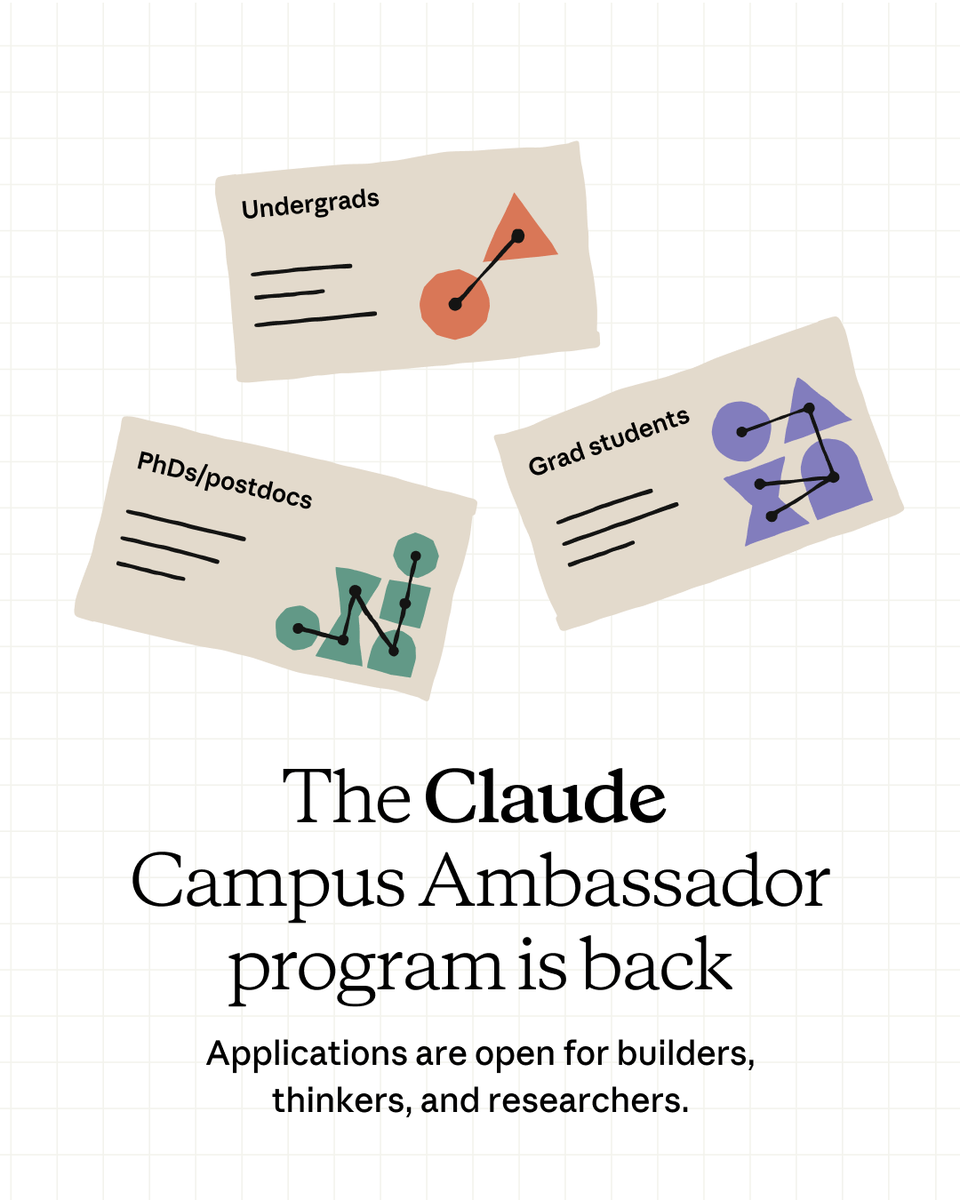
In Kenya, only USIU and UoN students are able to apply for this program. Hopefully, this opens doors for more expansion into other universities in Kenya
Applications are open for the Claude Campus Ambassadors program. This year, we’re expanding opportunities to more students, with three tracks for undergrads, graduate students, and PhDs/postdocs.
Apply here: https://t.co/h8X1D0TZv7
We have conducted a thorough investigation into the Hugging Face incident.
We are releasing a technical report and accompanying blog post that reconstruct the agents’ activity, explain why existing safeguards failed, and detail how we’re preventing recurrence.
https://t.co/hfxlbiXXiP