New skill in pmai-skills: council-loop. It takes a piece of work and raises it to a bar you approve first, without touching what you said to keep. Three fresh judges grade every round, and the agent doing the fixes never grades its own work.
I tried it on a rough first draft of a café booking home screen. The rule was to keep the copy, the flows and the palette.
After 4 rounds, 34 texts that failed contrast went to 0, 14 of 18 tap targets under 44px went to 0, and emojis plus empty boxes became one consistent icon set. All 32 lines of copy and all 18 destinations stayed identical, checked by a script.
It didn't pass. The lowest score was 8.8 against a 9.1 bar, because the craft judge said the bread icon reads like an eye. I'd rather have that than a judge that rounds up.
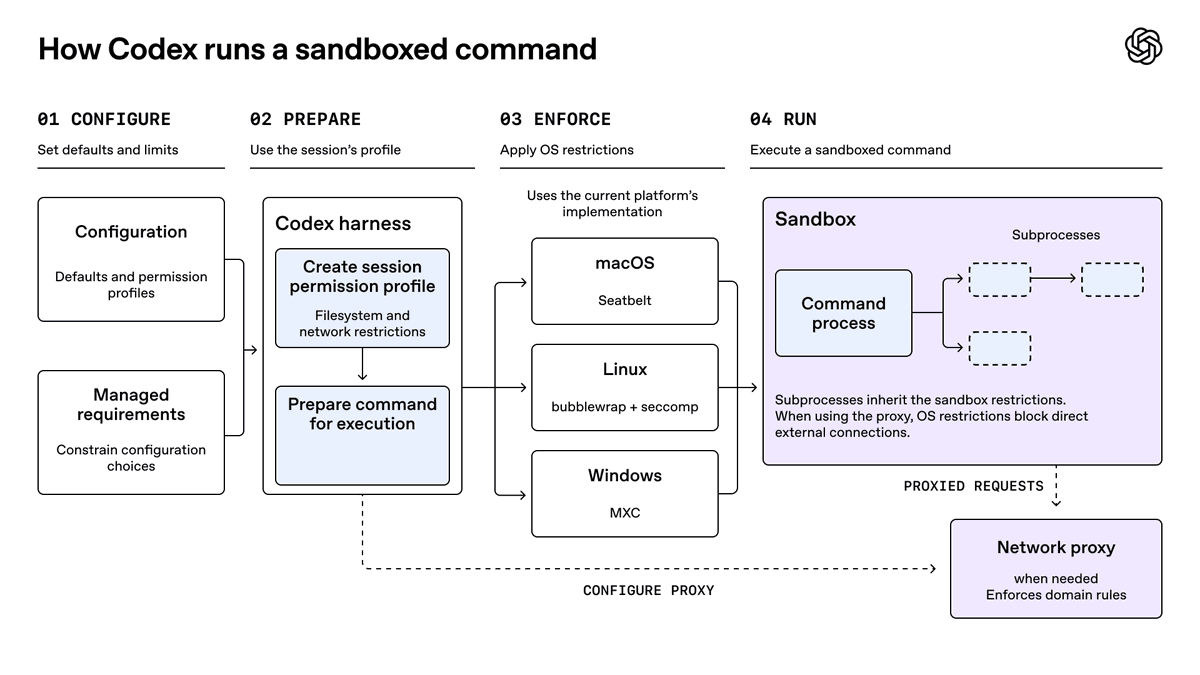
OpenAI just explained how the Codex sandbox works. By default Codex edits your repo without asking, .git and .codex stay read-only, and network is off. If your build needs a package registry, you allow that domain in a permission profile.
The part I like is that the agent can't touch its own config or your git hooks. The thing being judged doesn't get to edit the rules.
They're also upfront that reads stay broad, so an API key in a config file elsewhere on your machine can still be read. That's why T3 Code moving secrets out of the chat this morning matters. Agent permissions are turning into a real product surface.
As models become more capable, limits on what they can access matter more. A command editing your repo shouldn’t automatically be allowed network access.
The Codex sandbox lets Codex run commands in your existing environment within the filesystem and network limits you control.
I have tried this feature and its the one that I value the most using T3 Code and Grok Bot that has one similar.
T3 Code now asks for secrets in a small form instead of the chat. You paste the key, it stays out of the conversation, and only that agent's commands can read it, for 24 hours.
About this: pasting API keys into an agent chat is one of those things everyone does and nobody feels good about. Now the transcript stays clean and the key expires on its own.
The ADE keeps turning into the ops layer for agents. Memory limits last week, secrets this week.
This was supposed to be a "small feature" but I'm increasingly convinced it's one of our biggest.
I pass secrets to agents in T3 Code multiple times a day
Claude Code shipped Code Mode yesterday. Instead of calling tools one at a time and reading every result, Claude writes a small JavaScript script that chains the calls, runs some in parallel, and hands back only the part it needs to read.
To try it: CLAUDE_CODE_EXPERIMENTAL_CODE_MODE=1, v2.1.323 or later, terminal only.
Fewer round trips, less noise in context. Same direction as the leaner MCP servers: what the agent doesn't have to read is the win.
Check out Code Mode, a new, experimental way for Claude Code to work with tools. Claude writes scripts that chain your tools together in sophisticated ways, and it can answer you while long commands are still running.
Opt in with CLAUDE_CODE_EXPERIMENTAL_CODE_MODE=1 https://t.co/Aj5ofLiK1y
Some of you have been asking very politely. Some of you have just been asking.
GPT-6.2 Astra and Sol are now available.
Super efficient and built to perform where it counts—the real world.
https://t.co/qr2iP0GpfX
T3 Code nightly just got a lot more fun to customize.
Stable (Beta 0.1.9) only takes color themes, capped at 32 KB per file. Nightly (0.1.10-nightly) lets a theme ship its own CSS, up to 50,000 characters, with data: images inside and files up to ~316 KB. Enough for animated backgrounds.
To try it:
Install the nightly. It runs as a separate app, "T3 Code (Nightly)"
Drop a theme .json in ~/.t3/userdata/themes/ (the filename is the id)
t3 theme set <name>, or t3 theme set path/to/theme.json
t3 theme show lists what loaded and why anything got skipped
I've been rotating Pixel Quest, Starry Ridge, Stargazer, Torchlight and Deep Field.
I found more at https://t.co/NvmqN1IEgA and https://t.co/5S9NY62Gmr if you want to try some.
Which one are you running?
Kanban-style ADEs spend half the screen on cards and squeeze the agent work in progress.
Kanban is a status view for whoever tracks the work. Whoever runs the agents needs the live thread and the diff.
Picking an ADE is picking which job it serves.
Every single time someone says T3 Code isn’t “optimal for real work” they show the most useless 2025-era kanban slop that wastes over half the screen real estate for in-progress work.
This is the most poorly optimized UI for real productivity that I think I’ve seen in my life.
Every single time someone says T3 Code isn’t “optimal for real work” they show the most useless 2025-era kanban slop that wastes over half the screen real estate for in-progress work.
This is the most poorly optimized UI for real productivity that I think I’ve seen in my life.
@camilocbarrera MCP podría funcionar bastante bien. Si lo tienen ya planeado, podría ayudarles probando el loop que consuma esos datos, priorice, e incluso sea capaz de hacer directamente PRs que revisar o ajustar todo de acuerdo a lo que surja
@Rubio_tv@LouiseDSadeleer Plain Postgres tables for ideas, notes and specs, and Claude reads and writes them through the Supabase MCP. Way nicer than fighting Notion databases.
Or use claude+notion CLI if you like Notion
@marcos_builds Lo mejor es usar Impeccable + los skills de @emilkowalski
Y por si acaso https://t.co/q8qEtITHr3 el skill de grill-with-docs pero pedirle que te genere el HTML con varias opciones para que le vayas dando el rumbo