I've got an agent in a loop optimizing a renderer with the goal to minimize frame times (and tests to measure). It got times down from 88ms to 2ms and allocations down from ~150K to 500. Sounds good, right? Wrong. This is exactly why agent psychosis is a big fucking problem.
As an experiment, I rewrote the Ghostty core render state in Go, with access to identically laid out data structures as Ghostty and the exact same validation tests. I made a purposely naive renderer (simple, correct, but slow). 88ms per frame with 150,000 allocations (horrendous, lol)!
I then kickstarted a Ralph loop to bring the frame times down. I told it it can't modify input data structures or the public API or tests (they're correct), but it can do anything else it wants. It got to work.
It has worked for about 4 hours. I've spent around $350 on this experiment so far. The results?
88ms => 1.5ms
150K allocs => ~500 allocs
Incredible right? Nope.
My hand-written renderer I ported has frame times (same benchmark) of ~20us (0.020ms) and 0 allocations in the update path.
This is the problem with psychosis and lacking systems understanding. If you don't understand the system, you're going to accept that this is an incredible result. If you understand the system, you'll see better solutions immediately and can do roughly 75x better on throughput.
The people who blindly trust agent output are in the former camp. They're sheeple, overdrinking from a fountain of mediocrity.
Standard disclaimer: I use AI all the time. I like AI. The point I'm making is to not blindly accept results. Think. Analyze. Learn.
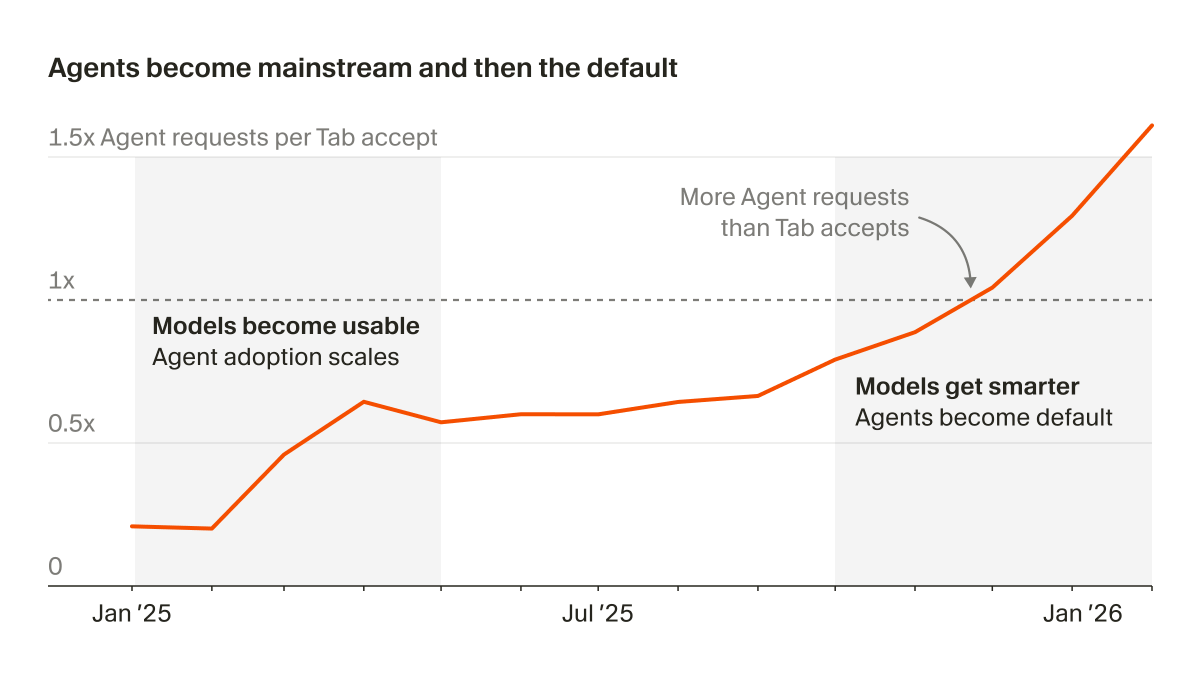
Cool chart showing the ratio of Tab complete requests to Agent requests in Cursor. With improving capability, every point in time has an optimal setup that keeps changing and evolving and the community average tracks the point. None -> Tab -> Agent -> Parallel agents -> Agent Teams (?) -> ???
If you're too conservative, you're leaving leverage on the table. If you're too aggressive, you're net creating more chaos than doing useful work.
The art of the process is spending 80% of the time getting work done in the setup you're comfortable with and that actually works, and 20% exploration of what might be the next step up even if it doesn't work yet.
> created the Linux kernel at 21
> built Git because no existing tool was good enough
> accidentally became the backbone of servers, Android, cloud, supercomputers
> never chased fame, money, titles or hype
> stayed private, consistent, and brutally honest for decades
> still reviews code, still improves Linux, still avoids drama
Is Linus Torvalds the most underappreciated legend of the tech industry?
One of my favorite lessons I’ve learnt from working with smart people:
Action produces information. If you’re unsure of what to do, just do anything, even if it’s the wrong thing. This will give you information about what you should actually be doing.
Sounds simple on the surface - the hard part is making it part of your every day working process.
Every Black Friday Shopify shows how "boring" technology can be scaled just fine.
This year they did 45M queries/sec with MySQL and somewhere around 1.3M request/sec on Rails.
If a tech company has enough business to need to scale: it can scale with whatever boring tech it uses