Dan Dennis: 'Property Rights, Future Generations and the Destruction and Degradation of Natural Resources': Future generations have an entitlement to natural resources equal to ours. So if someone degrades natural resources then he must compensate them:
https://t.co/phb22txaGe
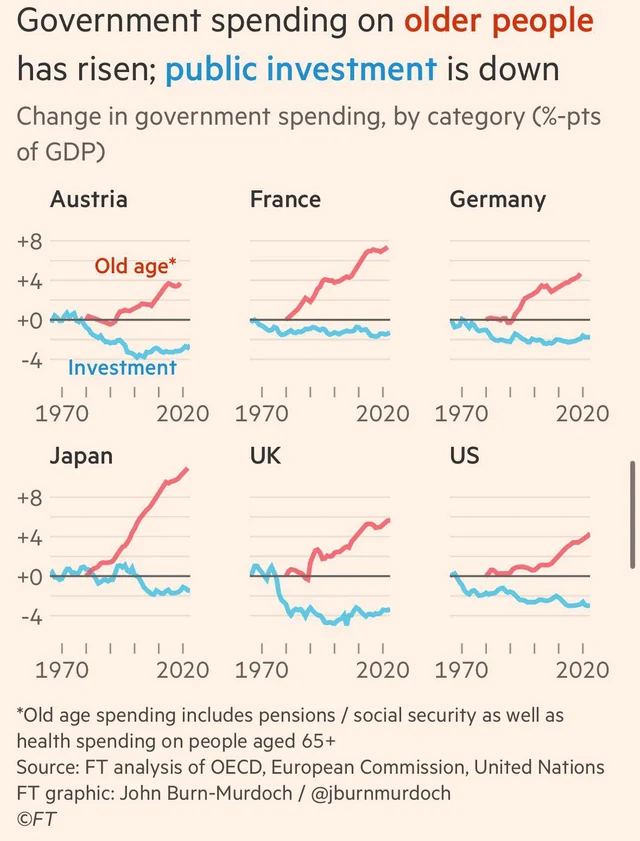
As nations grow wealthier, they should cut spending on older people, who can increasingly provide for themselves.
The West spent half a century doing the exact opposite. We'll pay the price for this mistake for decades to come.
@JohnRentoul Burnham should spend time deepening understanding of a wide range of policy areas before he takes responsibility for them. It would be irresponsible for him to become PM whilst he is so clueless about finance, defence, foreign policy etc.
Burnham won Makerfield because he abolished social housing requirements in new development.
Genuinely.
There’s a near universal understanding that Manchester is a part of the country that is actually growing, because people can see it growing.
They can see the new shops, restaurants, bars, public realm, and gleaming skyscrapers - all new in the last 10 years. They see the wealth and success that investment has brought.
This was not inevitable.
Had Burnham ‘done a Sadiq’ and insisted on ludicrous social housing requirements in every development, little would have been built. Investment would have remained on the floor, and Burnham would have no magic Manchester ‘for us’ growth vibes about him.
Outsiders drive many of science's biggest breakthroughs. A draper discovered bacteria. An actress helped invent WiFi.
But there's not enough room for them in modern science.
In @WorksInProgMag , @LauraLungum and I explore why this matters and what to do about it! 🧵(1/10)
@JohnRentoul 'AI slop' is more concise.
'AI slop' needn't be untrue, it may simply be banal, a variation on what is already around, generating a sea of mediocrity making it more difficult to find what is valuable, important, original.
Britain has the:
- fourth highest level of social housing in the OECD
- and amongst the most generous levels of social housing subsidy of its comparitors
Yet our national debate pretends the exact opposite. We have a gigantic amount of social housing. The problem is too many people need to use it.
By acknowledging this facet of human nature, we draw some of its sting and give people a relatively harmless outlet, while confirming - in a strange way - the desirability & necessity of the higher virtues:
"When it comes to the pinch, human beings are heroic...battleships go down with their guns still firing when their decks are awash. It is only that the other element in man, the lazy, cowardly, debt-bilking adulterer who is inside all of us, can never be suppressed altogether and needs a hearing occasionally...Like the music halls, [bawdy jokes] are a sort of saturnalia, a harmless rebellion against virtue. They express only one tendency in the human mind, but a tendency which is always there and will find its own outlet, like water."
Whole essay here: https://t.co/Uy4Rv4Ukqd
There really is something to the @edwest hypothesis that we have reached the end of a transitional period between two strict moral orders, & these photos are a classic example of something that would have been unthinkable before c1970 and has now become unthinkable again.
We worked 16–18 hour shifts producing the first versions of the Falcon 9 thrusters.
To this day, it is still the hardest manufacturing assignment I have ever been asked to run.
We ran the first prototype thrusters in South Bend, IN. I still remember source inspectors coming on-site, finding the smallest cosmetic blemish, and denying payment on the entire product run.
That kind of pressure is what most people never see.
SpaceX did not become what they are today by luck or hype. They became it through manufacturing hardship, brutal design iterations, tight tolerances, failed attempts, rework, and people on the shop floor grinding through problems most will never hear about.
SpaceX is not just an engineering success story.
It is a manufacturing success story.
A true innovative masterpiece built through pressure, persistence, and relentless improvement ( late night calls with the engineering team )
I attest to their achievements.
Good job @SpaceX
Ukraine shot down Russian Kalibr cruise missiles. Then took them apart — board by board, component by component.
What Ukraine's Ministry of Defence @DefenceU found inside should be uncomfortable reading for Western regulators and sanctions enforcement agencies.
More than 80–90% of the guidance system electronics: foreign-made. Every part marked. Every manufacturer identified. 🧵👇
Smartphones are not the explanation for the recent decline in fertility. Instead, they are an accelerator of deeper forces already at work.
Let’s start with the facts. Fertility is falling almost everywhere: in rich, middle-income, and poor countries; in secular and religious countries; and in countries with high and low levels of gender equality.
The decline accelerated around 2014. So, no country-specific explanation will work unless you are willing to believe that 200 distinct country-specific explanations arrived at roughly the same time.
Smartphones look like the obvious candidate: the first iPhone was released in 2007, and global adoption has been astonishingly fast.
Economists understand the first major decline in fertility in advanced economies, from 6 or 7 children per woman throughout most of human history to about 1.8, that occurred between the early 1800s and roughly 1970, well before smartphones. The main drivers were a sharp fall in child mortality (effective fertility was rarely above 3 and often close to 2) and the shift from a low-skill, rural agrarian economy to a high-skill, urban industrial one. We have quantitative models that fit these facts well.
Country-specific factors mattered too, of course. Proximity to low-fertility neighbors accelerated Hungary’s decline, while fragmented landowning structures accelerated France’s. But these were second-order mechanisms.
This is also why most economists long considered Paul Ehrlich’s doom scenarios implausible. We forecast that fertility in middle- and low-income economies would follow the same path as in the rich, probably faster, because reductions in child mortality reached India or Africa at lower income levels (medical technology is nearly universal, and most gains come from handwashing and cheap antibiotics, not Mayo Clinic-level care). Much of what we see in Africa or parts of Latin America today is still that old story.
But in the 1980s, a new pattern appeared. Japan and Italy fell below 1.8, the level we had thought was the new floor. By 1990, Japan was at 1.54 and Italy at 1.36.
This second fertility decline began in Japan and Italy earlier than elsewhere, driven by country-specific factors, but the underlying dynamics were widespread: secularization, an education arms race, expensive housing, the dissolution of old social networks, and the shift to a service economy in which women’s bargaining power within the household is higher. The U.S. lagged because secularization came later, suburban housing remained relatively cheap, and African American fertility was still high. U.S. demographic patterns are exceptional and skew how academics (most of whom are in the U.S.) and the New York Times see the world.
My best guess is that, without smartphones, Italy’s 2025 fertility rate would be about 1.24 rather than 1.14. I doubt anyone will document an effect larger than 0.1-0.2. Italy was at 1.19 in 1995, not far from today’s 1.14. The TFR is cyclical due to tempo effects, so I do not read too much into the rise between 1995 and 2007 or the decline from 1.27 in 2019 to 1.14 today. The direct effect of smartphones is not zero, but it is not, by itself, that large.
Where social media, in general, and smartphones, in particular, matter is in the diffusion of social norms. What would have taken 25 years now happens in 10. Social media are not the cause of fertility decline; modernity is. But they are a very fast accelerator.
That is why social media are a major part of the story behind Guatemala (yes, Guatemala) going from 3.8 children per woman in 2005 to 1.9 in 2025. Without them, Guatemala would also have reached 1.9, just 20 years later.
Modernity, in its current form, is incompatible with replacement-level fertility. By modernity, I do not mean capitalism: fertility fell earlier and faster in socialist economies than in market economies. Socialist Hungary fell below replacement in 1960, and socialist Czechoslovakia in 1966 (both experienced small, short-lived baby booms in the mid-1970s). By modernity, I mean a society organized around rational, large-scale systems and formalized knowledge.
Countries will not converge to the same fertility rate. East Asia is likely stuck near 1, possibly below, given its unbalanced gender norms and toxic education systems. Latin America faces the same gender problem plus weak growth prospects, so I expect something around 1.2. Northern Europe has more egalitarian family structures and might hold near 1.5. The very religious societies are probably the only ones that will sustain 1.8.
All of this could change with AI or changes in population composition. We will see. But on the current evidence, deep sub-replacement fertility is the “new new normal.” Unless we reorganize our societies, better learn to handle it as best we can.