@jimmyfallon watching U2 perform Ordinary Love on the Tonight Show again… what was it like and what were you thinking sitting 3 feet away from them as that incredible moment came to life?
@DoorDash ur driver was 20 mins, deliver ed a tampered package with a half eaten burrito. We reported it, no response. We reported it again, you say “sorry, too late for a refund.” We paid $75 for a @ChipotleTweets meal we had to toss because of safety. Wow.
Nothing like talking to customer service, being talked down to, blamed for a company’s poor technology and data management, feeling even more like a faceless passenger to monetize. @United#theUnfriendlySkies
Flying @United this holiday with my 3 sons. We check in online to find “the system” created a separate record for my 12 y.o. Since “the system” thinks he’s a minor traveling alone & the humans can’t fix it, he has to check in at the airport. That’s always fun at O’Hare #SoBroken
Flying @United this holiday with my 3 sons. We check in online to find “the system” created a separate record for my 12 y.o. Since “the system” thinks he’s a minor traveling alone & the humans can’t fix it, he has to check in at the airport. That’s always fun at O’Hare #SoBroken
“More Hunches” ad from @FanDuel is irresponsible - the last thing you should do is bet on a hunch when #FanDuel is using advanced analytics. #ftc
https://t.co/AHkgRmJoJW via @YouTube
Why is lactate not the cause of exercise fatigue?
Lactate is often mislabeled as the cause of exercise fatigue, burning, and even muscle soreness. In reality, it generally does the opposite and also plays a positive role in numerous physiological processes, from muscle to heart to brain performance.
Buffer Against Acidity: Lactate acts as a buffer to neutralize the acidity that builds up in muscles during intense exercise. When muscles generate ATP through anaerobic glycolysis, hydrogen ions are produced, increasing acidity. Lactate helps manage this by binding to hydrogen ions, thus reducing the muscle's acidity and preventing fatigue from accumulating too quickly.
Fuel Source: Lactate is an excellent fuel source in the body, particularly for vital organs. The heart, as the largest consumer, prefers lactate over glucose, especially during low-oxygen conditions. In the brain, astrocytes favor lactate for energy. Essentially a pre-digested carbohydrate, lactate is efficiently utilized across physiological systems.
Clearing Misconceptions: High lactate levels often coincide with exercise fatigue but don't cause it. It is a byproduct, not a cause. Instead, fatigue during high-intensity exercise is a result of other metabolic byproducts and, eventually, energy depletion (e.g., muscle glycogen). Lactate actually aids in managing these byproducts and participates in glucose production through the Cori cycle.
Understanding lactate's true role can transform our approach to exercise and recovery. Far from being a hindrance, lactate is a key player in our body's energy management system, helping us perform better and recover faster.
Of course, the physiology and biochemistry of lactate are more complicated than outlined in this summary post, so if you'd like to learn more about lactate's essential roles in metabolism and athletic performance, please check out the full episode of Perform with Dr. Andy Galpin.
Be sure to drop any questions below, and I'll do my best to respond!
Building VO2 Max
Choose any activity where you can elevate your heart rate for an extended period of time with proper mechanics
You do not need to run; running can be great — but it is just one activity for raising VO2 Max
Lower intensity for long durations is very effective and requires less recovery, but of course, it is very time-consuming
Higher intensity for short durations is also very effective and time efficient but requires lots of recovery
A proper training plan for building VO2 Max must dose these appropriately
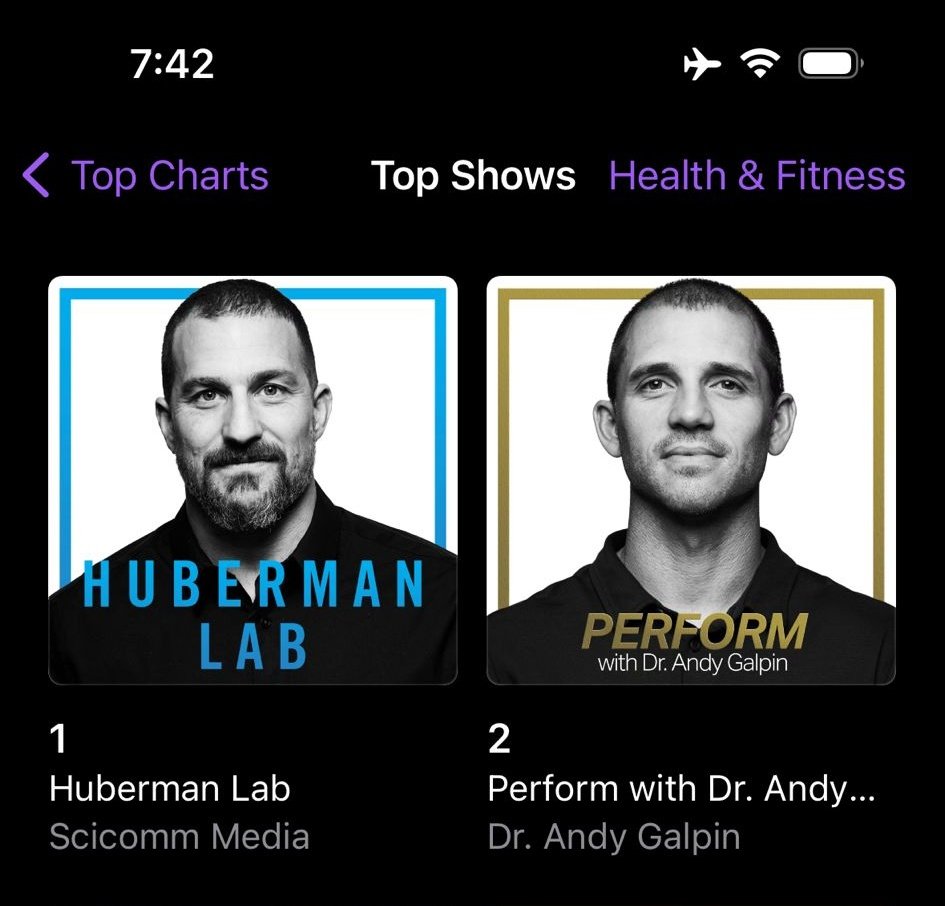
One week in and we're already at #2, just behind @hubermanlab , thank you, friends!
Episode 1 we tackled the heart.
Episode 2 we went for muslce.
Any guesses what's coming next week?
In this episode — Building a Strong Heart — you’ll learn all about the special anatomical and physiological characteristics that make your heart the most unique MUSCLE in your entire body, and you’ll learn specific steps you can take to improve your cardiovascular health and VO2 Max.
I cover things like why you breathe, how a heart can keep beating even after it loses nerve innervation (e.g., if it gets pulled out of your chest, Temple of Doom style), why it never gets sore, and how heart function and measures like VO2 Max relate to your short and long-term health and performance.
And, like every episode, I’ll discuss multiple ways to gauge your fitness and how best to improve it. I’ll do this by covering the “Three Is” — Investigate (what and how to measure VO2 Max score), Interpret (are your scores good, bad, terrible, best in world history), and Intervene (how to improve!).
So whether your jam is sports, longevity, physical fitness, or just avoiding death for as long as possible, you all have a heart, so this episode is for you.
Remember, in the words of legendary track coach Bill Bowerman, “If you have a body, you’re an athlete.” And nobody ever complained about their heart performing too well.
I really do my best to keep up with the comments, but given this is the very first installment in our 10-episode season, I’m going to work super hard to respond to all of your questions and comments, and there are far worse ways to spend time on a Wednesday, and I love teaching, so go nuts below!
As always, a million thank you’s to my co-workers at this podcast, RAPID, Vitality, Absolute Rest, BioMolecular Athlete, Anthropy, and elsewhere, my students in the lab, and most importantly, all of you.
The podcast — Perform with Dr. Andy Galpin — can be found on Apple Podcasts, Spotify, YouTube, across all other podcast platforms, and at https://t.co/Ai31qsKrkS. Enjoy!