Heads down, building.
@passexplorer is part of the @StellarOrg Stellar 37 program alongside @nearxschool — and we're making every sprint count.
The festival ticket marketplace is taking shape. 🎪
And that’s a wrap 🙌
Last week, we closed Ipê Village with Demo Day and a very special closing ceremony, after one month together building solutions for the cities of the future with AI and blockchain, creating connections, and deepening relationships.
But this is only the beginning of what we’re building together. There’s a long road ahead, and the community doesn’t stop here.
Every month, we’ll host a new event, online or in person, following the same spirit: workshops, buildathons, and hands-on experiences.
To stay updated on Ipê’s next steps, keep an eye on our Telegram group and join our community calls.
Let’s go!
Un estudiante de 21 años de la Universidad de Shanghái Jiao Tong mostró el robot de trading automático que creó con Claude Code.
Claude se encargó de la mayor parte del trabajo pesado.
Este robot monitorea los diferenciales de precios en más de 50 mercados de Polymarket, mientras sincroniza datos de Binance con OpenClaw para analizar las tendencias de ultra corto plazo de BTC.
Esa es la fuente de las ganancias exorbitantes.
Solo le tomó 2 días completar el script, durante los cuales solo usó un iPad como pantalla secundaria.
Arquitectura del sistema:
Claude Code se encarga de generar estrategias y vigilar de cerca las fallas en la fijación de precios en Polymarket.
OpenClaw se encarga de ejecutar las operaciones y sincronizar con Binance para el análisis de BTC.
0 intervención manual, ejecución completamente automática.
Instantánea de rendimiento:
De la noche a la mañana: abrió 3 posiciones, cerró automáticamente 2.
Caso de trading: short en BTC a nivel de 15 minutos, entrada a 0.31, salida a 0.79.
Ganancia neta en una noche: +$1,940
Lógica de la estrategia:
Especializado en cosechar vulnerabilidades de fallas en la fijación de precios entre mercados.
Ejecución de alta frecuencia, cada operación solo toma una ventaja mínima en la relación riesgo-recompensa.
Puro volumen de trading para hacer rodar las ganancias.
Referencia de comparación:
planktonXD
Volumen anual de trading aprox. 61,000 operaciones
Ganancias aprox. 106,000 dólares
Estrategia: arbitraje
Proceso de evolución:
Empezó con unos cientos de dólares
Al principio solo jugaba con copias simples sin cerebro
Luego directamente creó un sistema personalizado de monitoreo y ejecución
Gestión de riesgos:
Protección automática de apagado en caso de anomalías de liquidez
Liquidación de emergencia requiere confirmación manual
Caso de pérdida: en una caída repentina, retroceso aprox. 3%
Estado actual de operación:
Sistema completamente autónomo y autoalojado
Monitoreo puro por notificaciones push
Casi sin necesidad de intervención humana
Capital inicial: aprox. 1,400 dólares
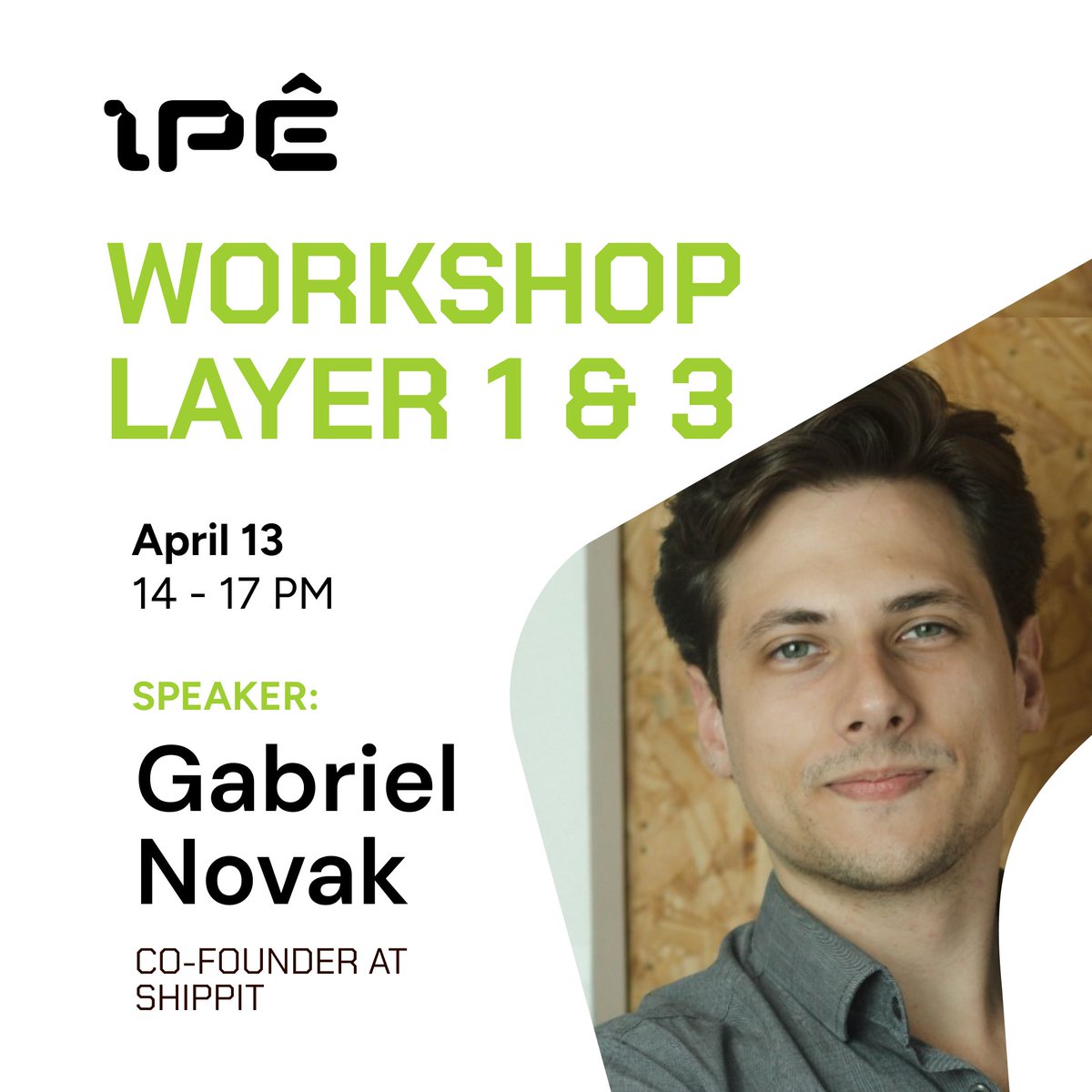
Hands-on workshop: Layer 1 & 3 - From Zero to Autonomous Systems
Building autonomous systems starts with understanding the layers beneath them.
🎤 @Gabriel_nvk
📍 IA House | April 13 | 14h BRT
🎟 Residents: free entry with the Resident coupon
Registration link in the comments 👇
Isso aqui é surreal.
O cara literalmente programa com os pés na mesa.
Ele vibe codou um app pra conectar o iPhone com o Claude Code. Ele fala o que quer, o código aparece na tela.
O senior engineer de $300k tá em performance review agora.
Esse cara tá deitado 😭
Joining us at The Startup Society Conference is Hanna Schiuma.
GP at Lucero Ventures and Institutional Relations Director at Crecimiento, connecting founders, investors, and governments across Latam's Web3 and AI ecosystem.
📍 Florianópolis 📅 April 10 & 11
Join us! Link below.
"AI becomes the government" is dystopian: it leads to slop when AI is weak, and is doom-maximizing once AI becomes strong. But AI used well can be empowering, and push the frontier of democratic / decentralized modes of governance.
The core problem with democratic / decentralized modes of governance (including DAOs on ethereum) is limits to human attention: there are many thousands of decisions to make, involving many domains of expertise, and most people don't have the time or skill to be experts in even one, let alone all of them. The usual solution, delegation, is disempowering: it leads to a small group of delegates controlling decision-making while their supporters, after they hit the "delegate" button, have no influence at all. So what can we do? We use personal LLMs to solve the attention problem! Here are a few ideas:
## Personal governance agents
If a governance mechanism depends on you to make a large number of decisions, a personal agent can perform all the necessary votes for you, based on preferences that it infers from your personal writing, conversation history, direct statements, etc.
If the agent is (i) unsure how you would vote on an issue, and (ii) convinced the issue is important, then it should ask you directly, and give you all relevant context.
## Public conversation agents
Making good decisions often cannot come from a linear process of taking people's views that are based only on their own information, and averaging them (even quadratically). There is a need for processes that aggregate many people's information, and then give each person (or their LLM) a chance to respond *based on that*.
This includes:
* Inferring and summarizing your own views and converting them into a format that can be shared publicly (and does not expose your private info)
* Summarizing commonalities between people's inputs (expressed as words), similar to the various LLM+https://t.co/Nzord33s0z ideas
## Suggestion markets
If a governance mechanism values "high-quality inputs" of any type (this could be proposals, or it could even be arguments), then you can have a prediction market, where anyone can submit an input, AIs can bet on a token representing that input, and if the mechanism "accepts" the input (either accepting the proposal, or accepting it as a "unit" of conversation that it then passes along to its participant), it pays out $X to the holders of the token.
Note that this is basically the same as https://t.co/nUL0HyTyK2
## Decentralized governance with private information
One of the biggest weaknesses of highly decentralized / democratic governance is that it does not work well when important decisions need to be made with secret information.
Common situations:
(i) the org engaging in adversarial conflicts or negotiations
(ii) internal dispute resolution
(iii) compensation / funding decisions.
Typically, orgs solve this by appointing individuals who have great power to take on those tasks.
But with multi-party computation (currently I've seen this done with TEEs; I would love to see at least the two-party case solved with garbled circuits https://t.co/PIY2LZtbeK so we can get pure-cryptographic security guarantees for it), we could actually take many people's inputs into account to deal with these situations, without compromising privacy. Basically: you submit your personal LLM into a black box, the LLM sees private info, it makes a judgement based on that, and it outputs only that judgement. You don't see the private info, and no one else sees the contents of your personal LLM.
## The importance of privacy
All of these approaches involve each participant making use of much more information about themselves, and potentially submitting much larger-sized inputs. Hence, it becomes all the more important to protect privacy. There are two kinds of privacy that matter:
* Anonymity of the participant: this can be accomplished with ZK. In general, I think all governance tools should come with ZK built in
* Privacy of the contents: this has two parts. First, the personal LLM should do what it can to avoid divulging private info about you that it does not need to divulge. Second, when you have computation that combines multiple LLMs or multiple people's info, you need multi-party techniques to compute it privately. Both are important.
Vai rolar a primeira cidade temporária do Brasil em abril
26 dias em Jurerê Internacional construindo infraestrutura AI/crypto ao vivo
$10k+ em grants | Demo Day | 10+ países
→ https://t.co/3LyjcrofDx
OpenCode: 120k stars, 5M devs/mês, open source AI coding agent que roda em qualquer modelo, qualquer editor, sem armazenar teu código Coding agents viraram infraestrutura. Quem não tá usando vai ficar pra trás. → https://t.co/6sZy0qfzEZ
What happens when you bring together the world’s most ambitious builders in Florianópolis for 30 days? 🇧🇷
@ipecity is not an event
It’s a pop-up village where the operating system of a new city is prototyped.
Powered by AI, crypto, and real optimism.
April 6 to May 1, 2026
For those already building on @openclaw: We’re doing an advanced, hands-on session to dive deeper into implementation.
If you aren't building yet but want to see the workflow, feel free to join as an observer.
Expect a steep learning curve 🧠