Our internal data shows Claude is accelerating AI development—a possible path to recursive self-improvement, or AI autonomously building a more capable successor.
It’s happening faster than we thought, and the implications deserve greater attention. https://t.co/OVVPJO7VQx
Every time someone asks me what's going on with AI, I give them the safe answer. Because the real one sounds insane.
I'm done holding back.
I wrote what I wish I could sit down and tell everyone I care about.
Send it to someone who needs to read it.
https://t.co/bRTaral3lj
This is a dopamine loop, and it’s one of the most powerful ones humans have ever encountered.
Every time you prompt an AI and get a useful result back in seconds, your brain gets a hit. Variable-ratio reinforcement, same mechanism as slot machines, except the reward is real: actual output, actual progress, actual leverage on your ideas.
Traditional work follows a delayed-reward structure. You write code for 6 hours, maybe it compiles, maybe you get feedback in a week. The gap between effort and reward is wide enough that motivation decays constantly.
AI compresses that loop to seconds. Effort → reward → effort → reward. Your prefrontal cortex stays engaged because the next payoff is always one prompt away. This is why people describe it as “fun” when they’re actually working 14-hour days. The subjective experience of effort disappears when reward frequency is high enough.
The “harder than ever” part is real too. When your bottleneck shifts from execution to imagination, you run out of excuses to stop. There’s no “waiting on the build” or “blocked by review.” Every idea you have can be tested immediately, which means your brain never gets a natural stopping point.
People who thrive on this are selecting for a specific neurotype: high novelty-seeking, high conscientiousness, tolerance for rapid context-switching. That’s maybe 10-15% of the population.
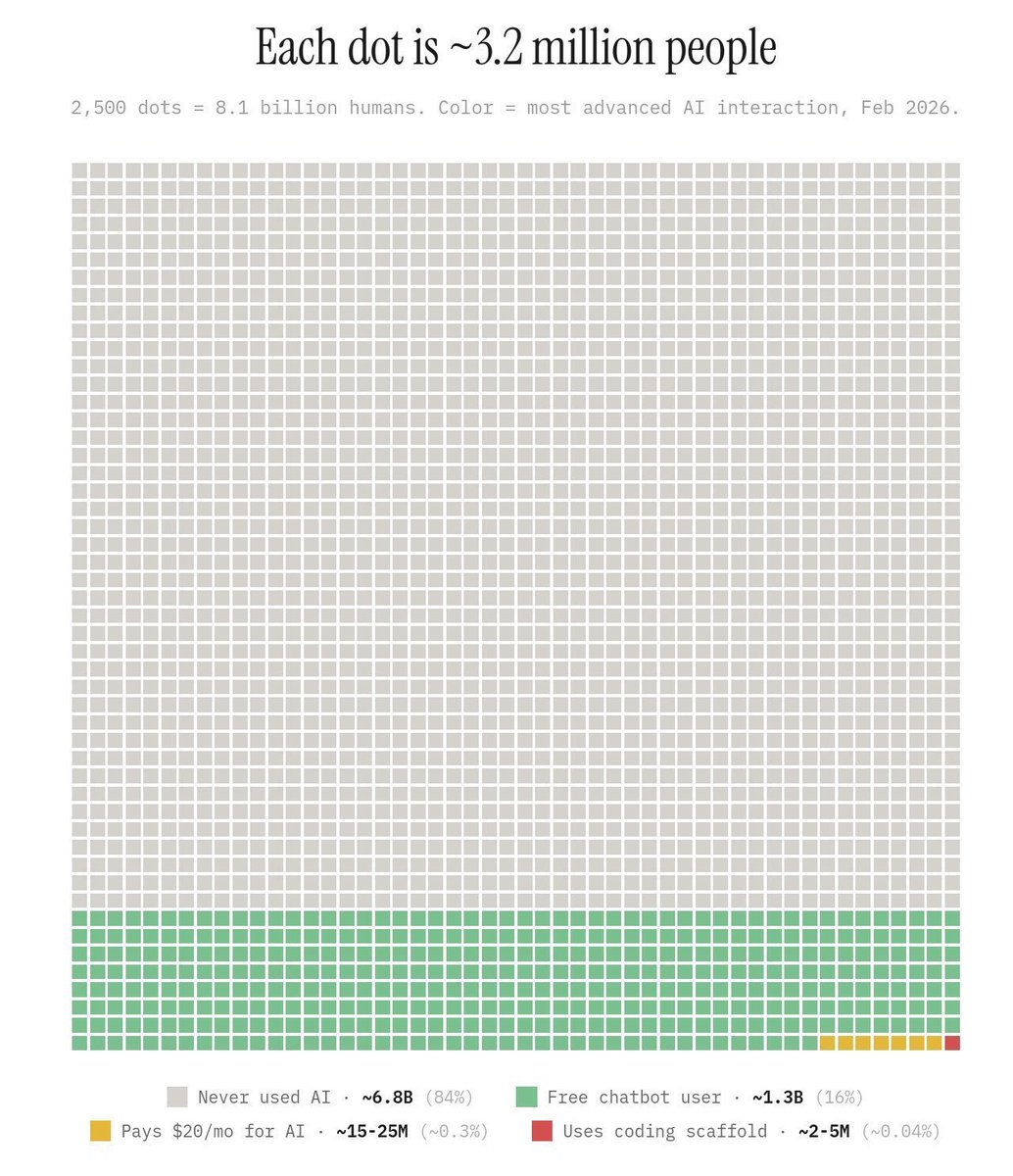
The other 85% will experience the same tools as overwhelming, not energizing. And that split is going to define the next decade of who captures value from AI and who gets displaced by it.
"Learning to program was so obviously the right thing in the recent past. Now it is not."
~ Sam Altman on skill to survive the AI era.
Now you need High agency, soft skills, being v. good at idea generation, adaptable to a rapidly changing world
Una de las mentes más brillantes de nuestros tiempos te explica en 3 minutos lo que está pasando en tech IA y una recomendación sopresiva!
Ojo: está en inglés
IMPERDIBLE!
Eric Schmidt Sum-up The 3 THINGS Are Changing The World https://t.co/Z6VEkiSxTE vía @YouTube
Musk says “we might have AI that is smarter than any human by the end of this year. and I would say no later than next year. And then probably by 2030 or 2031, AI will be smarter than all of humanity collectively”
Brace yourself - it’s coming.
It was the best of times,
it was the worst of times,
it was the age of wisdom,
it was the age of foolishness,
it was the epoch of belief,
it was the epoch of incredulity,
it was the season of light,
it was the season of darkness,
it was the spring of hope,
it was the winter of despair.
I think it was Charles Dikkens (with two k’s) who wrote that.
Today, @US_FDA and the European Medicines Agency released 10 guiding principles to inform, enhance, and promote the use of artificial intelligence (AI) for generating evidence across all phases of the drug product life cycle. https://t.co/ztd9I56XIH
FDA is now open to Bayesian statistical approaches. A leap forward!
Bayesian statistics can help:
✅ Clinical trial design
✅ Finding the optimal dose
✅ Extrapolation to children
✅ Leveraging phase 2 results in phase 3
I asked Claude Cowork to identify the 10 most important skills for thriving in the age of AI, based on my 320 podcast conversations.
Impressed with the results.
Part 1: Timeless Skills (become more valuable)
1. Taste and judgment — The bottleneck when AI generates unlimited options. Develop through "exposure hours." — @rauchg
2. Curiosity — The meta-skill that enables all other learning. @mikeyk says it's what he'd prioritize for children in an AI world.
3. Becoming a cross-functional "builder" — "Dissolve role boundaries and call ourselves builders." — @joulee
4. Clear communication and storytelling — As execution is automated, articulation becomes your primary output.
5. Strategic thinking — "The leverage of getting strategy right goes up when execution costs go down."
Part 2: AI-native skills (must develop)
1. Writing evals — "AI is almost capped by how good we are at evals." — @kevinweil
2. Prompting and context engineering — "Great prompters are great writers."
3. AI fluency through constant use — You can't understand AI by reading about it. Cancel your meetings and play with every AI product.
4. Understanding systems under the hood — Paradoxically, fundamentals become MORE valuable as AI abstracts them away.
5. Working with AI Agents as teammates — Management skills transfer directly. "Used to be people, but now it's basically AI models." — @joulee